18 Charing Cross

Historic Jersey buildings

If you own this property, have ancestors who lived here, or can provide any further information and photographs, please contact us through editorial@jerripedia.org |

Property name
18 Charing Cross
Other names
York Chambers
Location
Charing Cross, St Helier

Type of property
Part of Art Deco style commercial block extending into York Street
Valuations
No recent transactions
Families associated with the property
- Letto: In business here since 1930
- Martin McDermot was living at No 18 when his will was drawn up in 1882
- Edward Le Quesne’s 1956 will left 18 Charing Cross, part of York Street Chambers, to his children
Census returns The property does not feature in any census returns, suggesting that even in the 19th century, it was purely commercial, with no families living there Almanac listings
- 1837 - J Clifford, auctioneer
- 1837-1842 - A Ennis, bootmaker
- 1874 - F Payn, grocer
- 1880 - F Payn, publican
- 1886-1890 - Mrs Payn, grocer
- 1895 - Miss du Heaume
- 1900-1925 - Miss Le Caudey
- 1930- H Letto
Historic Environment Record entry
Listed building
A relatively rare example of the Art Deco style commercial architecture in Jersey, on a prominent corner site. Circa late 1930s.

Does not appear to be shown on 1934 Ordnance Survey map, but is evident in archive photographs taken during the Occupation.
Three-storey corner building with six bays to west (incorporating 2-4 York Street) and two-bay curved frontage to southwest corner and to south (incorporating 18 Charing Cross). Flat roof hidden behind parapet.
Walls rendered with moulded panels on parapet, giant pilasters between bays of first and second floors, rusticated piers on ground floor. Panels incorporating first and second floor windows with panelling at floor level are replacements. A projecting cornice curves around corner over shop fascias.
Ground floor reputed to retain glass panelling (currently covered) in Lalique style.
Notes and references
-
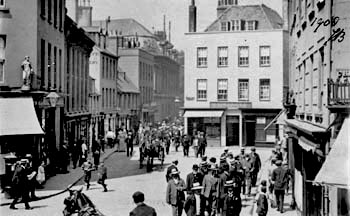 1908, before the block was rebuilt
 -
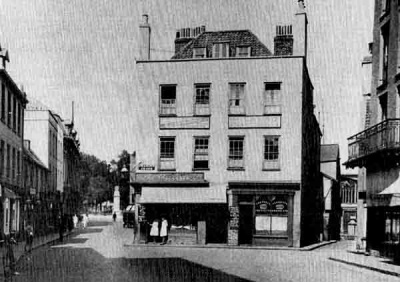 The 1920s
 -
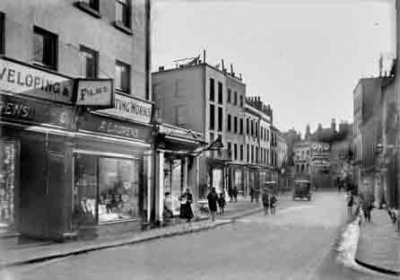 This 1930s photograph shows demolition of the old building almost complete, before redevelopment
 -
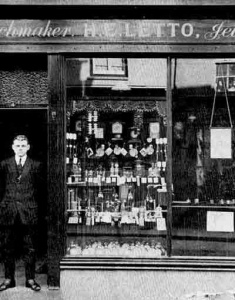 Henry Letto outside his watchmakers and jewellers at 4 York Street in 1917. The business moved a few doors along to 18 Charing Cross in 1930. It was founded by Henry Letto in 1913 and carried on by his son, and then his grandson Colin, whose death in 2020 brought to an end over a century of family management
 -
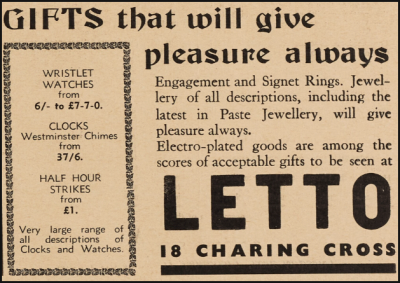 Advert from Jersey Leader, 1935
 -
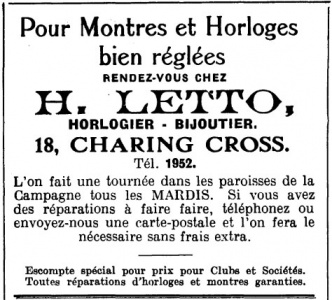 1940
1940 -
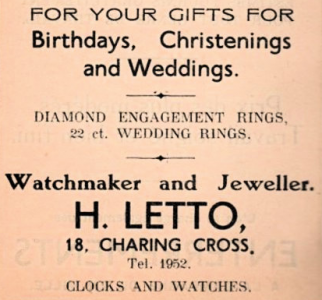 1953
1953 -
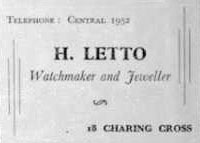 1960s
1960s