A brief history of education in Jersey

A brief history of
education in Jersey

This article is based on a presentation at Jersey Archive in February 2025 as a prelude to their What’s Your School’s Story? series
The history of education in Jersey is told through a wide variety of records: from records concerning the establishment of two free grammar schools in the 15th century, to minutes, acts and court documents detailing legal reforms in the late 19th and early-20th centuries, through to school admission registers and log books up to the current day
In 1477 Jean Hue, the Rector of St Saviour, offered to build and endow a school on a field that he owned, next to a chapel dedicated to St Mannelier, on the condition that it was exempt from the law of mortmain. The Royal Court accepted the gift and Edward IV agreed that it could be exempt from mortmain. St Mannelier School was built soon afterwards.
In 1496, a second school, St Anastase, was founded after two Jerseymen who had prospered in England, Jean Neel and Vincent Tehy, gave money towards it, with Henry VII confirming the grant and some of the rules of the institution. St Anastase and St Mannelier were to dominate education in the Island for the next couple of centuries.

Le Don Baudains
In 1596 farmer Laurens Baudains gave rente and the mill of Dannemarche to the States of Jersey in order for them to found a college in the Island. However, despite appointing regents and obtaining a letters patent, his plans never came to fruition.
Instead, in 1611 Baudains secured another letters patent from James I to set up a fund allowing poorer students to apply to study divinity at the Universities of Oxford and Cambridge on condition that they returned to Jersey to carry out their ministry. This fund became known as Le Don Baudains.
Letters Patent of James I establishing Le Don Baudains. The document confirms that Laurens Baudains had established a College for the ‘instruction of youth in laudable arts’.
Church monopoly
In 1623 James I approved the Canons for Jersey. Within the Canons was an agreement that there should be a schoolmaster in every parish, chosen by the rectors, and that they should teach children to read and write. All schoolmasters, appointed by the Ecclesiastical Court, had to sign an oath of office. The Court records saw cases brought against people who were running illegal schools. They would often be brought by the licensed schoolmasters in the parish who saw their monopoly being threatened.
In the late 18th Century this situation was challenged. Charles Dorey, who was the official schoolmaster in Trinity, summoned George Ahier to the Court for running an unauthorised school in his parish. This ultimately led to the Church monopoly being overturned, leading to the creation of more private schools.
In April 1664, a case was brought before the Ecclesiastical Court by Thomas Bichard, Rector of St Ouen, against Francois de Caen, accusing him of running an illegal school in the parish. The case rumbled on for at least four more years
Francois Jeune
Following the Lieut-Governor’s letter to the Bailiff in May 1847, a committee was formed and the views of the Rev Francois Jeune, the former Dean of Jersey and a Master of Pembroke College, Oxford, were sought.
In June 1847, Jeune expressed his view that:
- “As Governor of a College in Oxford, which is very intimately connected with the Channel Islands, I have to deplore that the natural abilities of my fellow countrymen are, generally speaking, so ill cultivated that few indeed attain to academical distinctions. There is a marked superiority in those young men who come from the sister Island of Guernsey, which I can attribute only to the teaching received in Elizabeth College.”
After this damning indictment, local authorities were quick to move forward: on 24 May 1850, less than three years after Jeune’s report, the foundation stone for Victoria College was laid.
Establishment of a college
By the 19th century, the two grammar schools were becoming increasingly dilapidated and obsolete. Whereas in Guernsey a new charter had been agreed for Elizabeth College, this did not take place in Jersey, with the Ecclesiastical Court saying that they were powerless to act. By 1830 the number of scholars at St Anastase was down to seven.
By the 1840s it was realised that it would be beneficial for a college to be built in the Island. In May 1847, the Lieut-Governor wrote to the Bailiff saying that although the Island was, “distinguished by its high state of civilization, that it does appear to me that a scholastic establishment would be of great permanent advantage to Jersey.”

Compulsory Education Act, 1894
In the 1870s the first Comité d’Éducation Élémentaire was formed, with responsibility for education transferred from the UK to local authorities. Introduced in the UK in 1870, it took longer for compulsory education to arrive in Jersey: the principle of it was adopted by the States Assembly in February 1889, however it wasn’t until 1893 that a bill was brought.
Debates started in parish meetings, with a clear divide between the town parishes, who supported compulsory education, and the country parishes , which urged their representatives to reject it. Opponents to the bill’s introduction employed delaying tactics at every turn. Even during the final sitting, after all amendments had been heard and the bill had been read aloud, the Constable of St Martin made a final move for it to be rejected. His motion was defeated by two votes, and the law was finally passed on 25 January 1894.
Prosecutions under the Compulsory Education Act
The introduction of the Compulsory Education Act in 1894 appeased the UK Government, who were threatening to remove their inspectors if compulsory education was not introduced. The act stipulated that children aged 5-12 who lived within two miles of a school had to attend, and gave powers to bring prosecutions against parents whose children did not attend.
The first prosecution under the Compulsory Education Act mentioned in the Elementary School Committee minute books came in October 1895 when Jacques Mahé, of St Saviour, was charged with neglecting to send his children Jean and Louis to school. He was fined 2s 6d and he agreed to send his children to St Saviour’s National Day School, or he would incur a fine of 10 shillings. Extract from the Magistrate’s Court recording the prosecution of Jacques Mahé in October 1895, accused of an infraction of Article 1 of the Law on Compulsory Education by not sending his children Jean and Louis to school
-
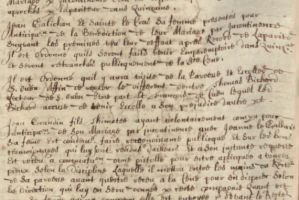 Record of a case concerning an illegal school
 -
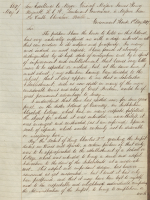 The Lieut-Governor's 1847 letter to the Bailiff
 -
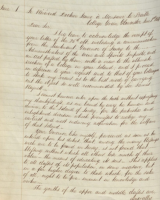 Rev Francois Jeune's letter
 -
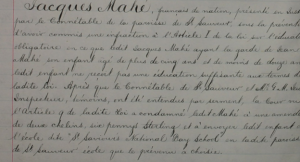 A case against a father who kept his son out of school