A prisoner of the Japanese

Prisoner of the Japanese

Norman Foster's diary, which gives a remarkable account of his wartime adventures
Norman Foster, who moved to Jersey with his family as a child, joined the Royal Signals in 1940, at the age of 20, was captured when Singapore capitulated in 1942, and spent over three years as a Japanese prisoner of war. This is his story of his war years
Shortly after the outbreak of war I volunteered for the Air Force, but after a frustrating delay awaiting call-up I enlisted in the Royal Signals in March 1940 as a wireless operator. [It has since been established that Norman falisfied his birth date by a year in order to be accepted - Editor]
While on a course in Portsmouth I watched the French Navy steaming in following the collapse of that country, and learned of the occupation of the Channel Islands.
Collision at sea
The following March I embarked on the Strathaird at Gourock in a convoy bound for Crete, but a few hours after sailing we collided with the Stirling Castle and were forced to return to port.
After a week's survivors' leave we spent a month firewatching on the docks at Liverpool, leaving shortly before a heavy air raid destroyed the warehouses we had been guarding.

Singapore
In October we embarked for the Middle East via Halifax and Trinidad, reaching Cape Town in early December. Here the entry of the Japanese into the war led to our being diverted to Bombay. After a stay inland we embarked on the Empress of Asia for the Far East. Our convoy hove to off Java awaiting orders, and the Commodore was instructed, in the absence of a fighter escort, to proceed to Singapore at his discretion.
In the Bank Straits an attack by nine Japanese shattered our out-swung lifeboats and the next day, a few miles from Singapore, 27 planes attacked us. Several direct hits turned the vessel into a blazing inferno, forcing us into the shark-infested waters. We made it ashore late on 5 February in a very bedraggled state.
Considered fresh reinforcements, we were promptly moved up to the north coast, facing Malaya, to meet the expected landing there. Fortunately for us the Japs chose the west coast, where the Aussies took the brunt of the attack.
Prisoners of war
For a sleepless week we endured ceaseless air raids and mortaring, with no air support. On the 15th the island capitulated, and we became prisoners of war.
Soon I was shifted to a camp at Keppel harbour, where we worked as coolies on the docks. I became quite expert at looting, with several narrow escapes to my credit.
In November we were herded into steel goods trucks destined for Bangkok. Heavy monsoon rains had washed away a large section of the track en route, which we had to replace. The journey thus took four weeks, and at times the temperature in the trucks reached 140F. Often we begged for water, to no avail.
For the next three months I slaved on the Death Railway, mostly working seven days a week, and sometimes 36 hours in 48. Fortunately we were sent back to a base camp to recuperate, and I was hospitalised with dysentery. Within a few days patients either side of me died.
Here I received my first news through the Red Cross from my family who had been deported the previous year to Germany from our home at Gorselands, Rozel.
I avoided return to the jungle by going sick with a bad hernia sustained on the docks. During my operation under spinal anaesthetic an orderly swatted flies while I conversed with the two surgeons. Sterilised hairs from a bullock's tail were used for sutures.

Our next move was back to Bangkok, where we again worked as coolies on the docks. Here we endured frequent, and often massive, allied air raids.
It came as a relief to be moved to Ubon in north-east Thailand. Here we quarried stone for a mile-long airstrip. I became afflicted with a disease which defied diagnosis and lost the will to live.
The fit men were made to dig a huge mass grave around the camp and our execution was apparently scheduled for 20 August. We owe our lives to the dropping of the atomic bomb which precipitated the Japanese surrender on 14 August 1945.
Flying to Rangoon in a war-weary Dakota our engines cut out over the mountains in a violent thunder storm, but happily the pilot regained control in the nick of time.
In mid-November I finally got back to Jersey weighing 6½ stone and was dubbed 'the walking Belsen'. At a dance I met a pre-war friend, Madeleine Le Cuirot, of Boulivot, who had endured the Occupation. Something clicked and we married in South Africa in 1949. We have been blessed with two sons, two daughters and two grandchildren.
I also met a pre-war colleague from Midland Bank, Major Hugh Le Brocq, but our difference in rank prevented a renewal of this association.
Gallery
Norman Foster's family have retained his collection of photographs, his service records, diaries, the Red Cross letters which kept the family in touch while prisoners of the Germans and Japanese. They have generously been willing to share these with Jerripedia. This sequence of images tells the story of Norman Foster's war.
-
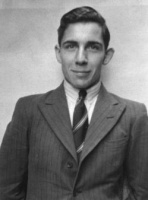 A bank employee at Midland Bank after the war
 -
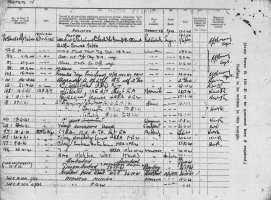 Norman's service record from the time of his enlistment in 1940
 -
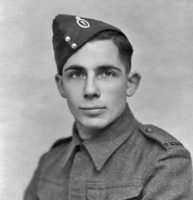 In uniform while undergoing training
 -
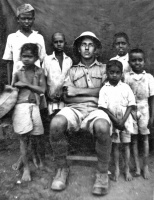 In India before the fateful departure for Singapore on the Empress of Asia, January 1942
 -
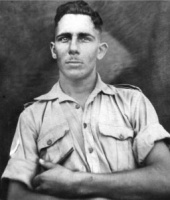 Another photograph taken in India, January 1942
 -
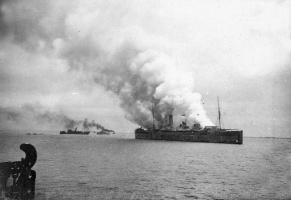 The Empress of Asia on fire after being attacked by 27 Japanese aircraft on 5th February 1942. Norman survived by jumping into the sea
 -
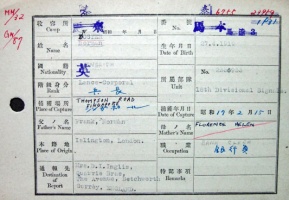 A prisoner of war, his details recorded in English and Japanese
 -
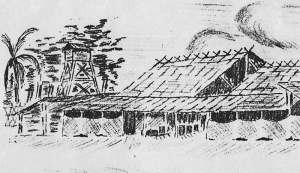 A fellow prisoner's drawing of the camp
 -
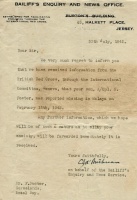 July 1942, and Norman's family hears through the Bailiff's office in Jersey that he has been reported missing in Malaya
 -
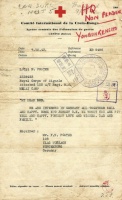 This Red Cross letter from his father in Wurzach took two years to reach Norman
 -
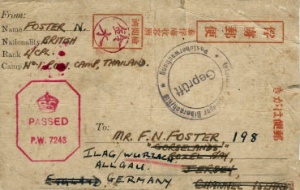 When Norman wrote to tell his family that he was alive, he thought they were still in Jersey
 -
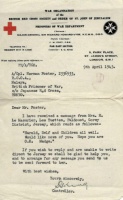 Another letter which took over a year to reach Norman with news of his sister and her family
 -
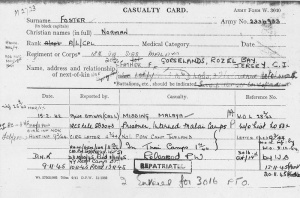 Post-war service record
 -
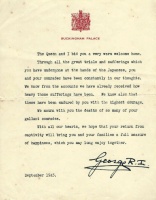 A welcome back from the King
 -
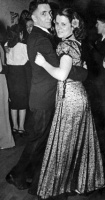 Norman, and his wife Madeleine, whom he met soon after his return to Jersey, and married in South Africa
 -
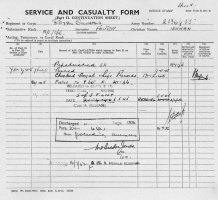 Record of Norman's discharge
 -
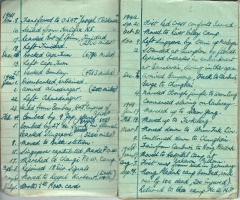 Entries in the remarkable diary of Norman's war