Crime and punishment

Crime and punishment,
Law and order

A parish police register
Follow the links on this page to articles concerning famous and notorious crimes and criminals in Jersey over the centuries, and some of the punishments imposed

- Hanging in Jersey
- The hanging of William Hales
- A Guernsey duel on Gallow's Hill
- The murder of Marie de la Place
- The ship which killed two men
- Philippe de Soulemont, the son of a prominent family who killed a man in a bar brawl and fled the island
- Banknote forgery in the 19th century
- Murderers pardoned over sentencing delay
- Public whipping [1]
- 1846 manslaughter conviction after pub brawl
- Corporal punishment for women
- The murder of Esther Le Brun
- The devastating fire at a Halkett Place drapery
- Smuggling
- 14th century murder
- A patient takes revenge on a Hospital doctor


- Court reports from 1299, some interesting cases heard by visiting Justices
- The activities of the Ecclesiastical Court
- Francis Joseph Huchet, the last person hanged for murder in Jersey
- Two cases from the 19th century, from a Jersey Archive article
- Extradition of prisoners to France
- Court hearings at the end of the 18th century
- Improper bathing costumes
- Jersey Heritage factsheet on prisons
- Transportation Registers
- George Sinel, deported to Australia for theft
- Edward Anquetil, another transported convict
- Deportation for robbery with violence
- An 1835 trial of three forgers
- German Occupation Court hearings
- Maximilien Messervy, convicted of forgery and hanged
- Walter John Lake's court appearances: A Jersey-born former soldier who beat his wife, who was accused of witchcraft, in Guernsey
- Royal Court convictions 1909-1918
- Youths cause disruption with fireworks
- Le Gallais robbery gang
- Conflict of interest, the 1855 Attorney-General dropped a prosecution against a club of which he was a member
- Lady bathers disturbed
- Smuggling on the steamers
- George Royston Jackson: Bigamist sentenced in 1919
- Manslaughter and drunken mayhem by the Town Church
- Female penitentiary in Dumaresq Street
- Englishman sued for libel by a lawyer ends up in prison
- Murder at Elizabeth Castle
- 1918 vandals
- Mulcaster Street murder
- Cardsharp gang trapped
- Nellie Rault, a Jersey woman murdered at an army camp in England in 1919, included in the island's Roll of Honour
- Man kills wife and child
- The Brighton Road tragedy: The story of a 1895 murder
- Early drink driving case

Triple hanging
This cutting from the 4 November 1797 edition of the Gazette de l'Ile de Jersey records the public execution of three men, known only by their surnames, Collins, Bisson and Deschamps, on Mont Patibulaire - Gallows Hill, now known as Westmount.
There is no indication of the nature of their crime or crimes, nor whether they had been sentenced for the same or separate offences. Although it may be assumed that they had been convicted of murder, the death penalty was still imposed for lesser offences in the 18th century.
This version of the Gazette was first published by John Stead in September 1797, taking over from Mathieu Alexandre's Gazette which ceased publication at the end of the previous year. It seemed likely that the death sentence was passed on the three men in the nine-month gap between the appearance of the two newspapers.
However, a search in the Pursuites Criminelles, a record of Royal Court criminal cases from 19 September 1797, revealed details of the cases against Thomas Bisson and Jean Deschamps, and separately James Collings and Thomas Parbut.
Bisson and Deschamps made several appearances before the Royal Court before they were sentenced to death on 24 October 1797 for breaking into the office of Mr Budd on the night of 25-26 June, using a skeleton key, and stealing a large amount of gold and coins.
Collings, believed to be the Collins referred to in this newspaper account, and Parbut were soldiers in the Regiment of Cheshire Fencibles. They were found guilty of breaking into the house of Charles Gruchy on 30 September 1797 and stealing various items, and were sentenced to death, also on 24 October. We have not been able to find any explanation for Parbut not being hanged along with the three other criminals.
The newspaper report indicates that a large crowd surrounded the gallows during the hanging. It concludes with a 'sermon' encouraging parents to assume responsibility for the conduct of their children.


-
![If only we knew more about this story! On 8 October 1824 Charles Le Sueur [2]appeared in Court charged with murdering Henri McCabe. The case merited a single paragraph in Chronique de Jersey. The sentence was equally brief: only four months imprisonment, for homicide...](/w/images/thumb/7/78/S24Chronique1824LeLueurHomicide.png/300px-S24Chronique1824LeLueurHomicide.png) If only we knew more about this story! On 8 October 1824 Charles Le Sueur [2]appeared in Court charged with murdering Henri McCabe. The case merited a single paragraph in Chronique de Jersey. The sentence was equally brief: only four months imprisonment, for homicide...
If only we knew more about this story! On 8 October 1824 Charles Le Sueur [2]appeared in Court charged with murdering Henri McCabe. The case merited a single paragraph in Chronique de Jersey. The sentence was equally brief: only four months imprisonment, for homicide... -
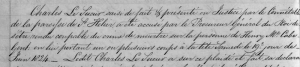 ...this Court document indicates that the accused hit his victim's head several times.
 -
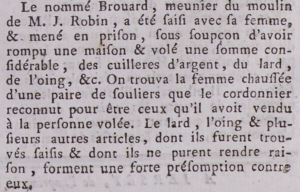 1787 Gazette de l'Ile de Jersey of Brouard couple arrested for breaking and entering and theft of 'a considerable sum', silver spoons, etc
 -
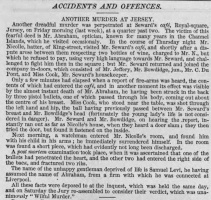 Illustrated London News report of a murder in a Royal Square bar in 1846
![If only we knew more about this story! On 8 October 1824 Charles Le Sueur [2]appeared in Court charged with murdering Henri McCabe. The case merited a single paragraph in Chronique de Jersey. The sentence was equally brief: only four months imprisonment, for homicide...](/wiki/File:S24Chronique1824LeLueurHomicide.png)


Prostitution
There were many prostitutes active in Jersey in the early 19th century, more often than not French women who had come to Jersey either deliberately to 'follow the oldest profession', or been forced to take it up after falling on hard times. They were usually sent back to France and barred from returning to the island for five years
-
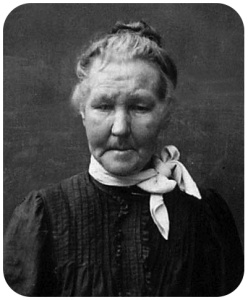 Jeanne Courtois, nee Brousterre (1865- ) banished for five years on 12 September 1914
 -
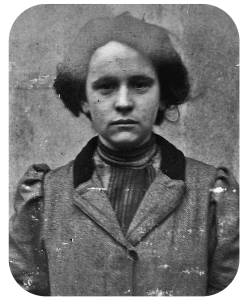 Josephine Alice Gella (1893- ) banished for five years on 14 December 1912
 -
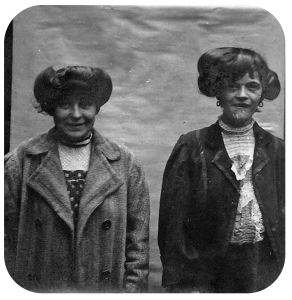 Lea Tande (1888- ) and Amelie Bazille (1887- ) both banished for five years for prostitution on 17 June 1911
 -
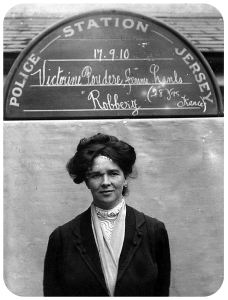 Victorine Lanlo, nee Poudere (1882- ) of Cote du Nord, sentenced to two months imprisonment and five years banishment in 1910 for robbery and prostitution


Notes and references
- ↑ The punishment for relatively minor thefts in days gone by could be hanging, but when a St John couple believed that they were the victims of a theft by policemen, they ended up with a particularly severe and barbarous punishment for daring to voice their concerns. When St John's Honorary Police searched the home of David Brouard and Margaret Tome in 1787, looking for the proceeds of a robbery, a box of theirs containing 48 guineas went missing. Understandably believing that an official complaint would not get them anywhere, the unfortunate couple decided to let as many people as possible in their parish know what had happened. When word reached the Constable of St John he was not amused, and took the couple to Court on 29 June charged with libelling his honorary officers. The couple were sentenced to the extreme punishment of being publicly whipped by the hangman the following saturday from the Courthouse door to the prison at Charing Cross. Following this Brouard was to have his right ear cut off and both of them were to be banished from the Island forever and their goods and property confiscated
- ↑ Despite the name given in this report, it is clear from original records that the correct family name was Le Sueur