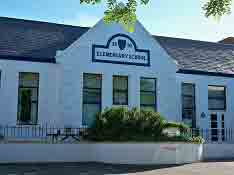
First Tower School

First Tower School

A young Mike Bisson with his teacher Miss Florence Hacquoil in front of the school, c1958
First TowerSchool was founded by the Parish of Saint Helier in 1865 in First Tower and was one of 14 parish schools taken over by the States in 1913.
Among its distinguished teachers was Francis Corbet, later president of La Société Jersiaise, and among his distinguished(?) pupils was Mike Bisson, later editor of the Jersey Evening Post and founder and editor of Jerripedia


History
From a Jersey Heritage What's your school's story? presentation in 2025
First Tower School was founded at the start of the 20th century to serve a growing community, following the rapid population growth Jersey experienced during the 19th century. Between 1821 and 1851, the Island’s population nearly doubled, prompting the need for schools in burgeoning communities including First Tower.
The area around First Tower thrived during the mid-19th century due to a boom in shipbuilding, driven by demand from the Atlantic cod trade. Jersey became a major player in the global shipbuilding industry, with the number of locally built vessels rising from 69 registered in 1815 to 422 by 1865.
The school site was once a key location for shipbuilding. It was used by George Deslandes, who operated the island’s largest fleet of locally built wooden ships. His family-run business included a shipyard, ropewalk, and timber merchant, and was later continued by his son and son-in-law, Daniel Le Vesconte, until the industry declined and the family relocated in the 1860s.
Construction, 1901-1902
First Tower School was established in response to Article 14 of the 1899 Loi sur les Ecoles Elementaires et L’Instruction Obligatoire from the Comite d’Education Elementaire, which required the parochial authorities of the Island to acquire suitable land and prepare plans for the building of elementary schools following the introduction of compulsory education for children between the ages of 5 and 12 in 1894.
On 3 November 1900, the Parish of St Helier purchased land on which George Deslandes had once ran his shipyard from George’s niece, Annie Elizabeth Le Gros. A ceremonial laying of the commemoration stone took place on 11 November 1901, attended by parish officials, committee members, and engineer Mr Le Masurier. A time capsule containing local records, newspapers, coins, and stamps was placed beneath the stone.
Construction was completed in October 1902 by builder W Husband, who worked from plans drawn by Le Masurier. The original building featured separate entrances for boys and girls, five classrooms (three of which could be opened into one large hall), teachers’ rooms, gas lighting, French windows, and lavatories. The design was praised in the Evening Post as ‘a credit to the Island‘.
Early years
First Tower School opened in late 1902 as a small institution, with classrooms designed for around 25 pupils. Charles Bird, appointed headmaster that December, was paid £130 a year. Early staff included Mary Ward, Lily Plymen, Lucinda Poirier, and Alice Alexandre. Pupil fees ranged from 1d to 3d.
By summer 1903, enrolment had already reached 101 in the mixed school and 83 in the infant school, a pattern of pressure that would continue for decades. Inspectors praised the school’s efficiency but noted overcrowding and recommended more time for ‘History and knowledge of common things’.
Lucinda Poirier, one of the school’s original teachers, later recalled walking into the school daily from her home at Bagot and earning £1 per week. She described a tightly knit community, in which children usually followed their parents’ trades and rarely ventured far beyond the parish.
World Wars
In the early 20th century, First Tower School was frequently disrupted by illness, with no unaffected school year until 1920. Seasonal agricultural work, especially the potato harvest, also caused widespread absences – sometimes up to eight weeks. In 1913, responsibility for the school passed to the States Education Committee, though the parish retained ownership of the site.
The First World War brought further upheaval. Many pupils were drawn into the workforce, and several staff members joined the war effort. Teacher William d’Authreau enlisted in 1914, returning in 1920 and later becoming Headmaster. Other staff, including Frederick Le Blancq and Annie Goaziou, also joined the war effort: Le Blancq as a medic, and Goaziou in the Voluntary Aid Detachment.
During the Second World War, the school community was again affected, this time by evacuation and Occupation. German was introduced into the curriculum, and former pupils like RAF airman Peter Emile Carvenec served overseas. Carvenec survived a plane crash in 1942, and though his family evacuated to the UK, news of his survival was reported locally.
Postwar life
The postwar years at First Tower School saw a mix of continuity, community, and charm. Among the lighter moments was the romance between two young teachers, Dorothy Hudson and Dennis Bridgeman. Encouraged by their pupils – who cheekily hung mistletoe above Miss Hudson’s desk – the pair fell in love, became engaged, and married during the summer holidays of 1954.
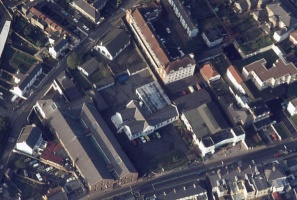
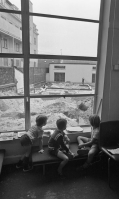
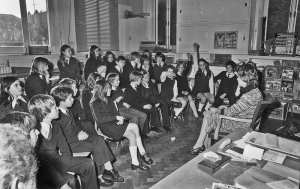
Despite the cheerful atmosphere, the school’s physical condition struggled to keep pace with its growing population. By 1977 the main building remained much as it had since 1902, though numerous small outbuildings had been added to meet demand.
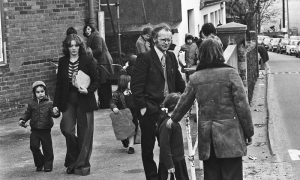
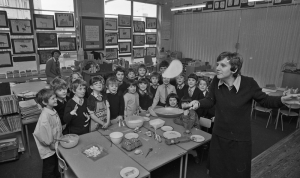
Conditions remained poor into the late 1970s. In 1979, some 43 pupils were still being taught in a former German military hut, and older children continued to rely on outdated outdoor toilets – highlighting the urgent need for modernisation.
Expansion and renewal
In September 1983the school finally underwent a serious, and much needed, renovation. Work in the September alone saw the addition of a workshop, a library, resources room, toilet and classroom.
Later that year, further upgrades followed with the construction of three more classrooms, new staff areas, and showers – significantly improving the school’s infrastructure after years of overcrowding and outdated conditions.
After these renovations were completed, First Tower became the second largest primary school on the island, after Rouge Bouillon, with 250 students enrolled. The renovations meant the schools capacity increased to 275.
Community, growth and celebration
From the 1980s onward First Tower School became a vibrant hub of community life. One standout event was the First Tower School Parent Teacher Association barn dance held in March 1983 at Haut de l’Orme Farm. Organised with help from the Infant Department, the event attracted over 400 attendees, plus a curious calf born that morning.
Highlights included line dancing, a conga, and a feast led by ‘Ziggy’ Shenck, featuring flapjacks made with maple syrup flown in from Canada. A gold miner on a donkey capped off the night by scattering gold-wrapped toffees. Proceeds supported the school’s refurbishments.
The school continued to grow. By 1993, the site was valued at £650,000, and the following year, the Planning and Environment Committee approved urgent expansion plans in response to increasing pupil numbers. Major works began in late 1994 and continued into 1995, when the school was officially purchased by the States of Jersey. The sense of community and pride built over decades culminated in a centenary celebration in 2002, marking 100 years of First Tower School at the heart of the parish.
-
-
 1977
1977 -
-
-
-
-
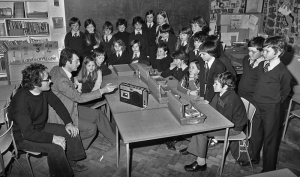 1979
1979