Hedley's diary - 4
From Jerripedia
Jump to navigationJump to search

Hedley's Liberation Diary
18 – 30 June 1945 
|
June 1945
Monday 18th
- The good news is that the mailboats will be back next week. The bad news is that for reasons known only to himself, the Harbourmaster has issued an order that nobody will be allowed on the pier to meet friends or see off departing passengers. There may be a good reason for this, but what seems an absurd and uncaring decision has not been explained. The EP is banging its drum very loudly and demanding to know, on behalf of all of us, what is behind this order. "The day of curt orders, with no explanation and no reason, is over. The Islanders stood that for five years; the men issuing the orders had force behind them to compel obedience. But now that we are dealing with our own people different treatment is expected" says the newspaper, and I am sure that we all agree with them. What can possibly be wrong with restoring the freedom we always had to stand next to the gangplank when meeting friends and relatives off the boats?
 Some evacuees' property was safely stored away, but others will not be nearly so lucky
- I don't know who will be on the first boats, but their return home is likely to come as a big shock. They will probably find that all their possessions have disappeared. Dr Evans is expected to be one of the first back and nobody knows where his furniture and other possessions from his St Ouen home have disappeared to. George Laurens, of Queen Street, is searching on his behalf and promising to treat any information in the strictest confidence. Somebody must know, because it is common knowledge that many evacuees' homes were stripped within hours of their departure – before the Germans arrived. Some who were turned back from the Harbour got home to find that light-fingered neighbours had already started helping themselves to the contents of their homes.

- I can't help but agree with another EP editorial appealing to motorists not to drive fast on our roads. Just because car owners are now free to use the roads again does not mean that they should be driving at dangerous speeds. Most small children are quite unaccustomed to the swift-moving vehicles which now dash past them. These little ones will need time before they become traffic-conscious, despite moves to give them road safety talks in school. It is up to motorists to do their share in this attempt to make the Island roads safe, not only for our children, but also the elderly folk who, after five years’ Occupation strain, are not as nimble, either mentally or physically, as they were in pre-war days.
- It is clear that anyone who worked for the Bosch during the Occupation is not going to have an easy time now that they have gone. One of them wrote to the paper complaining that he could not now get a job. His claim that he materially assisted in supplying petrol to farmers, bakers, wholesale grocers and haulage men is being laughed at. Stout fellow! He does not mention the prices charged by ‘the boys’ for this petrol – anything from 15s to £2 a gallon. Having filled his stomach with German rations and his pockets with German wages and petrol profits he now whines that he is unemployed. Long may he and his ilk remain so.
- And it has come as a great surprise to learn that a certain café in the town, the proprietor of which was notorious for his association with the Gestapo, and which had been closed for some time, had reopened. More surprising still, was that it was full of British troops. As presumably these places now have to be licensed by the Food Control to obtain rations of tea, coffee and milk, or whatever rationed goods they sell, it would be interesting to know how this came about.

- There have been some touching family reunions since the Liberating troops arrived, because where possible, islanders were chosen to be among those who proudly wear the badge of Force 135. Brothers were reunited within hours of Operation Nestegg reaching our shores. It took a little longer for Gunner John William Cook, RA, to meet his elder siblings Doris Herve and Norman George Cook, and they didn't believe who he was when he arrived on their doorstep in Richmond Road. Doris and Norman came to Jersey 17 years ago after the death of their mother, but John, then aged eight, was adopted by an aunt, and they did not meet again until last Saturday. At first, neither brother nor sister would believe that this big young man was their brother, but soon his identity was established and there was a happy family reunion. Gunner Cook had crossed from Guernsey, having reached the sister isle as a member of the Liberation Forces.
- The Liberation is being celebrated in many ways. Philip George Larbalestier the well-known Jersey conductor-composer has written a symphonic cantata (sounds like serious music, as posh as its title, Liberi Gaudeamous! which apparently means 'We who are free rejoice') to a poem by Horace Wyatt. The title page of the score bears the following inscription: ‘Composed to celebrate the liberation of the Island of Jersey after five years of German occupation, 1940-1945, this work being dedicated to Alexander Moncrieff Coutanche, Esq, Bailiff of Jersey. Mr Larbalestier sent a copy to the King and it has been granted the rare honour of a place in the Royal Library.
Wednesday 20th

- Jersey Airways will reopen civil air services between the Channel Islands and the United Kingdom tomorrow. Two services will operate each way daily and it is intended for the return of the refugees to the Islands and for those rejoining their families on the mainland – those who can afford this means of travel, of course. Exit permits will be necessary and for compassionate cases authority to travel must be obtained from the Passport and Permit Office.
- Problems for those who associated with the Germans during the Occupation won't go away in a hurry. It's causing trouble at the Girls College, where at least one pupil's parents are known for such associations. It is claimed that the girl was seen on occasions entering the Pomme d’Or Hotel – German Naval Headquarters – in her school uniform. Her fellow pupils not unnaturally resent this and have been ‘ragging’ her. She complained to her parents and was not seen at the school for some time. The headmistress has addressed the school and warned them that the girl was coming back and that any further ‘ragging’ would result in expulsion. It is rumoured that the Public Instruction Department issued instructions to this effect.

The Empire Day parade was well attended, despite the best efforts of the Public Instruction Department
- Most people I have spoken to think they have got this badly wrong, and they certainly did just before Empire Day, when an official of the local Teachers’ Association who asked what arrangements were being made for the celebration of the occasion, was told that they could not see their way clear to make any exception to the procedure which had been followed for the past five years – no celebration and no holiday. The military arranged their parade and informed the department that a holiday was granted. I think we would all like to know on what basis the powers that be feel it necessary to follow the procedures of the past five years.
- After the Great War the demand for rental properties created a rent ramp, and it seems that it is happening again. The Island is faced with the problem of housing and folk returning from the mainland, and there is no doubt whatever that a certain class of rapacious landlord is determined to take full advantage of this and exploit the situation to the limit. The States is sitting tomorrow and I hope some member will show sufficient public spirit to ventilate this matter in the House. We live in testing times and by the manner in which the problems now arising are dealt with, so will the Island’s administration be judged.
Thursday 21st
- Is footwear clothing? This is not a joke, at least not to the women who have been issued with the States’ subvention for clothing for their children and who find that it covers everything but footwear, which children need probably most of all. Deputy Philip Le Quesne is on the case but told the EP that it was beyond him. ‘Apparently it is the Social Assurance who decided this,’ he said, ‘but when I telephoned the Secretary after a woman had come to me and told me she could not get shoes with her vouchers – and she had five children, he told me that those were his instructions and he could do nothing about it.’
- The authorities really need to get with it. We can't have one parish deciding how to cope with the desperate poverty some families are facing, and others doing it differently. St Helier are refusing any loans and clothing supplies to people who cannot afford to buy the clothing they need. But I gather that non-natives can get, and are getting, all they want. Why? Because the non-natives are dealt with by the States, whereas natives come under the parishes, and St Helier do not see why they should shoulder this burden, arguing that it is an Island matter. I am told that one parish is allowing its native poor £1 and another £5; it costs £3 to rig out a woman and £4 for a man. Somebody needs to bang heads together; the island is not big enough for 13 different authorities to cope with the aftermath of war in the way they deem fit.
- I went to visit friends in Trinity yesterday and discovered an area which comprises three farms and their outbuildings and a considerable area of land which may never be used again, thanks to the Germans. This is at Egypt, on the parish coast, and it was used during part of the Occupation as a training ground and artillery target. At one time Egypt Farm, the home many years ago of the Gibaut family, was as prosperous and well-kept a property as any in Jersey. Dr Hitchcock lived there at one time and constructed a ballroom in the outbuildings. Shortly before the outbreak of the war Mr Gordon Rice acquired another farmhouse nearby and converted it into a summer residence, spending a considerable sum on the alterations. Lower Egypt was in the occupation of Mr W H de la Mare, who had made of it a very modern and well-fitted property, with electric light, bathroom and other amenities which are not always found in a Jersey farmhouse. All these houses were well-built of Jersey granite and had stood for many years in this secluded and sheltered spot looking out to the French coast and the Ecrehous; now they are merely heaps of rubble. It's an illustration, if ever it was needed, of the vandalism of the Germans. That is the way the German is made - he is like a mischievous child and loves destruction.

- Mrs T White of Kensington Street, has received news that her sister, Miss F Collas, who we remember well from pre-war days, is now Acting Principal Matron of Chatham Naval Hospital, and has been awarded the ARRC (Associate of the Red Cross), one of the most coveted decorations in the nursing service, and that she is to proceed to Buckingham Palace to receive it at the hands of His Majesty the King. This splendid news was conveyed in a letter sent by Miss Marlow, Matron of Trowbridge and District Hospital, who, prior to the war was with Sister Collas at Bristol Royal Hospital. When war was declared Sister Collas volunteered for service and was sent to Ceylon. Since then she has served in Africa and Alexandria.
- A letter from a Mr Larbalestier to the paper stating ‘There was no collaboration of any importance’ in the Island, has certainly stirred up a hornet's nest. I would like to know what he calls importance, because it seems to me and many others that there has been quite a lot. As far as the women are concerned who fraternised with the enemy, most of them would mix with any men, of any nationality, either for what they can get out of them or merely companionship, but they are evidently branded. What about the shopkeepers who have traded with the enemy to the detriment of their registered civilian customers? They have sold to the Germans at very high prices what civilians should have had at States-controlled prices, with the result that they can now ride in their own cars and boast of owning property etc which could not have been bought on profits made from our meagre rations. They know full well now the war is over that they will still get customers (especially the shops out of town), more from convenience than choice. It we are all to let the past die, then we may as well forget everything, the murders of men, women and children, the terrible tortures of innocent people etc. But I am afraid it is so instilled in the minds of some people that they will NEVER forget.
Saturday 23rd
- At last we are going to see new films, films which have been made recently and which have not been seen here before. They arrived yesterday and are to be screened tomorrow and next week at the various picture houses, so no longer will patrons at these houses be condemned to see the same picture over and over again, as has been the case lately, through no fault of the managers. They have been doing their best ever since the Liberation to get new films for their patrons for, as one of them put it: ‘It was no pleasure for us to dish up this old stuff week after week.’ Now their untiring efforts have been rewarded.
- Wests, for instance, have secured Melody Inn, featuring Dorothy Lamour and Dick Powell, for screening on Sunday. This picture will also be shown from Monday to Wednesday inclusive, with three performances daily at 2.30, 6.15 and 8.45pm. For the end of the week they have Claudette Colbert, Paulette Goddard and Veronica Lake in So Proudly we Hail.
- A bright musical film in Technicolor, This is the Army, with music and songs by Irving Berlin, is on at the Forum. The cast includes Geo Murphy, Joan Leslie and other well-known stars.


- It's all very well having ration books, but we have all been finding that shops don't actually have what we need. Now we learn that the Board of Trade are making further arrangements to enable traders in rationed goods to obtain supplies. And, surprise, surprise, it's going to take a Jerseyman to sort things out. Donald Picot, a Board of Trade accountant, with obvious local connections has now come over to assist in providing local facilities for traders to participate in the clothing coupon scheme in operation in the United Kingdom. Mr Picot, an Old Victorian, is a son of Alex Picot, the well-known accountant. He was formerly with his father in the Hill Street office of A E Picot and Co, and lived at 25 St Clement’s Gardens. Evacuating with his wife and family in 1940, Mr Picot joined the Board of Trade and has been with them over since. His wife Joan, nee Silvester, and the children are all well and hope to return to Jersey soon.
Monday 25th
- The Haslemere, well known here before the Occupation on the Southern Railway cargo service from Southampton, was in on Saturday with her first general cargo for the Island in five years. She is commanded by Capt G Light, who was a master of Southern cargo boats in those far-off days and who has now picked up the run again. Seen in town this morning was the familiar green-painted lorry of the Southern Railway, delivering part of this first cargo. Cheering sights these days for they are landmarks on the long road back to normality.
- For five years the activities of the Jersey Motor Cycle and Light Car Club have been confined almost solely to an occasional dance or social evening, with the idea of keeping club members in touch with each other. For five years of Occupation these men who had raced at speeds approaching, even surpassing, 100mph, had been seen jogging along on old 'push bikes'. Sports cars and motor cycles were hidden to avoid their falling to the hands of the Germans. It’s been a pretty long wait for these enthusiastic club members, but cars and cycles are out again now, engines tuned and revving as sturdily as on the day they left the factory.
- But unlike the ordinary road-users, these men are not content to merely tour the countryside; the old urge has returned to sit astride their machines and shoot up and down rock-strewn, precipitous tracks or cleave through water-splashes, a pastime which appears to afford them the maximum pleasure that life holds! On Sunday afternoon, with the full co-operation of the Military and Civil Authorities, the first event to be organised by the club since the motor car Grand Prix of 1939 will be held, and takes the form of a reliability trials match between the club and a team of riders from the Royal Engineers. The club is awarding a trophy, to be known as the Liberation Cup, which is to be won outright by the winning rider.
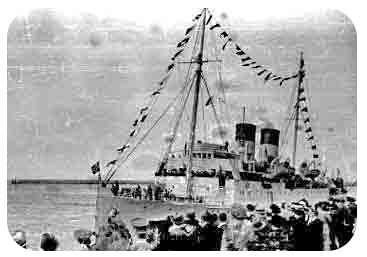 The Isle of Guernsey approaches the Harbour ...
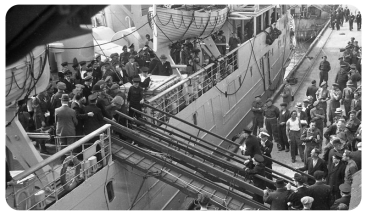 ... and discharges her long-awaited passengers


Tuesday 26th
- Five years ago to the day, on 26 June 1944, the Southern Railway mail boat, Isle of Sark, cast off from the Albert Pier with 444 passengers on what proved to be the last trip. Today the Isle of Guernsey tied up in the same berth on the first trip of the resumed service. Jersey is almost itself again. What a sight it was to read on the signal mast at Fort Regent the progress of the ship, two pennants ‘left Guernsey’, ‘sighted off Corbiere’, and there she was in the dim hazy distance, for she gave Noirmont a wider berth than usual, looking bigger than one expected owing to the mist, but undoubtedly one of the old Southern boats.
- As she came closer the sense of excitement grew as, standing on the promenade, the closest we ordinary mortals were allowed to get to the Harbour, we recognised the familiar shape with the freshly painted yellow funnels with their black tops proving without all doubt that here at long last was our mailboat. As she rounded the breakwater she was seen to be dressed all over in honour of the occasion, for it was a historic occasion with the Southern house flag at the jackstaff and the Red Ensign at stern. As she got closer we could recognise people on board, fewer than expected. Soldiers on leave, civilians returning home, some from England, some from Germany and they cheered and cheered again as the vessel passed through the pierheads answered no less heartily by the group of States officials, military officers and others on the pierhead. Before the gangways were hoisted aboard the Bailiff welcomed the returning exiles, speaking with evident emotion through loud speaker equipment. ‘Welcome home. After five years of separation it is a wonderful thing to welcome you on this historic occasion. God bless you all.’
- An EP reader has asked what should she do with her gas mask. She may be leaving the Island shortly – should she take it with her or leave it behind? Or why not throw it in the dustbin?
Thursday 28th
- Sporting facilities are much in demand now that we can go out and about and need to burn off the excesses of having enough to eat again. We hear that everything possible is going to be done to return the FB Playing Fields to their pre-war condition now that the trustees are again masters in their own house. They have to take account of what materials and labour are available, and may be delayed while claims for damage by the enemy await a general settlement by the authorities.
- The buildings will be repaired against weather and cleaned up generally, but the playing surfaces are to be made the immediate and primary concern. Overuse right through the 12 months of each Occupation year has caused great havoc to the pitches which, in 1940, were due for re-seeding and feeding. Now it is intended to adopt a bold long-term policy of resurfacing. Two pitches are to be ploughed up in September and also the present allotment field. It is the hope of the Trustees to engage the services of a representative of the lawn and turf department of a well-known English firm who would give advice and supervise the work.

Friday 29th
- The plucky action of Helen Boleat, of Rocklands, Le Hocq Lane, on Wednesday evening undoubtedly saved the life of little Robert Proper, aged seven, living in Le Hocq Lane. He got into difficulties while floating on a makeshift raft near the Martello Tower in front of Le Hocq Hotel. It appears that the youngster and a little friend were playing with an old petrol tank which was floating nearby. They used it as a raft. His companion fell off and reached the shore safely but young Proper was carried out by the current. Fortunately his cries were heard by Mrs J Boleat, at the hotel. She called her niece who, without a moment’s hesitation, rushed down to the beach, threw off her skirt and swam strongly out to the rapidly-receding youngster. After a gruelling swim she drew level with the tank and, calming the boy with a few words of confidence, she slowly managed to swim back to shore pushing the ‘raft’ ahead of her. Helen was warmly thanked by the relieved parents, and a crowd which had gathered gave her a special cheer.
Saturday 30th
- Trinity police are investigating a somewhat peculiar case involving what appears to be the wanton killing of a goat and two kids, the property of John Starck of Les Hougues. Mr Starck kept the goat as a pet, and when two kids arrived he kept them also as pets. The animals each had a name and used to follow him about. One evening this week he went to get the animals in from where they were pegged out on a cotil, not far from the house, and found one of them dead and no trace of the others. As it was getting dusk he could not make a thorough search then, but did so next morning when he found the goat and the second kid, both of which had been dragged some distance into a patch of fern and, it is alleged, brutally done to death apparently with a spike.
- It's time to start the serious work of clearing mines from coastal areas, and Brigadier Snow has formed a committee to decide where work will start and announcements will be made when areas are declared safe. I'm sure that we will all be relieved when these areas are again available for normal use. They are going to start along the south coast from Plat Rocque to St Aubin's Harbour, followed by the west coast, Greve de Lecq, St Catherine's Bay and Grouville Bay. It seems obvious, but we have been warned not to cross a minefield, or any perimeter fence with mine warnings.
| Previous page | Next page | |
| 5 - 15 June 1945 | Back to index | 2 - 14 July 1945 |