Hedley's diary - New Year
From Jerripedia
Jump to navigationJump to search

Hedley's Liberation Diary
1 – 10 January 1946 
|
January 1946
Tuesday 1st
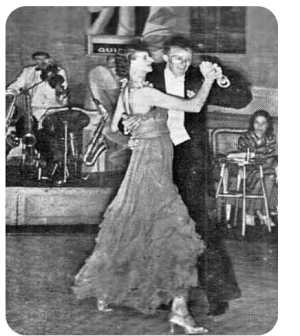 I'm not sure they were all dressed this smartly last night, but this is a photo we treasure of Doris and me strutting our stuff at the Plaza back in the 'thirties

- And so a new year starts. It has to be better than any of the past six, but it was welcomed in a very quiet way, certainly by those old enough to remember the celebrations of pre-war days, including Doris and me.
- Apart from the younger folk returning home from the crowded dance halls, both town and country were very quiet after the midnight hour. Most folk stayed at home and it was with an air of thankfulness and full hearts that 1946 was welcomed at midnight. We are thankful for our deliverance from those five years of despondency and tragedy, our thoughts are with the relatives of those who will never return and died so that we might today welcome the New Year with fresh hope, and courage to face the future, whatever it may hold.
- Now that the initial euphoria of the Liberation and our restored freedom has passed, it is still easier to remember the deprivation and sadness of the days which preceded it, than to look forward with any degree of certainty. Life is not back to normal, and we can only hope that we will get closer in 1946. We know that many families gathered round their wireless last night, waiting for the notes of Big Ben to announce the new year, but Doris and I had long gone to bed.
- Helier and Lizzie did not get back home until this morning, having stayed with friends in town after being among the 300 folk they tell us made things really go with a swing at the Stadium – although there was not much room in the ballroom to “swing”. The Plaza was likewise crowded and, at the Stadium, Lizzie told us that nobody minded the crush because they were out to enjoy themselves, and really did. Young minds heal faster, or so it seems. But why, they asked, as the last stroke of midnight fell on the air, did the street lamps go out? Was this really necessary? It seems that in so many ways our lords and masters have yet to come to terms with the idea that they can, and should, now organise things to suit their own people, not the occupying forces that had to kowtow to for so long.
- Today was a great day for the French Colony in Jersey, among whom we have many friends who have managed to get back since May. Once more, after a lapse of six years, they were able to call on their Consul, Mons Deflin, at the Consulate in Queen Street, and offer New Year greetings. A goodly number assembled, at their head being Dr Maurice Labesse, President of the Comite Permanent; M Henri Duval; Pere Maré, Rector of St Thomas; Pere Meline, Rector of St Martin’s RC Church; Rev Father Rey, of Maison St Louis; Dr EAC Drecourt; Brother Edward, Principal of The Beeches; Flight Lieut A Le Neindre, Legion of Honour; Mr L Dubras; Mr H E Fuel; Mr E Vitel, president of the Anciens Combattants; and others.
- Dr Labesse, whose daughter Solange is a good friend of Lizzie's, was deported to France in 1942 and somehow allowed back to rejoin his family, shortly before D-Day would have prevented his return. He told M Deflin that from time immemorial the members of the French Colony had assembled twice a year – on 1 January and 14 July, to pay their respects and to offer greetings to the representative of the government. This privilege had been suspended during the last six years as there had been no Consul. It gave them renewed pleasure to be able to resume these visits and renew their vows of loyalty and fidelity to France. Some had undergone great trials, having passed through Buchenwald. In 1939 some 600 of their compatriots left the Island to defend their native land, which was in danger, and had served in either the army, the navy, the air force or in the Maquis.
Wednesday 2nd
- The young soldiers of the RASC, who have been such valued work for us since the Liberation, have generally been very well behaved, but young men will be young men, particularly after a pint or two, and some of those stationed at the Grand Hotel appeared before the Constable of St Helier this morning on an allegation of having caused a disturbance at the Parade Café last night. A report that soldiers were fighting with knives led PC Howe to the café, and with the aid of a sailor who was inside, he quelled the disturbance before anyone was hurt. The soldiers were taken into custody and this morning were warned by the Constable as to their future behaviour and were handed over to a military escort. I don't suppose their officers will be quite as forgiving as the Constable.
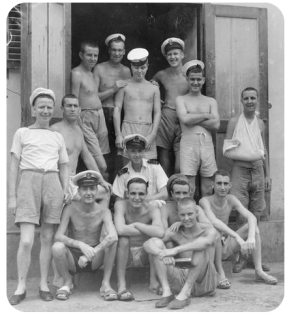 These were some of the lucky ones -prisoners who survived the Japanese PoW camps in Java and were rescued after VJ day. Charles Philip Le Clercq, Charles and Eva's eldest, was not so lucky

- During the whole of the war while our good friend Eva Le Clercq, the girl Pinel, was living in London, she had only one postcard from her eldest son, Charles Philip, in the RASC, a prisoner-of-war card from a camp in Java, sent from there on 1 January 1942, saying he was well. Now, reunited with her husband Charles at their residence, Mon Desir, Bagatelle, St Saviour, fate has dealt a hard blow, for they have received a message from the War Office to the effect that on 13 October 1944, while a prisoner of war, Charles Philip died at sea. They still don't know any of the details.
- Charles Philip was a plumber before the war, employed by Albert Murphy of Trinity Gardens. In 1940 Charles left the Island and joined the RASC on 21 April, and two days later he celebrated his 21st birthday. He left home shores late in 1941 for the Far East and arrived out there just before the fall of Singapore. He was sent to Malaya and then on to Java, where he was taken prisoner.
- Eva left Jersey with her youngest son, who is now employed locally as a motor mechanic, and four daughters, and went to London where they lived throughout the war, enduring days and nights of the great blitz, and also the buzz bombs and rockets. Her husband remained in Jersey and they were anxious days for Eva, for scant was the news that came through from Jersey, and after January 1942 she heard no news of Charles Philip. Ever since 1942 Charles and Eva have been hoping, fearing and praying for their son’s safety. Since the surrender of Japan in August, the reoccupation of Singapore and the neighbouring islands on 5 September, they have been exploring all channels in an effort to obtain news of their son. Their efforts and enquiries were fruitless, however, and on 30 December came this tragic news. They have another son in the Forces. He is an electrician with the 2nd Battalion, East Surreys and is at present stationed in Palestine.
Thursday 3rd

- There have been too many accidents at work as employers have cut corners in the attempt to get their businesses going again. Our friend Bertie Le Gros was one of the unfortunate victims and was lucky not to lose his arm, no thanks to his boss, and will probably never work again thanks to his injuries. The English Factories Act does not apply to Jersey, but it seems that action is now going to be taken to protect workers here, and not a moment too soon. An amendment to the Social Assurance Law, presented to the States back in March, 1940, has at long last been given Privy Council approval, which, it is hoped, will give all the powers necessary to protect workers without complicated legislation.
- From the outset of Social Assurance, the committee have been alarmed by the number of fatalities or serious accidents which have occurred and were due primarily to the absence of safeguards on machinery, proper equipment or through wrong methods of working. Jersey's law only gave power to inspect after an accident had taken place, but now an inspector will have the power to inspect at all times and order the carrying out of alterations to premises, machines, etc, which are considered to constitute a danger or potential danger of accident.
- When it appears that any premises in which workers are employed, any machinery and work activity are likely to be dangerous, the management will be given 48 hours notice to write to the committee if they want to avoid a direction to take action to make their operations safe. Too late to save Bertie from a premature end to his working life, but hopefully it will spare others the same fate.
- Our family has always been interested in horse racing and we joined more than a thousand fellow enthusiasts at Plemont on Tuesday for the first point-to-point meeting for six years. The meeting was almost up to pre-war standards and, despite a bitterly cold wind, the many exciting events helped to keep our blood running fast. We walked from home but, long before the first race at noon, cars and lorries began to arrive bringing people from further afield and causing congestion on the narrow roads. We were lucky to find my brother and Vera, who we did not know were going, with space on the back of their lorry for the four of us, and plenty of refreshments to share.
- The sun shone brightly for the opening, to temper the cold wind, and conditions were quite pleasant and everyone was in good temper and the best of spirits. We were in good company because the Governor, General Grasett, was there with his good lady, and his secretary Colonel Taylor. Others present included Lieutenant-Colonel Christopher Riley and Mrs Riley, and many other prominent local ex-Army officers, as well as Francis Le Boutillier, Constable of St Ouen, who gave permission for the meeting to be held.
- The races were exciting and there were many close finishes, results being in doubt up to the last moment. There were a few spills but nothing really serious, and fallen riders took their bumps very cheerfully. The course was a shortened one, starting and finishing by the Plemont Pavilion, covering a distance of approximately two miles. The prizes were presented by His Excellency, who said that he and Lady Grasett had really enjoyed the meeting, the forerunner of many more. To round off a good day, a Hunt Ball was held in the evening at the Sports Stadium, where a crowd of more than 500, not including yours truly, who was walking home with his family, spent a really enjoyable time.
- A New Year’s party was held at the Girls Home on Tuesday evening, when the staff and girls entertained a number of friends and Old Girls. During the evening a presentation was made to Mr and Mrs Le Feuvre, who have recently retired after over 20 years service with the home. Jurats Philip Bree and Edgar Dorey praised the loyal and efficient work done by the couple and thanked them for their past services. All present joined in wishing them every happiness in their retirement.

- We went to watch a very interesting and enjoyable road run, organised by the 1st Jersey Rover Group, last Sunday afternoon, because both Jack and Vera's lads were taking part. The race started at the lower College gate and followed a circular route up Mont Millais, via Bagatelle Lane, Wellington Road and St Saviour’s Road, back to the starting point. The winner, P Hamon, of the 10th Jersey (Beeches) finished about 13 yards ahead of C P Ashelford of the 11th Jersey (Victoria College) in the excellent time of 13 minutes. The performance of the 17th Jersey (Aquila Road) was a particularly creditable one as each runner was obviously much younger than the runners of any other troop. The race was run in good spirit throughout; it is to be hoped that many more events of this nature will be organised in the future.
- Much is being made of the successful claim of the TGWU for higher wages in the drapery, outfitting and footwear trades, reported in the paper last week. But I am staggered by a comment attached by the newspaper's editor to a letter from Richard Shepherd supporting this achievement but bemoaning an immense disparity between wages of male and female workers. 'Surely by this time, especially after the most testing war humanity has ever experienced, women have established their right to be treated in every field of human endeavour as men’s equals,' Mr Shepherd, one of the few with the courage to sign a letter to the editor with their own name, rather than a pseudonym, wrote. 'No honest employer can do otherwise than admit that women employed on the same jobs as men are quite as efficient, and generally more loyal, than men. Why, then, are they not paid equal wages? The answer lies of course in the ages-old but ludicrous claim of an assumed masculine superiority. The blitzing of British cities did not reveal any female inferiority, often quite the contrary. A woman can bear twice the pain and with half the whimpers of most men, and if this skill has no direct bearing on her skill in industry it is nevertheless in itself a potent argument against unfair discrimination. And what had the editor of our esteemed daily to say about this?
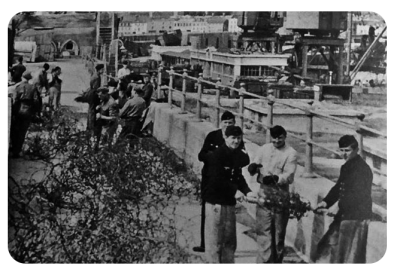 The barbed wire has gone but now the Albert Pier is a dumping ground for all sorts of metal objects which could be put to good use, rather than dumped as sea
- 'Surely Mr Shepherd ignores the fact that, in most cases, mere man has to support a wife and family out of his wages, the woman in business only rarely supports anyone but herself' was his amazingly misogynistic footnote. That paper needs a woman in charge.

- I had to go into town the other day and while waiting for the bus home, I wandered down to the Harbour. I was amazed to see heaps of metal articles on the Albert Pier which are taken out to sea and dumped. It seems incredible. All sorts of useful things, many of them difficult, if not impossible, to obtain, such as wheelbarrows in good order, cooking utensils, stoves, grids, iron rods and beds etc, just thrown away when many people are sorely in need of them. Surely they could be sold, or at least the public informed and allowed to take their pick. I could make good use of one of those wheelbarrows.
Friday 4th

- There are some strange people about, and the sooner they are caught and dealt wih, the better. For the second time in a few days, premises have been broken into in St Helier and left burning. A few nights ago a newsagent’s shop in Seaton Place was found to be afire after a burglary, and last night West Park Pavilion was similarly treated. This morning, when Mr Hedouin, who is in charge of the rehabilitation work being carried out at the Pav, arrived, he smelled smoke and, on opening the door of one of the private offices, was greeted with a cloud of smoke issuing from the room. A few buckets of water dealt with the outbreak, but a hole was burned in the floor, and a wicker chair, settee and a desk were partially burned. An empty whisky bottle and a bottle partly filled with orangeade were found in the room. Apparently there had been a party after the yobs broke a window to get in. Mr Hedouin says there have been several instances lately of people breaking into premises in this way and as fast as the windows are replaced they are broken again. Police enquiries are proceeding into these happenings. It's about time they proceeded a bit faster. I suppose I shoudn't say this, but these things didn't happen when the Jerries were here.
- Apparently we are going to get pally with the Donkeys. As they helped to bring the islands back to some degree of normality after arriving in May, the Liberating forces have been finding it difficult to understand why they should have separate discussions with Guernsey and Jersey about the same things. So they set up a unified Civil Affairs Unit, and had conferences in one island or the other with officials of both States bodies. Bailiff Sir Alexander likes this. He told our States this week that there has been a level of inter-insular co-operation unknown in his 23 years in public life, and he wants it to continue when the British leave us to get on with our own affairs. Why it's all been kept such a secret is beyond me, but apparently there was a meeting in Jersey in September, involving our Governor, Bailiff, Attorney-General and senior Jurat, and their Guernsey counterparts, and they all trooped off to the sister isle at the beginning of last month for the return leg. I wonder how much enthusiasm there really is for all of this. In one breath the Bailiff told the States that they want to meet once a month, if possible. In the next he announced that the next meeting will be on 14 July. That's a long month to wait.
Saturday 5th
- I recall writing in this journal some months ago about the perils we would face on our roads once cars came out again and motorists were free to drive where they wish. Many have not sat behind the wheel of a car for well over five years and their driving skills are at best rusty. But the States don't seem to want to help by at least making it clear who has the right of way at major junctions. The Mulcaster Street tragedy of Christmas Day is typical of what may happen at any time in the Island to the most careful of drivers, as long as the existing traffic regulations take little account of major and minor roads.

- Can this really be the only place where there is no indication which driver has priority where? And what defence is it to say: ‘I blew my horn; he was going too fast to stop’? Surely it is time we took advantage of the lessons that England has learnt from years of terrible road casualties, and put the entire blame for a collision on the driver emerging on to a major road. A white line is warning enough, and cheap to paint, but it is necessary for all the police of the Island to co-operate by understanding the position and listening to no excuses from the driver in question. A white line with a meaning, across Broad Street or Mulcaster Street, would have saved a life this Christmas.

- Whilst the great majority were thoroughly enjoying themselves during this first Liberation Christmas, there were numerous folk whose duties kept them at work. As we took advantage of the opportunity to exchange festive greetings by telephone for the first time in six years, did we stop to think about the staff looking after the switchboards and connecting subscribers? In spite of the appeals made to keep down calls as much as possible, the central exchange was kept very busy, and Doris' sister Edith, who is working some shifts at the Western exchange because she can't get enough produce to make it worthwhile keeping her shop open every day, tells us that from Saturday 22nd to Boxing Day, 44,290 local calls were dealt with (not all by her, presumably). Over the same period trunk calls numbered 680 outgoing and 733 incoming. We all owe a debt of gratitude to Edith and her colleagues who, holidays or not, keep the service going.
- Francis Joseph Huchet, a distant cousin of ours, was in Court yesterday charged with stealing £7 in banknotes from his employer, Mr Acourt. The Attorney-General said that the accused was rather unlucky in his parents; he was perhaps most unlucky as regards his mother, who had been charged some time ago with larceny in company with her son, the latter being placed on probation on 24 May last year. He hesitated to move for imprisonment, and as to Borstal he did not think that could enter into the question. There remained corporal punishment; it was old-fashioned perhaps but he felt it might have the desired effect. In consequence he moved that Huchet be sent to prison to receive 15 strokes of the birch, under the supervision of the prison doctor, or such lesser number of strokes as the doctor might deem necessary. We don't have much to do with this branch of our family, but by all acounts the boy is a nasty piece of work. I don't think we've heard the last of him.
Monday 7th

- Are we going to be able to afford a holiday to France this year? We'd so love to go to visit Michel and Sylvie in Normandy and we have been making inquiries about what travel documents will be needed. Apparently we will have to have our passports stamped with a Jersey exit permit from the Aliens Office, plus a visa from the French Consul to let us in at the other end. There is going to be a direct steamer service to Granville. We still have some francs left from before the war, although heaven knows what they are worth now. French people coming here will be allowed to bring £10 worth of francs and they will have to be exchanged through the States Treasurer – no bureau de change yet.
- The Donkeys are having trouble with their airfield. It keeps getting waterlogged. They are blaming the Germans, of course. They can't afford a concrete runway, but are talking about extending the existing landing strip to cope with the 36-seater planes which are going to be operated between Jersey and the mainland, and Guernsey as well, if they can get down safely.
Tuesday 8th

- Visitors will be back from March – at least the Tourism people hope so. And so do the hoteliers who have been working so hard to undo all the damage done by the Jerries to their properties. Will the holidaymakers be doing their morning exercises on the beach as they were back in 1939?
- But do the figures add up? Apparently 6,000 beds will be ready in March. Just filling those for a six-month season will require 78,000 grockles staying for a fortnight. Where are they all going to come from, and how are they going to get here; more's the point? Tourism admit that 'transport will be a difficulty' but they are going to talk to railway officials in London to get more boats put on. The 6,000 beds are spread between 41 hotels of various sizes and 61 smaller boarding houses. Good luck to all of them.
- ‘Jersey, occupied by the Germans in 1940, liberated by British Forces in 1945, is ready in 1946 for occupation again by visitors from the freedom-loving peoples of the world,’ is the legend on the front cover of a new booklet giving all the latest information about the Island as a holiday resort, which is being sent by the States’ Tourism Committee to all those who apply for information. And letters seeking information are flooding in, according to an EP reporter who informs us that Tourism are getting 'shoals of letters – as many as 50 a day'.
- Yesterday afternoon a congregation of over 300 attended a thanksgiving service held at the Town Church for the safe return home of members of the Amalgamated Channel Islands Society. The service was conducted by the Dean, assisted by the Curate, the Rev H J Le Page with Mr A P Hotton at the organ. A collection was taken for the Channel Islands Welfare Fund.

- Doris spoke to Aunt Getrude out east this morning. She had been for a walk along the coast and told Doris that the work to lift the old German railway lines along the East Coast route is steadily continuing. Yesterday men were removing the rails on the main road at the old Fauvic Station crossing, and while this was in progress, traffic had to proceed cautiously over the two ‘gulleys’ caused by the removal, it was not long before the men had filled these in. I know our own railways did not do very well at the end of their days, but I just wonder if one day we are going to regret not having another try.
- There was a lovely letter in the paper last night from a young soldier who was here with the liberating troops and seems to have really enjoyed his time with us. Now he is back in the UK and, by all accounts, leading quite a lonely life. He is looking for penfriends to correspond with him. I would have thought there would be no lack of takers. Perhaps Lizzie will give it a try. I can't see Helier sitting down to write a letter.
- I think we can look forward to book after book chronicling the years of Occupation. We already have Leslie Sinel's diary – and pretty dull reading it is. Just a day-by-day account of what made the headlines in the paper, and some things which didn't. Now the Bailiff's secretary, who was even better placed to know what was going on in the corridors of power, has published Jersey Under the Swastika. I had a look at it while in town the other day and decided that I had better things to spend five shillings on. If Mr Sinel's diary is dull, I don't know how to describe Mr Mollet's. It's just a factual account of what the States and the Germans got up to in governing the island. It's supposed to be based on a diary Mr Mollet kept illegally, as did so many ordinary mortals, but it reads more like the official record of the States of Jersey 1940-1945, including Proclamations and Orders in full, often in two languages.

- The EP has been gushing in its praise for the book 'that every Jerseyman will want on his shelves and should sent to friends abroad interested in the story of Jersey under the rule of the Hun'. I somehow don't think so. If it had drawn on some of the things he must must have been aware about outside the formal processes of government, it might have been more interesting. What happened to his diary?

- The Yanks are after our cattle again. Well, at least the Canadians are. I was introduced to John Bull (good name for a cattle dealer) while walking past the farm down the road. He comes from Ontario and was well known over here before the war as one of the biggest buyers of Jersey cattle. He was being taken round by Jack Perree to see what might be on offer.