Hougue Bie
La Hougue Bie

The chapel interior
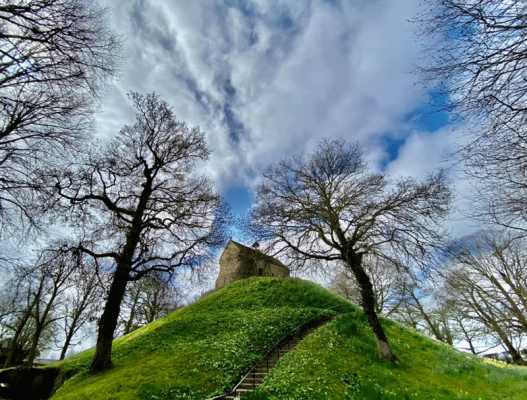
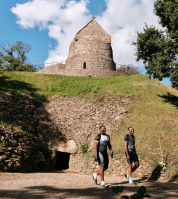
La Hougue Bie, on the border of the parishes of Grouville and St Saviour is a Neolithic passage tomb, one of the largest and best preserved in Europe


Passage Tombs
The term "passage tomb" is somewhat misleading: the main function of the site is as a place of ritual worship. It is notable that the orientation of the tomb is such that at sunrise on the vernal and autumnal equinox, the sun's rays shine onto the back of the tomb. It is estimated that construction began around 3500BC. The mound was raised over the site to a height of about 12 metres between 2,900 and 2,500BC.
The Legend of the Dragon
For over two millennia the site lay unused, and a legend grew up that underneath the mound there resided a dragon.
The best known version of the dragon legend concerns the Seigneur of Hambye in Normandy, who came to slay the dragon that was threatening Jersey. He did so, but was then murdered by his squire, who returned to Hambye seeking glory for himself as slayer of the dragon and claiming that his lord's dying wish was that his wife should take the squire into her bed. This she did, but in his sleep the squire confessed to the truth; his crime revealed, he was duly executed. Lady Hambye then ordered that a large mound be built upon high ground as a memorial to her murdered husband, and the body interred therein. The mound was named La Hougue Hambye of which Hougue derives from the Old Norse Haugr meaning eminence or mound. The author of the Chroniques de Jersey also adds that she built a stone chapel in his memory.
The Chapels
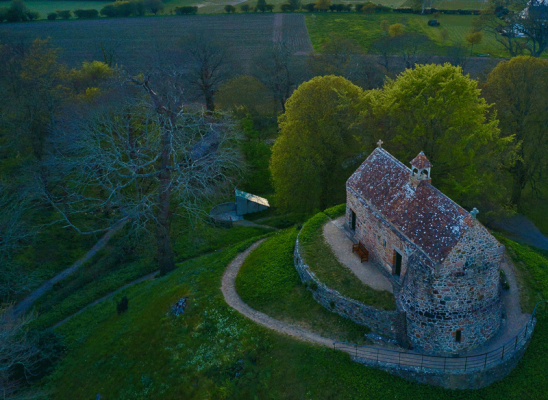
The original chapel - Notre-Dame de la Clarté (Our Lady of the Dawn) dates from the 12th Century.
In the early 16th Century, Richard Mabon, then Dean of Jersey, made a pilgrimage to Jerusalem. On his return he was inspired to construct a second chapel - the Jerusalem chapel, completed in 1520 - and on the eastern end he constructed a replica of the tomb of Christ in the Church of the Holy Sepulchre in Jerusalem. It is thought that he brought back relics from his pilgrimage to encourage donations that would cover the costs of construction.
A convenient lookout
The top of the mound has a fine view over the east of Jersey and to the French coast. It was this that attracted Philip D'Auvergne to the site during the Napoleonic Wars.
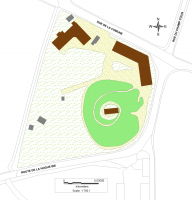
Much later, in 1940, the occupying German forces also discovered the benefit of the view from the top of the mound. La Hougue Bie became the headquarters of Abschnitt Ost (Sector East) of the defensive positions. A wooden tower was erected over the chapels, and a small bunker dug in the vicinity of the mound. The manning was provided by 3rd Battalion, 582 Infantry Regiment.
Tourism
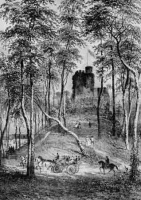
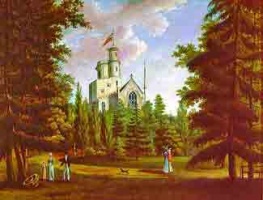
After the death of Philippe d'Auvergne, the mound was abandoned. However, the Victorian mania for ruins meant that the place became a popular place to visit. To take advantage of this a hotel - the Prince's Tower Hotel - was built next to the mound, and guided walks around the mound were provided.
Times changed, and the hotel business folded in the early years of the 20th century. In 1914 the States of Jersey were offered the site, and turned it down: it was eventually bought for £750 by La Société Jersiaise in 1919. The Societe very controversially removed d'Auvergne's tower from the top of the chapels and sponsored the archeological dig on the site. When it became clear that they had a major monument they opened the site as a tourist attraction, employing a resident gardien. The present building to the right of the entrance was the gardien's house and replaced the Prince's Tower Hotel.
Jersey Heritage
Brief history from Jersey Heritage website
Excavation
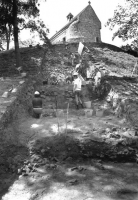
La Société Jersiaise excavated the mound at La Hougue Bie during September 1924 and discovered the passage grave beneath.
Dr Arthur Mourant was said to have ridden around the area on his bicycle announcing the find, calling out ‘the allée couverte has been found’! He and the other Société members were the first people to step into the passage grave since it was sealed over 5000 years ago.
La Hougue Bie dates from 4000-3500 BCE, when people in Jersey began to settle and farm and establish stone monuments as ritual and ceremonial places.
The Neolithic monument has a circular earth mound 12.2 metres high and 58 metres wide, making it a dominant feature of the landscape. The 1924 excavation revealed an 18m long passage grave with three smaller side chambers, one of the largest passage graves in Western Europe.
In the 1990s a team of archaeologists excavated the main entrance and forecourt area with its impressive dry-stone walls.
Equinox
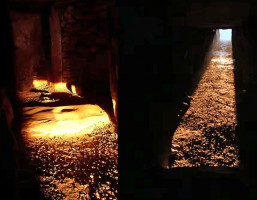
The chamber of the passage grave was probably a sacred place; both rituals and ceremonies may have taken place here. The structure aligns with the rising sun at the spring and autumn equinoxes – sunlight reaches the end of the passage grave if the weather is clear. This gives the stone at the far end a beautiful glow which may have had special meaning for the Neolithic people using the site.
Finds
Objects found during excavations at La Hougue Bie give insight into the lives of the Neolithic people who built and used the site.
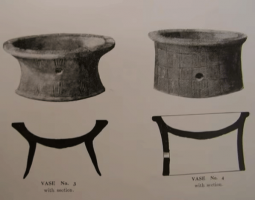
- Pottery: The remains of 19 pottery vessels, known as vase-supports, were excavated from the centre of the chamber. Some of these had decorative lines on them. It appears that the vessels were deliberately broken, perhaps as part of a ritual. The saucers show signs of burning, so they were used as lamps or for the ritual burning of offerings.
- Human bone: A small amount of human bone from at least eight people was found scattered on the floor close to the side chambers. Of the eight people found, two were definitely female and four were definitely male. The evidence suggests that their bodies were exposed to the elements to decay or had previously been buried elsewhere.
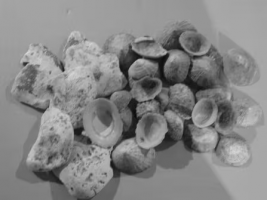
- Shell: Limpet shells were found on top of some of the capstones, placed there during the construction of the mound. The practice of putting limpet shells with human bodies seems to have been a uniquely Channel Islands custom.
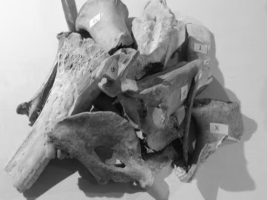
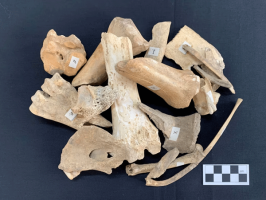
- Animal bone: Cattle, sheep, pig and bird bones were found scattered on the floor of the chamber. They may have been food offerings. The burial of cattle suggests people had a close relationship with their herds.
- Personal ornament: Two beads were found. In some societies personal possessions are buried with the owner.
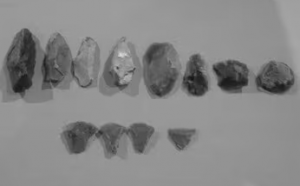
- Tools: A number of flint tools were discovered including four transverse arrowheads.
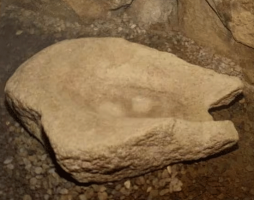
- Quern: A large broken quern was found buried beneath the slab at the entrance to the end cell. It might have had symbolic significance, possibly buried with seed and associated with ideas of renewal.
- Cist:
A small rectangular sunken box or ‘cist’, originally covered by three stone slabs, contained fragments of pottery and pebbles.
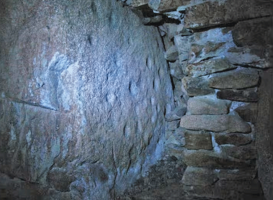
- Cup marks: Two stones of the side chamber are decorated with carved cup marks. Archaeologists don’t know why they were there or if they had any symbolic meaning.
The site still belongs to La Société Jersiaise, but management of it passed to the Jersey Heritage Trust in the 1980s. A conservation statement commissioned by Jersey Heritage was published in 2014.

- Timeline, the story of La Hougue Bie from 1213
- La Hougue Bie, a further article
- Prince's Tower, a Jersey Heritage article
-
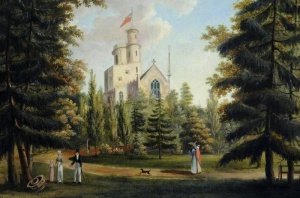 Prince's Tower
 -
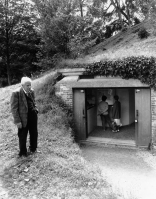
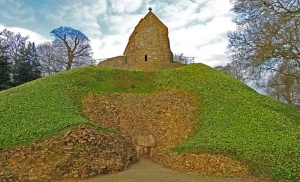 The entrance to the tomb
 -
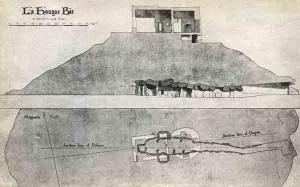 Drawings of a side section and plan of La Hougue Bie
 -
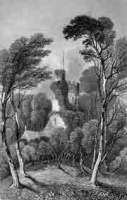 Prince's Tower in 1840
 -
 Prince's Tower painted by Ouless in 1855
 -
-
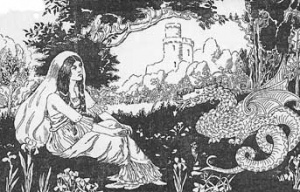 The legend of the dragon
 -
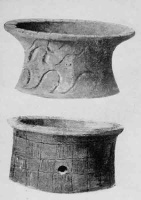 Ritual vessels found in the burial chamber
 -
-
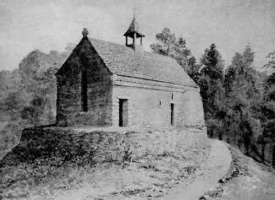 The chapels restored in 1925
 -
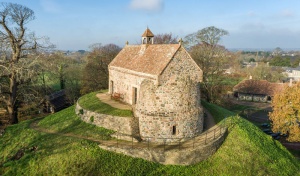 The chapel
 -
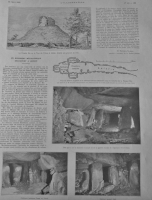 A 1925 article about the discovery of the neolithic tomb from the French magazine L'Illustration
 -
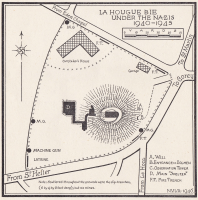 1946 plan drawn by Norman Rybot of German installation constructed during the Occupation
 -
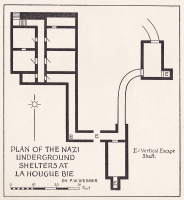 Occupation plan
 -
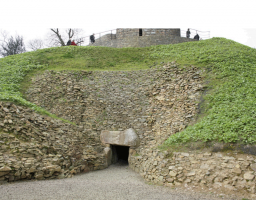 2012
2012 -
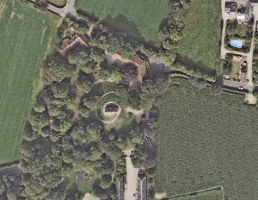 2012
2012 -
 2012
2012 -
-
-
-
-
-
-
-
-
-
-


Museum opening
The opening of the agricultural museum in 1956


-
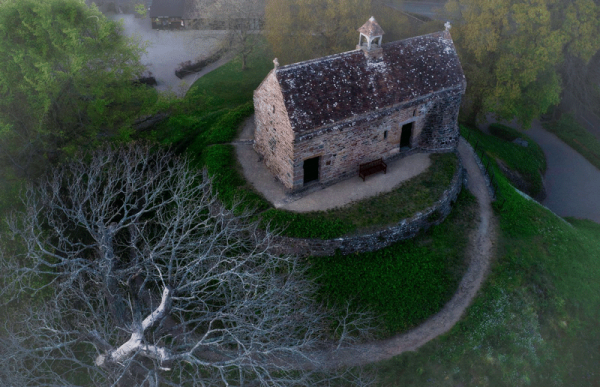 Two views of the chapel in 2021 and 2023 from Paul Lakeman's drone ...
 -
-
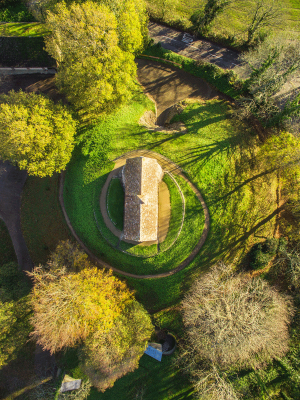 ... and two by professional drone photographer Chris Brookes
 -