Memories of Jersey's worst air crash

Memories of Jersey's
worst air crash

The scene on the night of the crash
Jersey's worst air crash was in April 1965, when a Dakota approaching the Airport in thick fog struck a landing light pole. Of the 27 passengers and crew on board, 26 died. On the 50th anniversary of the disaster in 2015, the Jersey Evening Post published this article based on the memory of Bernard Syvret, who was first on the scene with his wife Peggy.
On 14 April 1965 Islander Bernard 'Bunny' Syvret witnessed the horror of Jersey's worst air crash, when a passenger plane nose-dived into a field in St Peter.
It was a foggy evening 50 years ago, shortly after 6 pm, when flight 1030X from Paris Orly came in too low on its second approach and struck a landing light pole at Oak Walk, at the top of Mont Fallu. The British United (CI) Airways twin-engine Dakota C-47 lost its right wing, turned on its back and nose-dived into a field, killing 26 of the 27 people on board.
Airport worker
Mr Syvret (36 at the time), who had served in the RAF and was working at Jersey Airport, lived beneath the approach flight path and regularly watched planes coming in to land.
His wife, Peggy, dashed to the scene – 100 yards from their house on Rue de la Hague – after hearing the accident and rescued the sole survivor of the tragedy, a 22-year-old French air hostess named Dominique Sillière. Mr Syvret remembers the incident vividly.
'I was working at the Airport when the air crash happened,' he said. 'But I was off sick at the time with bronchitis.
'We lived right next door to where the crash was. If the pilot had turned the wrong way on the night I would have had it.
'Every day I would go outside and have a look up to see whether aircraft would be able to get in or not.
'This particular day there was thick fog.

Heard aircraft
'I think I had the window open and I heard the noise of an aircraft coming in, so I went outside.
'I looked up at the plane and I thought there's no chance he's going to get in in this weather.'
The aircraft flew back up, unable to make a safe landing, but the pilot, Guernseyman Captain Peter Self, steered the plane back round for a second approach.
'I went back in the lounge and I heard the noise of the plane coming again,' said Mr Syvret. 'So I went outside and heard a crack, and I saw him pulling away from me. I thought what happened there? I thought – pull back! Pull back! Then he turned a sharp right and I saw the wing come off. He turned over and nose-dived into the field – I saw the whole thing happen.'
Both Mr Syvret and his wife acted quickly to help the crash victims.
'My first thought was the fire service,' he said. 'I passed the wife, who was in the lounge. She had been upstairs when she heard the crash.
'She had seen the aircraft in the field and she shot past me outside.
'I went next door to try to use the phone line in my mother's place but the overhead phone lines were down.
'When I came back, I asked the kids where their mother was and they said she had gone out.
'She must have just shot out and jumped over the hedge to rush out and help the people in the crash.'
Helping emergency services
Mr Syvret then took action himself to assist the emergency services and potential survivors and headed outside towards the crash site.
'As I walked out there was a Jaguar parked in the middle of the road. Nobody could get past so it had to be moved.
'I had never driven a Jaguar before but I jumped in, started it up and reversed it into my drive. Whether it scratched or not was tough luck.
'I went down the road and one fire engine came up and I told him where to go. There were police cars coming from all directions.
'I carried on like that and was standing around directing the traffic for a while, before someone came up to me – I think it might have been a Centenier – and he said to me: "Thanks, mate. You've done well."'
But there was another shock in store for Mr Syvret when he returned home to find his wife missing.
'I went back home and asked the kids where their mother was. The kids said they hadn't seen her and she hadn't come back and I thought where's she gone?
'Two to three hours later she turned up and told me she had been to the Hospital. She burst into tears and I asked what had happened to her.
'She told me: "Nothing's happened to me – it's what I've just done. I dragged the hostess away from the aircraft – she was stuck and it was on fire."'
'I couldn't believe it and I told her she was crazy. What was she doing going towards an aircraft on fire?'

To hospital
Mrs Syvret had rescued the French air hostess, who had two broken legs, and had pulled her across the recently ploughed field to safety from the burning wreckage. She had then accompanied her in the ambulance to the Hospital.
She was assisted by a woman called Joan Egré, whose father owned the field. Miss Egré went back to the crash site to help the other victims, but found it was too late to rescue anyone else. Mrs Syvret, who died last year, received the Humane Society's bronze medal for her actions but the trauma of the night took its toll on her.
'I felt awful at the time of the air crash,' said Mr Syvret, a great-grandfather who lives in St Peter's Village. 'It took me a little while to get over it, but it took the wife a long time to get over it.
'She had to have treatment because she couldn't sleep. She used to say to me: "Was there anyone else I could have got out? Could I have saved more people?"
'I would tell her that there wasn't any more she could have done, but she couldn't get it out of her head. She was sick for a long time.'
Eventually a course of treatment helped Mrs Syvret back to better health and the horrors of that night weren't enough to stop the couple travelling by air.
'Just over a year after, in the summertime, I said we were going to go on holiday to see our friends in Plymouth,' said Mr Syvret. 'And we were going to be flying. She said no at first, but in the end we did it and after that day she was never worried about flying again.'
Of the 26 people killed in the crash three were crew. Four people from Jersey lost their lives, as well as five from Guernsey.
Investigation
A Ministry of Aviation investigation was launched into the crash and a report was published in 1966.
The report concluded that 'the aircraft struck the approach lighting when it was flown below the safe approach path during an approach to land in conditions of low cloud and poor visibility'.
The report also outlined that weather information given during the flight from Paris Orly to Jersey stated that there was visibility of 100 metres at Jersey Airport. Precipitation was described as 'very consistently bad' and the cloud 'really thick'.
Visibility was also reported to be 100 metres in Guernsey but the aircrew were advised that conditions at Dinard and St Brieuc airports in France were 'fine', with two kilometres and one kilometre of visibility at each respectively.
A weather report in Jersey eight minutes after the accident said that fog had reduced visibility to 70 metres.
Crew
The aircraft's crew on the fatal night were:
- Captain Peter Charles Edward Self, who was a 31-year-old Guernseyman and occupied the pilot's seat at the time of the crash.
- First officer Mr James Edward Lockhart-Mure, who was 27 years old and was believed to be standing in the flight deck at the time of the accident.
- Second officer Howard Christopher Clark Greenway, who was 24 years old and occupied the co-pilot's seat.
- Miss Dominique Sillière, a 22-year-old air hostess and the sole survivor of the crash. She had been working for British United (CI) Airlines for one month, after a year working for Air France. Miss Sillière visited Jersey Airport again four months after the crash and received a hero's welcome. She was greeted by Peggy Syvret, who presented her with a bouquet of flowers.
-
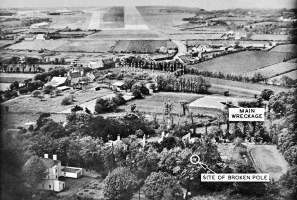 The aircraft crashed a short distance from the Airport runway
 -
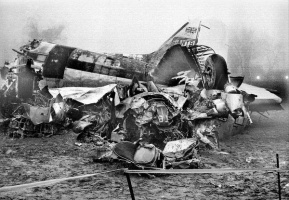 The scene on the following day
 -
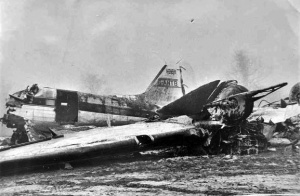 The plane nosedived after losing a wing