No 2 Queen Street

Historic Jersey buildings

If you own this property, have ancestors who lived here, or can provide any further information and photographs, please contact us through editorial@jerripedia.org |

Property name
2-6 Queen Street
Location
Queen Street, St Helier
Type of property
Large Victorian shop with residential accommodation above
Valuations
No recent transactions
Families and businesses associated with the property
No 2
For many years 2 Queen Street has been a jeweller's, but the earliest references we have found, in 1833-34, show it occupied by rope maker J Balcam, who also ran a tobacconist's, and milliners P Hillman and M Millikin.
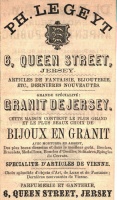
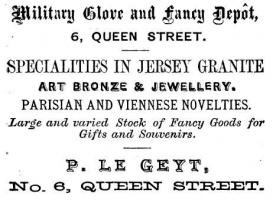
Philip Le Geyt established a jewellery and fancy goods shop in the 1870s. He first traded at No 6, then spread down to the corner. Later he was in partnership with his son-in-law, John Fouracre Cutler, who was born in Australia and married Clarissa Mary Le Geyt, daughter of Philip and Mary Jane, nee Bishop in St Helier in 1892. [1]
The 1851 census shows that hats were still to the fore, with English hatter Nicholas Brown (1807- ) in business there. He was living with his wife Susan, nee Renouf, (1817- ), probably the daughter of Philip and Elizabeth Carrel, and their children Nicholas, John, Susan and Philip jnr. Also at the same address was Napoleon Bienaime Goupillot, a watch maker born in France in 1909, married to Marie Anne, nee Jasper from Guernsey, and with three sons and a daughter. Mr Goupillot, a prominent jeweller and silversmith in Jersey in the 19th century is variously shown as Napoleon and Bienaime in different records. The Le Goupillots are not mentioned in the 1861 census, but they reappear in 1871, with son Eneas (1845- ) working for his father.
In 1861 grocer Jean de Veulle (1802- ) was listed at No 2, together with his wife Betsey, nee Marett (1808- ). An 1874 street directory shows tailor P Benest and watchmaker E Le Goupillot, presumably Eneas, trading at No 2, with just Eneas there in an 1880 almanac. Nobody was resident at the property at the time of the 1881 census, and by 1890 and '96 P Le Geyt was shown as running a fancy repository at 2, 4 and 6 Queen Street, one of the largest undertakings on this side of the street at any time in the last 200 years.
A 1900 listing shows jeweller J Cutler at No 2. This would suggest that he had taken over from Philip Le Geyt. Photographs of the premises from the late 19th century show both their names over the shopfront at the same time, and what we previously took to be an earlier picture showing just Mr Cutler's name, would now appear to be from a later date, suggesting that he had taken over sole ownership of the business. He was still listed as the trader in 1905, 1910 and 1920 almanacs, to be followed in 1930 by Goldsmiths Alliance, and then H A Assinder, renowned jewellers at the corner property until late in the 20th century.
No 4
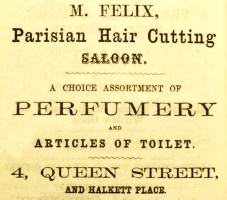
This property does not appear in any of the 1830s commercial directories. The 1851 census gives the occupants as dentist Robert Feltham, born in England in 1817, his wife Maria, formerly Wright (1812- ), and her three daughters from a previous marriage. The property is vacant in the next two censuses, and by 1874 it is occupied by tobacconist J J Shave. He was trading there until about 1886, when the property was absorbed into the Le Geyt fancy repository.
An 1862 advertisement indicates that George Bowring was trading in watches and jewellery here, up to 11 October that year. The business was then closed and taken over, with the stock, by the owner's brother-in-law John Genge, who was in business in Hue Street. This was presumably because of George Bowring being ill; he died in 1864 at the age of 38. He was married to John Genge's sister Mary (1825- ) and they had three children aged from four to eight when he died.
No 6
In 1833 these premises were the Blue Pigeon Tavern, run by a Mr Falle. This was followed by Clement Sullivan's (1818- ) pharmacy. He lived there in 1851 with his wife Jane (1825- ) and their son Clement.
There was another complete change by 1861, when the census shows No 6 occupied by French hairdresser Alexander Muller (1826- ), his wife Marie, born in St Helier in 1833, and their children Leontine, Elisa Albertine, Clemence and Auguste.
By 1871 jeweller Philip Le Geyt (1845- ), the only son of George (1794- ) and Elizabeth Howard, had taken over and lived there with his wife Mary Jane, nee Bishop (1848- ), daughter of William Henry and Elizabeth Ford and two-year-old daughter Clarissa Mary. The couple would have three further children, Philip George, Violet Ernestine and Winifred Marian. As shown above, Philip eventually occupied 2-6 Queen Street where he ran what was variously described as a jewellers or fancy repository. Philip was the grandson of Philip Le Geyt and Elizabeth Le Riolet dit l;Hermite, who married in Trinity in 1780.
Historic Environment Record entry
Listed building
Late Victorian shop. Striking and original landmark shop premises at a key focal point in the heart of the historic town centre. Unusual Ruskinian Gothic/Italianate detailing including highly elaborate decorative stonework and tiling.
The site has known retail uses since circa 1830, and is believed to have developed in its present form circa 1870. Three storeys plus attic, four bays on Queen Street frontage, two further bays round corner in Halkett Place. Fishscale slate roof.
The interior first, second and third floors are relatively complete, albeit with many original fixtures and fittings currently covered.
-
-
-
 1881
1881


Notes and references
- ↑ John Cutler was described as a bank clerk up to the 1911 Census. He and Clarissa appear to have lived in England for some time - their only child, Stuart Le Geyt Cutler, was born in Gloucester in 1893. He died in Belgium, killed in action in 1917. He was a lieutenant, acting Captain, in the Royal Flying Corps.
Philip Le Geyt was described as 'retired Jeweller' in the 1901 census. In the 1881 census the family were at 6 Queen Street and he and his wife lived at Khartoum, St Saviour from 1891. In 1901 Clarissa and her son were living at Beach Road, St Helier, Clarissa was described as a jeweller. Her husband had enlisted in the Army in 1900 and was a captain in Shropshire Light Infantry (53rd div).
By 1911 the Cutlers were living at 2 Queen Street; John was described as a jeweller (dealer) and Clarissa had no occupation.
Philip Le Geyt died in 1921, leaving Clarissa Nos 2, 4 and 6 Queen Street; Bernica, 4 Beach Road, St Saviour, and Belize, 5 Beach Road. His three other children also received multiple properties in his will.
He had bought 2 Queen Street from Mary Ann Jasper, separated wife of Napoleon Bienamie Le Goupillet, on 10 Mar 1881; 4 Queen Street from Attorney Michael Joseph Horgan and his wife. Mary, nee Bowring, on 2 April 1881; No 6 from Sarah Jewell, separated wife of Selig Samuel Simon, on 25 Nov 1865. He also owned 31 Queen Street.
John Cutler died in 1933, in Hendon, Middlesex. Clarissa died in 1955 at Cintra, Beach Road, leaving almost all her estate to Animal Rescue