No 43 King Street

43 King Street

No 43, on the corner of New Cut, is on the right in this early 20th century photograph by Albert Smith. It was then occupied by Le Poidevin's
This property makes the corner of King Street and New Cut and has had a variety of occupants, ranging from baker and confectioner to tobacconist, draper, tobacconist and jeweller.
The building
Nos 41 and 43 are shown as one property in the Historic Environment Record. It has been thought that No 43 was cut back when Coin es Anes was widened from a narrow passage to what is now New Cut, connecting King Street with Broad Street, but the fact that separate businesses traded at the two addresses until Rivoli Jewellers occupied both from 1970 conflicts with this idea. The New Cut frontage of the building aligns with that of the bank building on the corner of Broad Street and Library Place, as it did historically. Exactly how 41-43 was divided into two properties with separate businesses prior to 1970 is unclear.
HER: This prominent Victorian corner building retains historic character and features, and contributes to the streetscape character. Built circa 1870s. Coin es Anes appears on maps from 1700 onwards as a small yard off Broad Street. It appears to have been widened and knocked through to link with New Street in the early 1870s. It is shown in its present form on a map of 1875. Corner building. One bay to north, corner bay, two bays to west. Hipped, slate roof, two rendered chimneys. First floor corner opening houses unusual, mechanical, musical clock. Shop front has dentilled cornice over fascia, five bays of 2 paned windows. Corner recessed entrance.
Occupiers
T Cabot, a baker and confectioner, is the first known occupant, shown in an 1833 trade directory.

No 43 must have been a busy premises in 1851, when the census suggests that two businesses operated there – a pharmacy and a tobacconist. The pharmacy was run by James Christie, from Aberdeen, who lived at No 43 with his Jersey-born wife Mary Poingdestre, sons James, John and Matthew and daughters Mary and Eliza. By 1861 James is widowed and retired, and living in St Saviour’s Road with Mary and Eliza.
Tobacconists
The tobacconist’s shop at No 43 was a real family affair. Robert Gates (52) was assisted by his 28-year-old son George, and Thomas (18), while Hannah (20) helped her mother Mary with household duties. Mary (14) and Eliza (11) were still at school. The two younger girls were born in Jersey but the rest of the family had come from England. This family had also left No 43 by 1861 and the tobacconist business was being run by Mary Ann Belford.
Also living in a separate household at No 43 in 1851 were retired baker Thomas Cabot, his wife Susan and their daughter Elise.
Mary Ann Belford was born in St Helier in 1821, one of 15 children of John (Jean) Belford and Francoise Vardon. They were married in Grouville in 1802 and John died at the age of 59 in 1832. Mary Ann had an illegitimate son Frederick Edwin in 1844, but he was not living with her at No 43 in 1861, when her birthplace was wrongly shown in the census as England. She had two servants, John Pinel and Eliza Carrell.
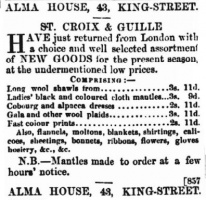
There was a gap between the two tobacconist businesses. Advertising shows that in 1857 the premises were known as Alma House and 'St Croix and Guille' were trading in ladies' clothing. This business appears to have been short-lived.
Drapers
By 1871 No 43 was home to King Street's most popular business, a drapery, run by woollen draper William Chinnick (1820- ) from Portsmouth, and his wife Maria Love Lamb (1824- ) from Devon, a linen draper. Unusually the census only records initials rather than full names for Maria and the couple's children. Their 16-year-old son is shown as a surgeon dentist, and their 14-year-old daughter Eugenia Elizabeth Lloyd is a scholar. Their other daughter Maria Love was born in 1850 and had presumably left home by this time.
The Chinnicks were followed by draper Frank Helier Le Rossignol (1839- ), who was at No 43 in 1880. In 1881 he was living on the premises, and assisted in the business by his sisters Esther (1835- ) and Clara Caroline (1849- ). All three were born in St Lawrence.
They were followed by Miss Grigriy, a draper and clothier who was doubtless from the same family who were in business at No 35 King Street, possibly a daughter of Lucy Grigriy, who was in business there until after 1880. She was not there for that long, however, because by the time of the 1881 census the premises were occupied by 79-year-old draper Jane Knight and her 50-year-old daughter Isabelle, a confectioners assistant.
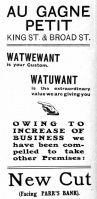
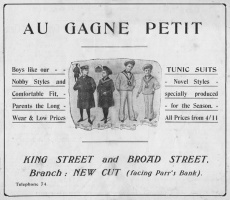
There was another change by 1900, when Le Poidevin Brothers had established their clothing business at No 43, and by 1903 it was trading as Au Gagne Petit. The 1901 census shows the building occupied but with nobody resident.
James (1863- ) came to Jersey from Guernsey. He was the son of Frederick John Le Poidevin (1829-1901) and Elizabeth Stonelake (1830-1914), one of seven of their children. He married Laura Jane de Faye (1863- ), and they had children James de Faye (1896-1956), who continued the business, and Jeanne (1898- )
In 1912 Le Poidevin's moved down the street to No 49 and No 43 was occupied by tobacconist Edward Alfred McKenzie, who was followed by his son with Eva Edith Shave, Howard Montague Shave McKenzie (1890- ), after the Occupation, and then by Mrs R E McKenzie until 1965. Then the property was occupied by Longstreeth and later Rivoli jewellers.
Chronology [1]
- 1833 - T Cabot, baker and confectioner
- 1837 - P Clark, tobacconist
- 1851 - James Christie, chemist; Robert Gates tobacconist
- 1857 - St Croix and Guille, ladies' clothes
- 1859 - Mary Ann Belford, tobacconist
- 1862 - Miller, chemist
- 1871 - William Chinnick, woollen draper
- 1880 - F H Le Rossignol, draper
- 1885, 1890 - Miss Grigry, draper and clothier
- 1891 - Jane Knight, linen draper
- 1900 - Le Poidevin Brothers
- 1903 - Au Gagne Petit (Le Poidevin's)
- 1909-1940 - Edward Alfred McKenzie, tobacconist
- 1945-1955 - Howard Montague Shave McKenzie, tobacconist
- 1960 - Mrs R E McKenzie
- 1965 - Longstreeth
- 1970- - Rivoli jewellers
-
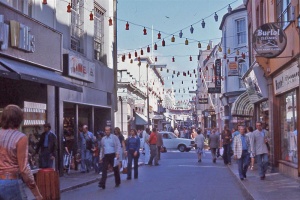 Looking towards the New Street junction. No 43 is the property with a white wall on the opposite right corner of the junction
 -
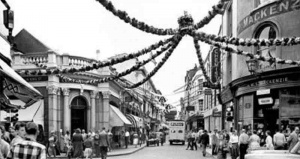 The street was decorated for Elizabeth II's Coronation. No 43 is the property on the right, with signage for the McKenzie family's tobacconist business
 -
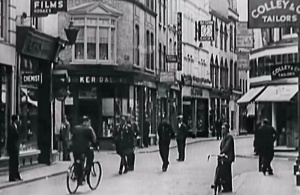 1942: No 43 is on the left
 -
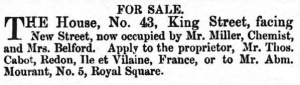 The property was put on sale in 1862
 -
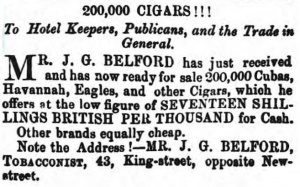 1859
1859 -
-
-
-
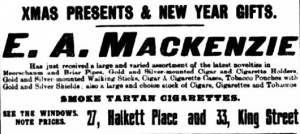 The King Street address in this advert was a typographical error. The 1910 advert appears to show that Edward Mackenzie was in business ten years earlier than previously shown in the chronology ...
 -
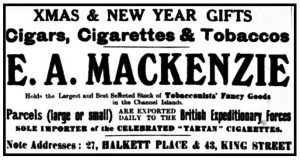 1915 advert
 -
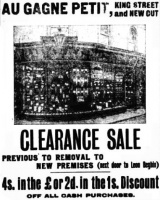 ... but this 1910 advert for Au Gagne Petit appears to show that this business was still closing down the following year
 -
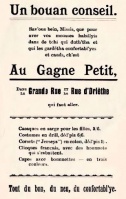 1913
1913


Notes and references
- ↑ Many of the start and end dates given for businesses are approximate. As more business advertisements and other records are discovered the dates will be adjusted