Occupation hiding

Hedwig Bercu and
Dorothea Weber

Solperstein commemorating the Occupation history
This page is based on an article by an unknown author in the history section of the Jersey Heritage website, and another article from an unknown source

Dorothea Le Brocq
Dorothea Le Brocq, born on 14 May 1911, was working as a clerk and living with her mother in St Helier at the time of the German Occupation. In May 1941 she married Anton Weber, an Austrian baker who had arrived in the Island in 1938 – probably fleeing his home country to escape conscription.
Dorothea acquired German nationality as a result of her marriage. She lived alone at 7 West Park Avenue after Anton was forcibly drafted into the German army and left the Island in 1944.
Dorothea took in a Jewish woman called Hedwig Bercu and sheltered her from the German authorities. Born in Vienna on 23 June 1919, Hedwig Bercu arrived in Jersey from Austria, via England, in November 1938. She was 19 – a young refugee from persecution.
As Hedwig arrived in Jersey as a domestic worker, it is unlikely that she was a woman of independent means who could pay Dorothea to shelter her. It is not known whether Hedwig and Dorothea knew each other before Dorothea took Hedwig into her home.
It is possible that after marrying Anton Weber, Dorothea may have been trusted by the German authorities enough to work in the same office as Hedwig and may have known her that way.
Organisation Todt
By 1940 Hedwig had become categorised as a 'registered Jew'. Despite this, she obtained employment in Jersey as an interpreter at the transport department of Organisation Todt, the paramilitary engineering organisation which was responsible for bringing thousands of forced and slave labourers to the Channel Islands to build the Atlantic Wall.
In this job Hedwig had access to petrol coupons, which she secretly took for distribution to Jersey doctors so that they could visit their sick patients. Someone discovered what she was doing and threatened to inform on her, which triggered her decision to go into hiding.
She decided to fake suicide by leaving some clothes with a note on the beach. On 22 and 23 November 1943 a wanted notice for Hedwig was published in the Evening Post.
Hedwig had first been hidden by Bozena Kotyzova, a Czech woman who had been employed as a housemaid and was now living alone in a large house. But shortly afterwards, she moved into Dorothea’s home, a narrow, terraced town.
She remained concealed there for 18 months until the Liberation in May 1945. At 4.30 pm on 14 May 1945, Hedwig reported herself to Jersey’s Aliens Office as having been hiding in secret with Dorothea.
German's help
During her time in hiding she was secretly helped by a German officer, who brought food to the two women. His name was Kurt Rümmele and Hedwig would go on to marry him. After the Liberation she stayed in Jersey for a few more years, working as a nanny for the local family for whom she had worked prior to the Occupation.
It seems that Dorothea Weber and Hedwig Bercu then lost touch. Having no contact with her husband Anton, Dorothea made enquiries of the German authorities, who informed her that her husband was dead.
On 23 August 1945, Dorothea Weber married Francis Flanagan, one of the British soldiers who had liberated the Island a few months earlier, and they moved to England. But her first husband lived out the war in a Russian prisoner-of-war camp.
In 1949 Dorothea and Francis were both brought back to the Island to stand trial for bigamy. Dorothea, an unwitting bigamist, was given a six-month suspended sentence. She returned to England after the ignominy of the trial but very little is known about the rest of her life.
She died in May 1993, aged 82, and her ashes were scattered in the memorial gardens of Worthing.
The two women never met again after 18 months of living at such close quarters and in such stressful and dangerous conditions. Dorothea had risked her life to shelter Hedwig. Had she been caught, then it is likely that she would have been sent to a concentration camp.
Tribute
In 1989, Hedwig made an emotional tribute to the woman who had saved her life:
- " She was certainly one of those who risked her life to save and help others who couldn’t help themselves and were in great need. Unfortunately, we lost contact when we left the Island, but we will never forget her and the great risks she took on our behalf. With gratitude we remember her sacrifice, and say thank you, Dorothy, from all our hearts. We survived only through your help and courage."
- "In November 2016, in a moving ceremony at the Occupation Tapestry Gallery, Dorothea Weber, née Le Brocq, was posthumously recognised as 'Righteous Among the Nations' by Yad Vashem, the State of Israel’s National Holocaust Memorial, for having saved the life of Hedwig Bercu.

Hedwig Bercu
Hedy Bercu was born in Vienna in 1919 into a Jewish family. In 1938, as the Nazi regime tightened its grip on Austria, she left her homeland and travelled to Jersey, arriving in November with a passport issued two months earlier, which listed her full name as Hedwig Bercu-Goldenberg. In Jersey, she found work as a cook and settled into domestic service. Like other non-British immigrants, she was required to register with the Office of Immigration under the Aliens Restriction Act. A card was created, noting her arrival, movements, and eventual address at 28 New Street. A microfilm copy of the card, held by Jersey Archive, is one of the few surviving records of her life in Jersey. By July 1940, when German forces occupied the Channel Islands, Hedy Bercu was still living in New Street. In October of that year, she complied with new German regulations requiring Jewish residents to register their identity. Her registration card was stamped with a red ‘J’ – a mark that set her apart and placed her in danger.
In an attempt to distance herself from her Jewish background, she claimed to be the illegitimate daughter of a protestant woman, who later married a Romanian Jew. Her statement was recorded by Chief Aliens Officer Clifford Orange, but her Jewish identity was now an official matter of record.
Despite that, she secured a job working for the German authorities in the transport department, where her knowledge of German made her a useful interpreter. This role gave her access to resources most islanders lacked. According to later testimonies, she used her access to obtain petrol coupons to help doctors to continue their work. But while she helped others, her own position became increasingly perilous.
Accused of smuggling petrol coupons, she made a desperate decision. She faked her own suicide and vanished on 4 November 1943. The German authorities responded quickly and her photograph – taken from her immigration records – appeared in the Evening Post alongside a stern warning: “Anyone concealing Miss Bercu or aiding her in any other manner makes himself liable to punishment.”
The authorities assumed she had escaped to France, as a note to that effect appears on her Registration card in 1944. But they were wrong. She was still in Jersey.
For 18 months she lived in hiding, first sheltered by Bozena Kotyzova, a Czech national, and then by Dorothea Weber, née Le Brocq. Dorothea’s husband, an Austrian baker, had been conscripted into the German army in 1942, leaving her alone in their house at 7 West Park Avenue.
There, Hedy Bercu was concealed for the rest of the war, at enormous risk to all involved. Food was brought by a German soldier, Kurt Rümmele, who was in a relationship with Hedy.
The danger increased in the summer of 1944. A list of 18 escapees, including Hedy, was circulated to the police. She remained hidden and when Liberation came in May 1945, she re-emerged alive and free. On 14 May she reported to the Aliens Office.
Her record was updated to include her hiding address, and in the months that followed she resumed her work in domestic service, first at Green Banks, St Saviour, and then at La Ferrière. She worked for two different families, as a cook and a children’s nurse.
In early 1947 she left Jersey to be near the prisoner-of-war camp in the south of England where Kurt Rümmele was interned after the war. They married in 1949, and Hedy converted to protestantism. The couple had three children before his death in 1956.
-
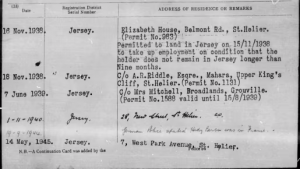 Hedwig Bercu's employment history
 -
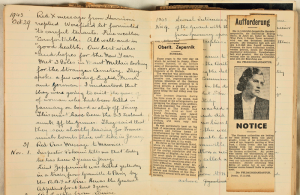 Bailiff's secretary Ralph Mollet's diary
 -
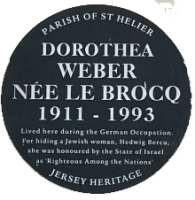
-
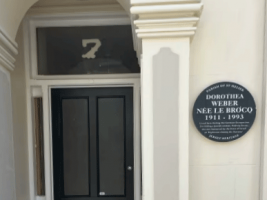 7 West Park Avenue
 -
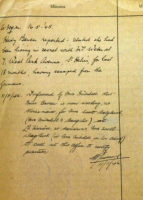 Part of Hedwig's Aliens Department file
 -
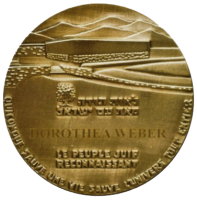 'Righteous among the nations'
 -
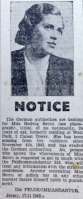 Evening Post notice


- Dorothea Weber and Hedwig Bercu - a further article from the 2019 Annual Bulletin of La Société Jersiaise