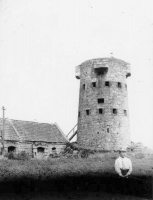
Platte Rocque tower

Platte Rocque Tower

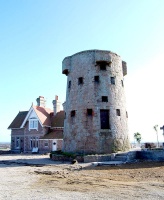
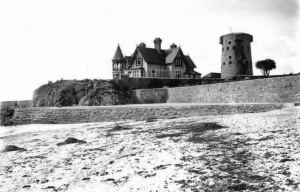
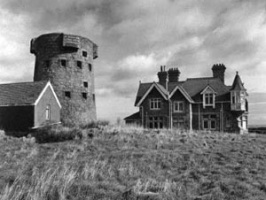
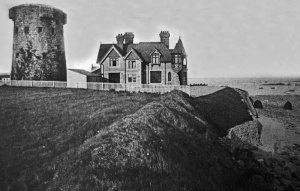
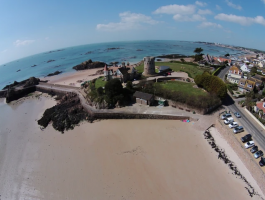
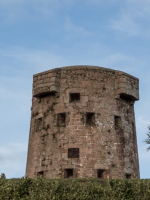
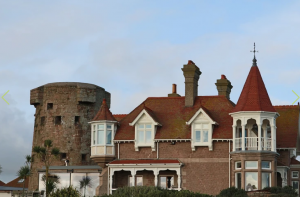
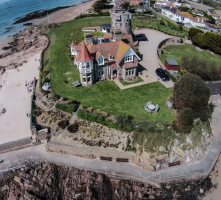
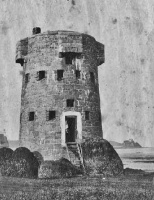
This tower in the south-east corner of the island at La Rocque is sometimes known as Grouville No 0. It was completed after the five towers stretching north beyond it had been numbered Grouville 1-5. The closest tower to the point where the French invaded in January 1781, Platte Rocque was commissioned in the wake of the Battle of Jersey. It is now privately owned. The house which stands next to it on the shoreline is also called Platte Rocque

The tower was built in 1782 and on the tower was the usual 18pdr carronade, with a later traversing platform which was served by a magazine holding up to 20 pounds of gunpowder. There were boulevards to the left and right which were repaired in 1778 and in 1795. These had been overrun by the French in 1781 with the loss of four guns. This tower was re-armed in 1787 with 2 x 12 pdrs plus 2 x 6pdrs on a nearby wooden platform. Between 1814 and 1817 this platform had 2 x 18pdrs and 2 x 12pdrs.
In 1840 the Tower had a garrison of one sergeant and twelve men, as well as a magazine for twenty barrels of powder. A report of 1840 states that it had an 18pdr Carronade mounted on a wooden traversing platform installed on the roof.
On 19 June 1944, after the Germans opened fire on over flying aircraft with their tower roof mounted twin mounted MG 34 flak guns, a single American Lockheed Lightning Bomber attacked the tower dropping two 560lb bombs which missed the tower, one landing in Robin Bay and the other in the road causing considerable damage to nearby housing.
There was a second bombing by an American bomber returning from bombing St Malo. The Germans on Platte Rocque Tower fired their anti-aircaft machine gun at it as it passed along the coast and as they had a few bombs left over, they tried to blow up the tower and missed, hitting some hosues behind.
HER entry
Built circa 1780s, the tower is significant as an integral part of a group of surviving Conway towers in Jersey that not only illustrates the changing political and strategic military history of the Island in the late 18th and 19th century, but represents a turning point in the history of defence strategy across Europe, and global trends in the history of war.
The interest of the tower is diminished by the addition of early-mid 20th century buildings and associated alterations.
Conway-pattern tower, circa 1782. Most probably named after the Earl of Albemarle, Governor of Jersey between 1761 and 1772, Conway's predecessor. The Richmond map shows Grouville Bay with five Conway Towers constructed in the southern half of the bay - designated 1-5 from south to north. Put up for disposal to the States of Jersey by the War Department in 1896.
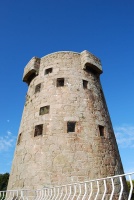
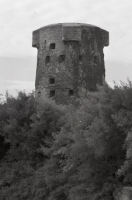
Private dwelling constructed around tower early-mid 20th century. Standard Conway Tower pattern. Round and tapered, built of regular squared and well-tooled blocks of granite. The upper floors are punctuated with musketry loopholes, with dressed granite doorway raised at first floor level. There are four machicolations at parapet level. Roof platform with masonry parapet. The tower has been cement rendered on its seaward face.
-
-
-
-
-
-
-
-
-
-
-
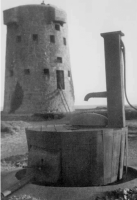 Picture from the German Occupation, when Platte Rocque was a heavily defended resistance post
 -
-