Portelet tower

Portelet Tower

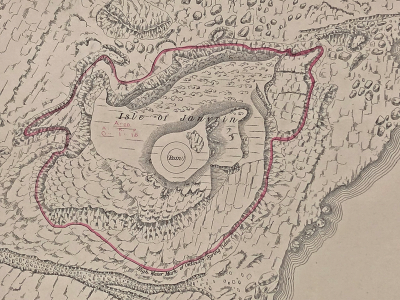
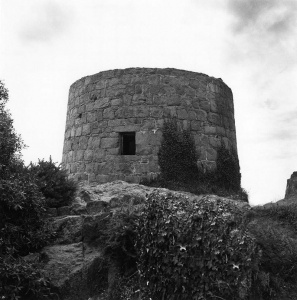
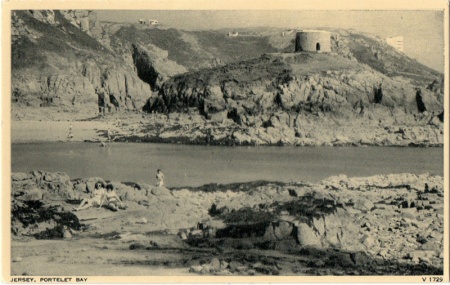
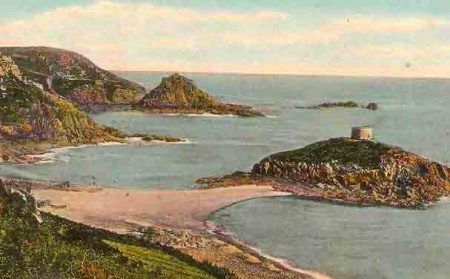
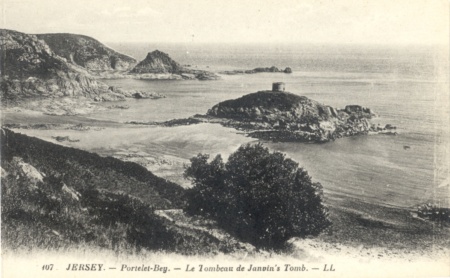
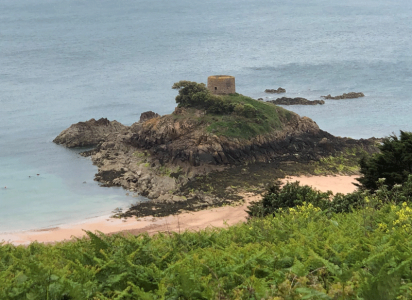
This tower is built on an islet known as Ile au Guerdain in the middle of Portelet Bay and is popularly known as Janvrin's Tomb because sea captain Philippe Janvrin was buried there after he died of the plague; but this was some considerable time before the tower was built. It is styled on the Martello design and was completed by March 1808, when the Lieut-Governor, General Don requested that it be dried out for a fortnight and then occupied by a sergeant and twelve men.

Although it is frequently called a Martello tower, as it is in the two official descriptions below, that is incorrect. Although it is certainly of the Martello tower shape, rather than the taller, multi-storey Conway towers, it is not large enough to qualify as a true Martello design.
HER entry
Along with all Jersey's other coastal towers and historic fortifications it is a listed building, described as follows in the Jersey Heritage Historic Environment Record website:
Martello-type tower, 1808. The tower is significant as an integral part of a group of surviving Martello-type towers in Jersey that illustrates the changing political and strategic military history of the Island in the early 19th century.
A variant of the Martello, designed by Royal Engineers in England, was adopted in Jersey. Three small towers were constructed between 1808-1811 on islets off the south coast at Portelet, Noirmont and Icho. More towers were planned for the coasts around St Helier, but were not built.
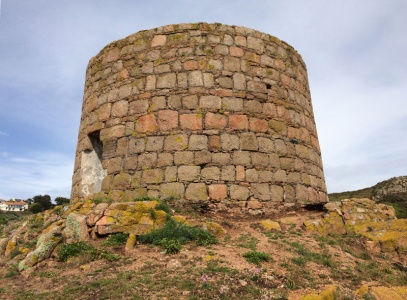
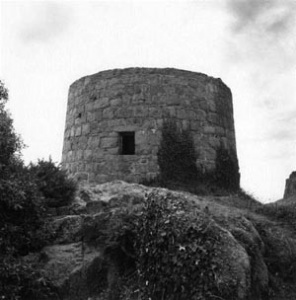
Portelet Tower, also known as La Tour Janvrin, was built on Ile au Guerdain in 1808. In common with other Martello-type towers, Portelet was designed primarily for mounting artillery on the roof platform (an 18-pounder traversing gun). It has a characteristic Martello profile - squat and robust with a battered outer wall of dressed granite. There are no loopholes and very few other openings, the very thick walls themselves providing the main defence.
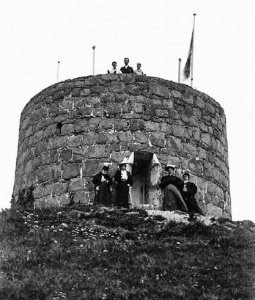
The first floor door faces landward and has a specially profiled threshold to enable the original entrance ladder to be withdrawn from above. Inside there is a bombproof vault designed to protect the accommodation for gunners and the small garrison on the main floor.
The islet is known as Janvrin's Tomb. It is so named after Philippe Janvrin, captain of the Esther, who on returning from Nantes in 1721 was forced to quarantine the ship and crew in Belcroute Bay, as plague had reached epidemic in France. Janvrin died onboard ship but his body could not be brought ashore because of the plague, and the court ordered that he should be buried on the islet. He was later reinterred at St Brelade's Church.

Jersey Heritage history
This history of the tower was posted to the Jersey Heritage Facebook page in 2024
Portelet Tower is very different fto the other Martello towers as it only contains a single room, no magazine, a lack of musket loopholes and a doorway at ground level. It’s hard to imagine how this tower could function as an effective defensive structure, especially given that it was intended to hold a detachment of one sergeant and 12 soldiers. The space available would have been very limited for these men, let alone for any of the ammunition, equipment or weapons required.
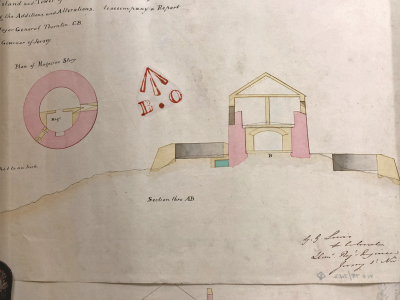
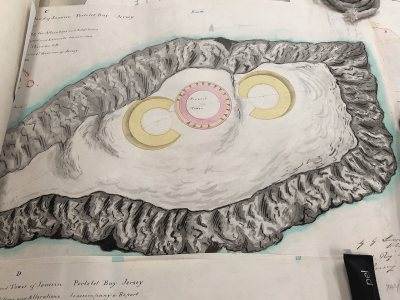
Research conducted at the National Archives, Kew, has revealed that Portelet Tower was in an unfinished state at the conclusion of the Napoleonic Wars in 1815, and only the magazine had been constructed. It is unclear whether this project simply ran out of funds, or the prospect of effectively defending Ile au Guerdain was deemed unfeasible.
Plans drawn up in the 1830s by the War Office, part of a series of proposed enhancements to several existing coastal defences in Jersey, clearly show the existing magazine of Portelet Tower would have been improved by the addition of a bomb-proof roof and the present window and door at the tower converted into protected ventilation shafts. The magazine would also have been roofed, possibly to create a gun observation platform, and two cannon batteries would have been constructed on the eastern and western sides of the tower to defend all of the seaward approaches to Portelet Bay.
These proposed alterations were never constructed and it appears that Portelet Tower never served in any defensive capacity. A plan drawn in 1878 records the site as a ‘ruin’ that was deemed uninhabitable. This lack of later alterations has left us with the only example of an uncompleted Martello tower in Jersey, with the magazine continuing to stand as evidence of this unfinished defensive structure.
-
-
-
-
-
-
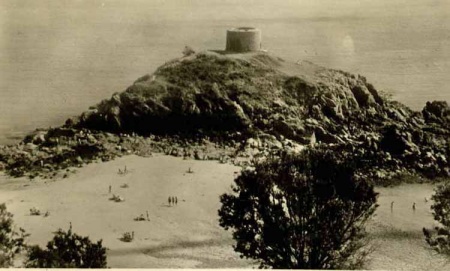 1920
1920 -
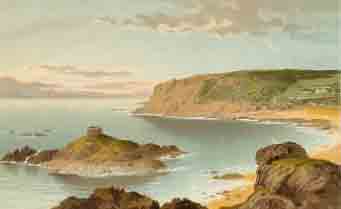 1890
1890 -
-
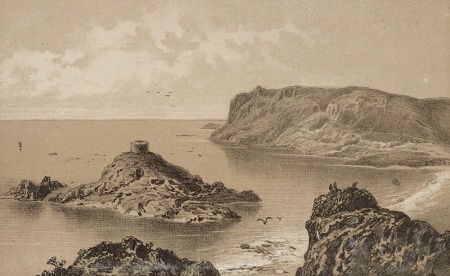 1875
1875 -
-
-
-
-