Prisoner of war's funeral

A German’s Funeral in 1915

By Paul Ronayne

'Unique occasion'
According to a report in the Morning Star Carl Brundig, a German sailor, died on 24 August 1915 at the Don Bridge detention camp and was buried in St Peter’s Churchyard two days later. The paper led with such headlines as ‘Funeral of a German Prisoner’, ‘Impressive Scenes at St Peter’s’ and ‘Ex-Sailor from the Mainz Buried with Military Honours’. The paper described the burial as unique in the Island’s modern history.
Brundig was a stoker on the German light cruiser Mainz, sunk by the British Navy at the battle of Dogger Bank in 1914. He was taken prisoner and ended up on a PoW ship moored at Ryde in the Isle of Wight. After a short stay on the ship he was transported to Jersey with about 1,500 other prisoners in March 1915. They were imprisoned at the camp at Blanches Banques in St Ouen’s Bay.
It was reported that the deceased had been a great favourite with the other prisoners at the camp, and Colonel Haines, the commandant of the camp acceded to the request of quite a number of them who wished to be present at the funeral.
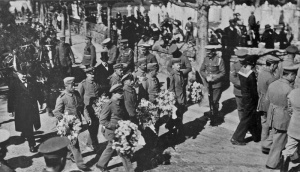
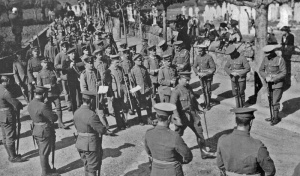
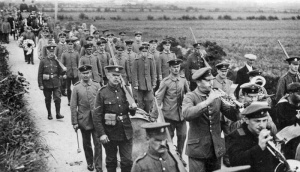
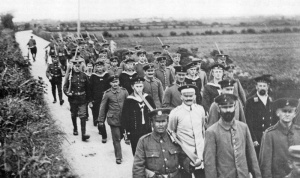
The body was first taken to the mortuary at St Peter’s Barracks, then shortly after 2.30 pm on 26 August, a body of some 30 Germans prisoners, preceded by a firing party of 14 men drawn from the Hants and Berkshire Reservists, who at the time formed the camp guard, and headed by their own band, marched between lines of guards with loaded rifles and fixed bayonets then halted in front of the hospital at the barracks.
Eight wreaths
Among the PoWs were several petty officers in white drill uniform and at the head of the column there were eight of the deceased's comrades from the Mainz carrying wreaths, who on arrival proceeded to the mortuary and reverently carried the coffin to the waiting hearse, where the firing party presented arms and the band struck up a mournful tune.
The coffin bore the following inscription: 'Carl Brundig, Alter 21 Jahre, 24 Aug Gestorben'
The firing party then advanced, and with reversed arms, slowly headed the cortege out of the barrack square and then took the road to St Peter’s Church to the solemn strains of Chopin’s Funeral March. When they were well clear of the barracks the pace quickened to the ordinary marching step, but even so it was reported that the funeral procession did not reach the Church until just before 3 pm.
It was also reported that the public did not generally know the actual hour of the funeral and therefore comparatively few people were present near the Churchyard, and at the direction of Col Haines the Churchyard wall was cleared of onlookers.
The ordinary Church of England Burial Service was conducted by the Rector, the Rev F De Gruchy, and the lesson was read by the Rev B Yandell who officiated at the PoW camp. After the service the procession re-formed and paced slowly towards the grave situated in the extreme western corner of the churchyard. The coffin was draped with a German flag, covered with wreaths, and on the top Brundig's naval cap had been placed.
It was reported that there was almost breathless silence as the Rector, in low tones, read the committal prayers, and the blue-garbed bearers slowly lowered the coffin into the grave. The Rev Yandell then, to the surprise of all there, repeated the prayers in German, for which afterwards he received great thanks from the prisoners. After another prayer came the sharp words of command to the firing party to fire three volleys over the grave. The prisoners and their escort then marched back to the camp and the day’s events came to an end.
The funeral was reported with great gusto in the local press, maybe because it took place relatively early in the war. In contrast, a funeral of a German which tookplace a year later seems to have been reported with less enthusiasm by the paper, maybe as a result of greater casualty lists and a belief that the War would drag on for some time to come , claiming even more lives. Time would prove them right.
Brundig’s remains were removed to France in 1961.
-
 PoW funeral
 -
 PoW funeral
 -
 PoW funeral
 -
 PoW funeral