Renault family history

Renault family history
This article by Ken Renault was first published in the journal of the Channel Island Family History Society
Bilingual family
Born and brought up in a family that on the male side down to my father was bilingual must have sharpened my inborn leanings towards research, for I soon began to inquire into the family origins and heard rumours of the rural countryside of Normandy that I could see clearly from Gorey.
But it was to be many years before I could take an active part in that urge to find out more.
When that time eventually arrived in the early 1950s, I made my first inquiries at the Roman Catholic Presbetry in New Street, where I found, in the late 18th century registers, an entry of a Pierre Jean Renault from a village the name of which was so indistinctly written that even the pries could not recognise it.
Service overseas delayed further research for a while but later, with the help of Pere Chuffart and a friend who produced an early 19th Century book of the Diocese of Coutances listing every parish in the diocese and a 13th Century map, we were able to decipher and identify the village as St Ursin, a really minute village just within the southern boundary, between Granville and Avranches.
Mairie visit
My wife was, if anything, more excited that I was, insisting that we go over at once to find the village and visit the maire. The precaution of a telephone call beforehand elicited the fact that the mairie was open for only one hour each week on Thursdays, between 11 am and noon. That call proved useful indeed for on arrival no time was wasted. We were expected and in anticipation several registers had bookmarks inserted at the name of Renault – an example of how helpful a mairie can be.
Three visits later we had accumulated a great deal of useful information, had visited the old Renault farmhouse, and built up the mid-to-late 18th Century family tree.
An interesting aspect of this search was the realisation that our early Renaults were living through the period of the Revolution from 1738 to 1795 when the new Republique Francaise was constituted.
Our early certificates are written out on printed forms which were already in use some 44 years before civil registration was introduced in England. Incidentally, we were permitted to photograph these early certificates – no photocopiers in these rural mairies.
Arrival in Jersey
We confirmed that my great-great-grandparents, Pierre Jean Renault and Jeanne Bisson, born 1800 and 1799 respectively, arrived in Jersey in 1825. A young French-speaking couple who settled in St Martin and farmed there for two generations. Here they raised a large family of six children, two boys and four girls, of whom one son was to break away from the confines of the family farm.
Guernsey branch
Pierre, the third son, born in 1832, was of an adventurous and ambitious spirit and realising that the eldest son, Jean, would take over the farm, and this being only on lease, his prospects were uncertain.
He appears in the 1851 census as an agricultural labourer in St Clement, aged 19. Eager to get on and prosper, he 'emigrated' to Guernsey and in the 1861 census he was shown married to Sophie Lucas in 1859 and was established as a farmer of seven acres at Les Nicolles, with his wife and daughter, Julie Sophie.
In 1881 he was still at Nicolles, farming 30 acres with two sons, Jean William and Frederick, and three daughters, Juilie Sophie, Marguerite Lucas and Alice Marie. A fourth daughter, Marie Anne, died aged only 18.
To have built up such an extensive area of land on lease and become a prosperous dairy farmer indicates the character of the man. This is borne out by the fact that he was noe negotiating the purchase of Le Bigard from the Robilliard family. We have a copy of the contract of December 1880, by which it was sold to Pierre for 4,900 livres tournois, and by 1885 he had been appointed Senior Constable of Forest.
Pierre's wife Sophie died in 1883 and he later married her sister, Nancy, widow of William Doorley. Pierre is buried in Forest churchyard with Sophie and other members of the family.
Le Bigard
An interesting coincidence enlivens our story here, for by the merest chance we have been given a photograph of Le Bigard as it was in about 1870, from which we can see that the recent improvements carried out in the 1980s have faithfully retained the original Guernsey style and character of the house.
Pierre's family of three marriageable daughters and four grand-daughters had inevitably introduced the name of Renault into several old Guernsey families, among them Mauger, Brouard, Le Pleux, Mahy, Torode, Priaulx, du Four, Tostevin and de Garis.
In later generations the incidence of deaths in infancy, no issue or the lack of a son, have diluted the name still further and the name of Renault finally disappeared with the death of Eunice Maud, widow of John Mahy, who died in 1989. Le Bigard was sold out of the Renault family in 1953.
-
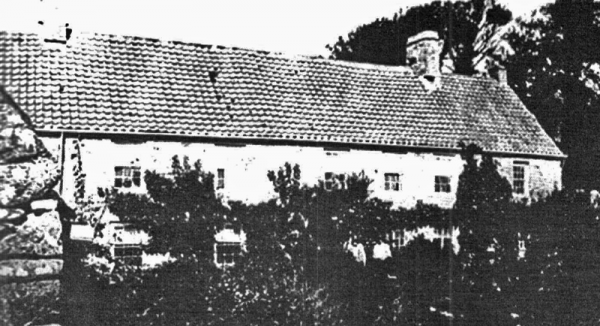 Le Bigard in 1870 ...
 -
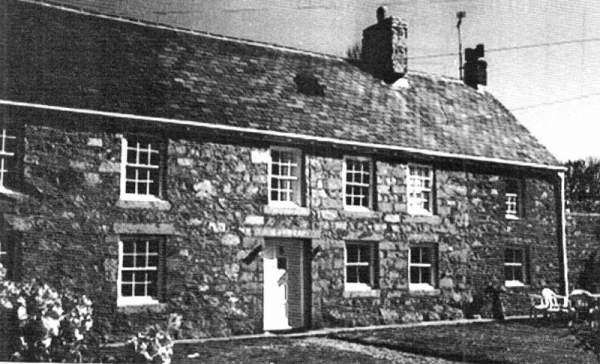 ... and restored in 1988