St Clement’s School

St Clement's School

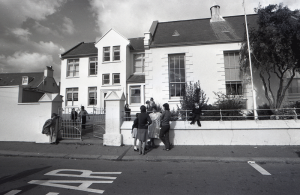
The old school building
St Clement’s School was established in 1902 as the parish school. It was one of 14 such schools taken over by the States in 1913. This history is based on a Jersey Heritage What's your school's story? presentation in 2021

For more than a century, St Clement’s School has been a central part of parish life, educating generations of children and standing as a familiar landmark. Its history reflects not only the growth of the parish but also the evolution of education across Jersey since the early 20th century.
After the introduction of compulsory education in 1894, island parishes moved to create schools in their area. St Clement formed a committee to ascertain how many students attended school in the parish.
In 1900 the committee presented its conclusions that 103 children from the parish went to schools, the majority States run, with several others frequenting the school of St Joseph’s Catholic Church in Grouville. In light of the report, it was decided that it was necessary for a school that could take 120 scholars, which was later reduced to 90, to be built in the centre of the parish.
Opening of the school
A field between Maitland Villa and the house of James Pinkett, on Rue de la Chapelle was earmarked as an ideal location and was purchased on 26 January 1901. The parish assembly set aside just over £2000 for the project, with Charles Bowles named as the architect, and John Crill and Sons the builders.
On 29 September 1902 the Comité d’Ecoles Elémentaires received a report from the Constable of St Clement that the final bill for the construction of the school had come to £2494 17s 10d and, although it was over the original estimate, they agreed to pay half the costs, with the parish paying the other half.
An article in the Evening Post of Saturday 1 November 1902 noted that St Clement’s Parish School was to open, for the reception of scholars at 9 am on Monday next, with the public invited to take this opportunity of visiting the school. Edward Carter, the head of St Matthew’s Mixed School, was appointed as the new headteacher on an opening salary of £90 per annum. He was assisted by his wife Margaret, who joined in January 1903 and ran the infants’ school, Ada Renouf, and Lucille Marett as a pupil teacher.
Early years
Under Carter’s leadership, the pupils seemed to flourish. The first inspector’s report remarked that a good start has been made in this new School – the classes are well taught, and their discipline is excellent.
At the annual prizegiving in 1907, a number of pupils received perfect attendance awards, including Charles Gerald Le Masurier (for the fourth year in a row), who was also named the best all-round scholar. In February 1908, aged 12, Charles obtained honours in the 3rd Class, with distinctions in English and French, and was placed sixth overall in the whole of the United Kingdom.
Tragically, his life was to be cut short. A member of the civil service before the First World War, he joined up with the 4th Battalion Rifle Brigade in October 1915. He was killed in action, aged 22, on 4 April 1917, with news reaching Jersey later that month.

Between the wars and Occupation years
After nearly 20 years as Headmaster, Edward Carter retired in 1921 and was given an emotional farewell by parishioners and pupils. He was succeeded by J F Cutland, who led the school for over a decade with teachers Misses K M Ahier, S V Ahier and F E Cabot, before ill health forced his retirement in 1932.

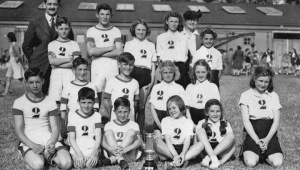
Following a brief interim under Ernest Le Gros, Leslie Gale became headmaster in 1933 and soon made his mark, particularly in sport. Two years later, St Clement’s won the Atkins Trophy at the Country Schools Sports’ Meeting by three-quarters of a point, with Gale proudly noting that the girls earned 20 of the school’s 26 points.
The start of the German Occupation in 1940 brought immense disruption in the form of pupil and staff evacuations, compulsory German lessons, rationing, and heating shortages that led to shortened hours. The parishy, led by Constable Sydney Crill, supported children with soup kitchens and Christmas treats.
Post-war sporting success
After the war, St Clement’s established itself as a powerhouse in island sport. Their second Atkins Trophy triumph came in July 1947, before a crowd of 1,500, marking the beginning of an extraordinary era of dominance. The school went on to win the event for six consecutive years, followed by second place in 1953, and a tie for first in 1954. In 1955, a handicap system was introduced to give smaller schools a fairer chance.
During this golden era, 1952 was a standout year. In addition to the Atkins Trophy, the senior football team secured the Le Cocq Trophy, and the cricket team became the first country school to claim the Lord Trent Cricket Shield.
Growth and a new building
Leslie Gale retired in 1954 and was succeeded by Miss Coad, the school’s first headmistress, who had previously headed the States’ Intermediate School. In 1961 Miss J E Fitter took over, and with the pupil population growing, focus quickly turned to improving facilities to accommodate rising numbers.

Education Committee visits in 1962 reviewed required alterations, additions, and decorations. Practical improvements included the installation of a swimming tank in 1963, which provided pupils with lessons in water confidence. By 1964, pressure on reception-age spaces necessitated the use of a temporary classroom at FB Fields.
Although an extension had been needed since the early 1960s, work only began at the end of 1970. A new building across the road added three classrooms, a hall-cum-gymnasium, toilets, cloakrooms, and changing rooms for pupils and staff, along with outdoor play areas.
Honouring service and embracing change
In the mid-1970s the school marked the long service of deputy headmaster Jack Le Breton, who had devoted nearly 40 years to the school. He retired in December 1976, leaving a legacy of dedication to both the academic, sporting and pastoral life of generations of pupils. Gifts presented to the couple at an informal ceremony reflected the respect and affection they had earned from staff, pupils, and the wider community.
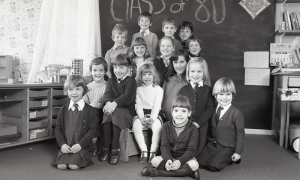
Mr Le Breton’s influence went beyond the classroom, helping maintain continuity and stability through times of change. His departure marked the end of an era, but the school continued to grow under new leadership. In January 1980, Barbara Smale succeeded Doug Gibaut as headteacher, and further building work, including a new classroom in the loft of the original building, supported the expanding pupil roll.
By the start of the 1983 school year, the school had 150 pupils, continuing a steady increase from the 81 recorded at the end of its first year in 1903. This growth continued into the 21st century, with 191 pupils on the books in 2024, reflecting the school’s enduring role in the heart of the parish community.
-
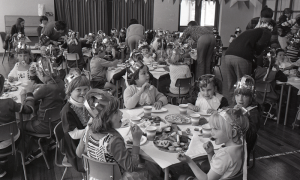
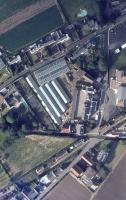 1977
1977 -
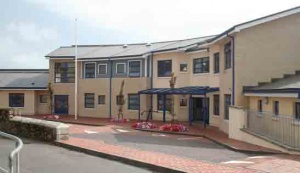 St Clement's School
 -
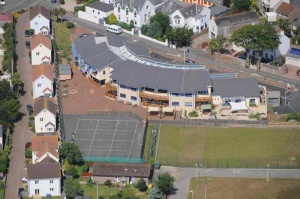 The new school from the air in 2008 with the former school across the road behind it
 -
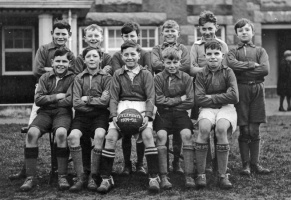 Football XI 1934-35
 -
 A school sports team at Springfield
 -
-
-
-
-
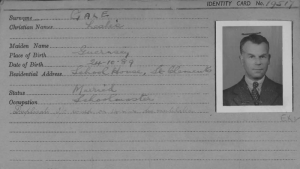 Headmaster Leslie Gale's Occupation identity card