St John’s School

St John's School

St John's School opened in the mid-19th century as a parish school, and was taken over by the States, along with 13 other parish schools, in 1913. It is one of the few island schools of this vintage to include parts of the original structure in the curent buiildings.
This article was based on a 2025 presentation in the Jersey Heritage What’s Your School’s Story series

The States of Jersey adopted the principle of providing free elementary education in 1889, but when it came to putting this into practice there was a great deal of opposition. St John was one of the parishes which spoke out against it most strongly, the Constable calling it 'arbitrary and despotic'.
The Compulsory Education Act nevertheless came into force in 1894, and in 1899 the new St John Education Committee was instructed to find a suitable site for a school, and decided to ‘make provision for a school near the parish church for at least 100 children’.
Opening of the school, 1902
Plans were drawn up by the States Architect, Adolphus Curry, and by August 1902 building work was well underway. The new school opened at 10 o'clock on Wednesday 26 November 1902 – staffed entirely by the daughters of the chairman of the St John Education Committee.
Originally the school had separate girls’ and boys’ entrances, as they had separate toilets, cloakrooms and playgrounds, despite being taught in a mixed group. The building soon became too small, and in 1903 a new infants’ classroom was added to the end. After a chaotic start, the school settled down and by 1909 there were 100 pupils.
In 1935 a new infants’ room was constructed on a field at the rear of the school buildings, and in 1947 a former German wooden hut that had been standing at St Peter’s Barracks was acquired by the headmaster. The hut was installed, and used for the first time in January 1949. These buildings, with the original school, managed to accommodate 300 pupils in the 1950s.
Between 1949 and 1965, St John’s School took secondary school-aged children from other western schools, before the opening of Les Quennevais led to a mass exodus, and the school became a village primary school yet again.
Sports
A surprisingly wide range of school sports have been offered at St John. Along with the usual football, rounders, netball and cricket, at various times it has also had boxing, tug of war, volley ball and canoeing. The school was particularly strong at athletics in the 1960s, and even had its own long jump pit. The badminton team played in front of the Duke of Edinburgh at the opening of the St John Recreation Centre in 1983, and in 1987 the school held a 12-hour badminton marathon which raised £800 for a reception pupil needing a heart transplant.
Harold Le Druillenec
In June 1949 the school’s Headmaster, H A Journeaux, who had served at the school for 20 years, died suddenly while invigilating an examination at another school. His successor, Harold Le Druillenec, was appointed in the July of that year, and served 22 years.
He arrived four years after his incarceration at Belsen Concentration Camp. Despite only having been out of hospital for two weeks, he gave evidence at the Nuremberg Trials, and was decorated by the French and Russian Governments, as well as being made an MBE in 1971.
Having a celebrity for a headmaster occasionally meant that the school had to do without him: In March 1959 he was absent for three days while filming This Is Your Life, and in 1965 he accepted an invitation from the Soviet War Veteran’s Committee to spend ten days in Moscow. He took many photographs and gave talks about his experience there. He always wrote after returning from his time away that the children welcomed him back delightfully, often with flowers.
He retired in July 1971. He died, aged 73, in February 1985.
A few months after his death in February 1985, Harold Le Druillenec‘s widow presented the school with a framed photograph of him.
New school, 1970s
By the 1970s, the school premises were suffering: the heating system was failing, and investment was required. Discussions started in 1972, but consultations and arguments about the proposed changes continued until February 1977, when proposals were accepted.
Building work on the new school, to be built around the original building, started in the summer holidays in 1978 and continued until June 1979, when the headmaster commented that the whole school was “now under one roof for the first time since the early '50s.”
For the first time, the school had an assembly hall.
The new building suffered constant problems, and was eventually entirely demolished. The school standing today was constructed between 1996 and 1998.
Concerts, assemblies, plays and special events
Concerts were a feature of school life from the beginning. The newspapers reported these in great detail, even giving the names of the songs sung and the identities of each performer. Fundraising concerts were fairly commonplace, and often took place at the same time as the school’s Christmas party or prize-giving.
At the official opening of the new school building on 10 October 1979, which was attended by members of the Education Committee, and included speeches, school performances and 1970s party food, the infants graced the assembled dignitaries with a song about a hedgehog, while dressed accordingly.

-
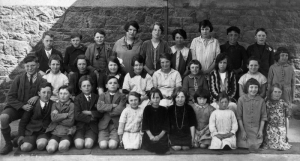 Another class in 1927
 -
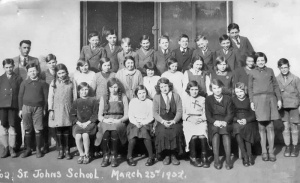 1932
1932 -
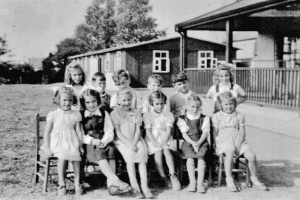 1948
1948 -
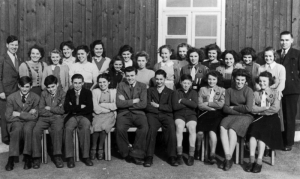 Mr Tostevin's class in 1949
 -
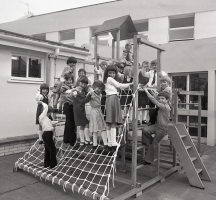 The playground in 1975 - Jersey Evening Post picture
 -
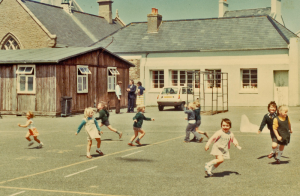 1975 - Jersey Evening Post picture
 -
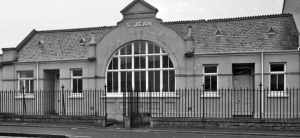 1977 - Jersey Evening Post picture
 -
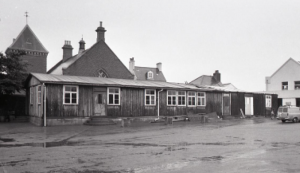 1979 before the demolition of old huts to make way for an extension
 -
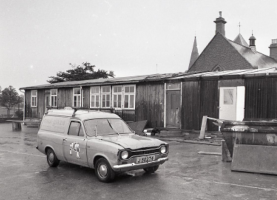 1979
1979 -
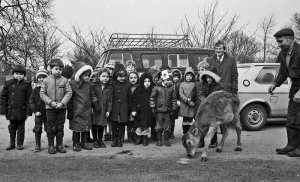 The school's adopted calf in 1982 - Jersey Evening Post picture
 -
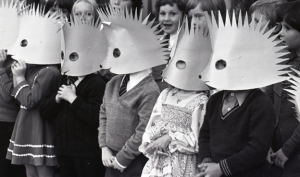 Children dressed as hedgehogs - Jersey Evening Post picture
 -
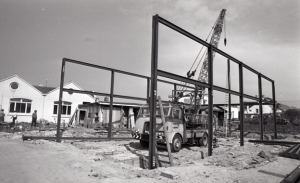 The new building goes up in the 1990s - Jersey Evening Post picture
 -
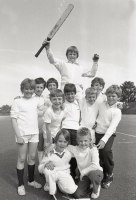 The school cricket team - Jersey Evening Post picture
 -
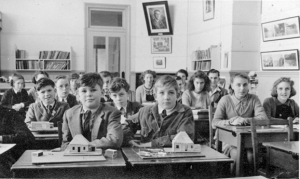 A classroom in the 1980s