St Lawrence School

St Lawrence School

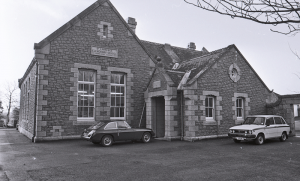
St Lawrence is the only parish in the Island to have its church, the parish hall, arsenal and school all situated next to each other and running in a straight line, in this case on Grande Route de St Laurent

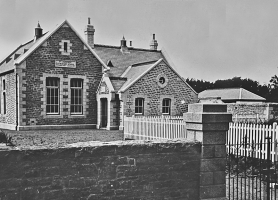
The school was built in 1902 and opened in 1903, is similar in design to many other parish schools built around this time. The traditional granite walls of the building blend well with the beautiful surrounding countryside.
St Lawrence in its early days was an Elementary School. At that time most pupils received the whole of their education at St Lawrence and left to commence their working life at 14.
In 1913 it was one of 14 parish schools taken over by the States.
In 1949 St Lawrence became the first Primary School to take children from five to eleven years, and it has not changed over the past 76 years.
The Nursery was added in 1992 and the complete refurbishment/rebuilding programme for the whole school was completed in 2000.
Jersey Heritage history
This history is based on a 2025 talk in the What's your school's story series
St Lawrence School has been at the heart of parish life for more than 120 years. Generations of children have passed through its doors, with the building and its traditions becoming a familiar landmark alongside the parish church, hall and arsenal. It was one of several parish schools built at the start of the 20th century following the introduction of compulsory elementary education in 1894. The previous year, in January 1893, the parishioners and ratepayers of St Lawrence had met in the parish hall to discuss the States’ proposal to introduce compulsory elementary education for children aged between five and twelve.
For the parishioners of St Lawrence, many of whom were families involved in agriculture, the prospect of having children, who were of potential use working in family businesses, in school every day instead, was not an entirely welcome one. Despite the objections of the St Lawrence representatives, the law was passed, and the parish was required to appoint a committee to ensure that it was followed.
Construction of the school
In 1898 the Education Committee recommended a school be built in the north of the parish with the idea that it would also serve the needs of some of the children in St John, St Mary and part of St Peter, and that those parishes should also contribute proportionally to the cost of its establishment and maintenance.
By the end of the following year, the parish had been instructed to provide a central school for at least 150 children. Two sites were considered, and in November 1900 the parish bought land beside the arsenal from Henry Nicolle Godfray for £300. Architect C G Bowles was appointed to draw up plans. The idea of including a teacher’s residence was later dropped.
Charles J Le Quesne won the contract at £3,613 to build the granite-faced school, but construction ran nearly eight months late due to poor-quality stone and the need to bore a 60-foot well instead of the planned 25 feet. Although the contract allowed for penalties of £1 per day, the parish assembly agreed to reduce the fine, recognising the difficulties faced. On completion, the Constable declared the finished building “a credit not only to the parish but to the contractor”.

Early years
The school opened its doors to pupils at 8:45 am on Monday 2 November 1903, with weekly fees set at 2d, 3d or 4d. The first headteacher was Maria Vibert, chosen, from 11 applicants, by the parish assembly on a salary of £120 per year.
Miss Vibert came with an excellent reputation, having spent 16 years as headmistress of St Luke’s School, where, according to a glowing newspaper report, she had raised the school “to the highest state of efficiency”.
Despite early challenges around attainment, progress was swift. In 1905 inspectors noted that Miss Vibert had “infused an excellent spirit of work into the school” and that the pupils responded well. Miss Vibert’s time at St Lawrence was short. After just over four years as headmistress, she died following a brief illness in February 1908.
The first entry of the new school logbook, reads: “I, Maria Vibert, take charge of this new school today, and am allowed a free hand in the choice of new books and apparatus. Admitted 31 children ranging from the ages of 3 to 13. Attainments very low indeed.”
New uniforms, and a school motto
After Miss Vibert’s death, the school entered a period of stability under her successor, Maria Bartlett, who served as headmistress until the early 1920s. She guided the school through a time of steady growth and shifting responsibilities as parish and island education developed.
In 1920 wider reorganisations in Jersey’s school system affected St Lawrence directly. The closure of Millbrook Elementary School and St Mary’s South Catholic School brought new pupils into the parish and in 1924 the parish appointed its first headmaster, Frederick Herbert Whistler.
He introduced several innovations that became part of the school’s identity. He encouraged sport, organising football and cricket matches against other parish schools, and introduced the first school uniforms in yellow and blue. Embracing new technology, he also made use of wireless radio broadcasts in the classroom. In 1927 the pupils adopted their first motto, “Each for all and all for each”.
Impact of the Occupation
Harold Carter became headmaster in September 1940, a few months into the Occupation. His log book reflects the daily impact of war: in June 1941 he noted being ordered by a German soldier to have children walk on the right-hand side of the road.
The school was deeply affected. Former pupil Francis Jouanny died in action in Italy in 1944, and three children – Anthony Shepherd, Constance Carter and Lionel Blackwood – were struck from the register after deportation to camps in Germany. By late 1944, fuel shortages forced pupils to collect wood on their way to school, and hours were cut when no heating allocation was given.
Two days before Liberation, German soldiers dismantled wire netting from the playing field, despite Mr Carter’s protests. Soon after, the school was requisitioned by British forces as a processing and delousing station for German prisoners, which Mr Carter called: “a magnificent sight to see the school full of Tommies in their battle dress.”

Sporting success
In 1949, the school officially became a junior mixed and infants school, quickly establishing new traditions such as the first parents’ evening in 1950, along with sporting and folk dancing successes.
By 1953 inspections described a thriving school with fields, a garden, and two playgrounds where children “work, play and grow happily and efficiently.” Four classes served 130 pupils, and despite a cramped infants’ room, children were progressing well. Harold Carter remained Headmaster until 1958, leaving the school well established.
Doug Perchard succeeded him and oversaw growing demand for infant spaces, with a new extension opened in 1965 and the department split into reception and infants classes by 1968. Sporting achievements continued, including St Lawrence winning the B C O’Neill Trophy in 1963 and 1964, while music and arts flourished.
Modernisation, growth and adaptation
By the late 1960s the school was facing increasing pressure on space, with the growing number of pupils meaning that the infants’ class had to be relocated to the school hall for lessons. This arrangement continued for several years, with the lack of dedicated indoor sporting facilities a particular concern for staff. After prolonged discussions with the Education Committee, a new school hall was finally built in 1977, providing much-needed space for assemblies, physical education, and school events. That same year, long-serving headmaster Doug Perchard retired.
The school continued to expand and adapt to the changing needs of its pupils. In 1992 a dedicated school nursery was opened, reflecting a growing focus on early years education and providing a foundation for younger children entering the school system. These developments were part of a wider effort to modernise the school and improve facilities for both teaching and learning.
The most significant transformation came in the late 1990s when St Lawrence underwent a complete refurbishment and rebuilding programme, the largest since its original construction. This project addressed the school’s ageing infrastructure, improved classrooms, facilities, and accessibility, and was completed in 2000, ensuring that the school could continue to serve the local community into the 21st century.
-
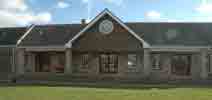 The new school building
 -
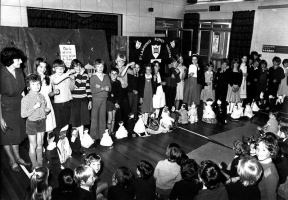
-
 1970s
1970s -
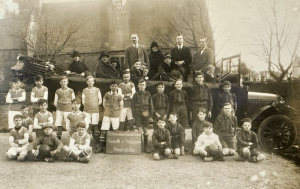
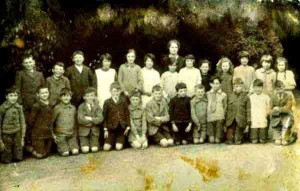 A school group in the 1920s
 -
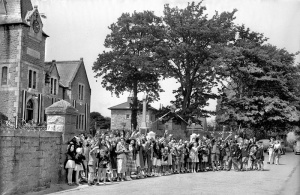
-
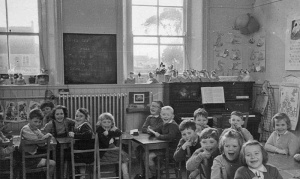 1959
1959 -
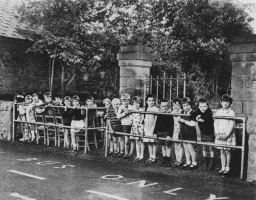 1960s
1960s -
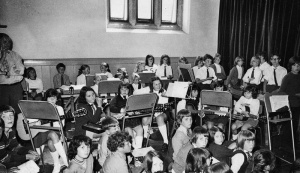
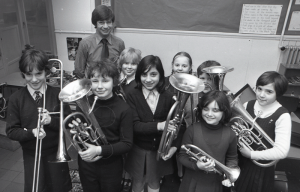
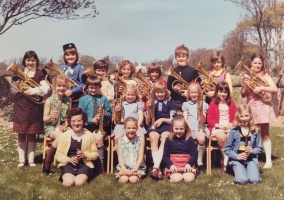 School band in 1973-74
 -
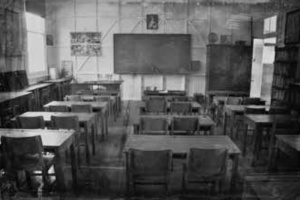 A view of an early classroom
 -
-
-
-
-
-
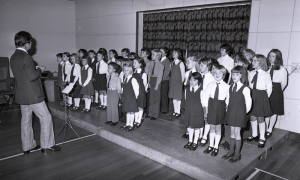


School concerts

Three more pictures of the same concert