St Luke’s School

St Luke's School

A presentation in the Jersey Heritage series What's Your School's Story?, was given in May 2025

St Luke's is a suburb of the town of St Helier, although its church and school are over the border in the parish of St Saviour.
The school was established by the church in the late 19th century, and taken over by the States in 1913.
It was earmarked for closure in the 1980s, but survived and still continues as a single-form primary school in a much refurbished Victorian building.
For over 160 years, the school has played a vital role in the life of the Georgetown area of St Helier. Though its official opening was recorded as 28 May 1861, records suggest an earlier, informal school was already operating.
The school’s early years were not without drama. The first headmaster and mistress were dismissed by the School Committee for failing to provide a satisfactory education. What began as a modest educational effort evolved into a vital institution for local children, surviving social change, epidemics, and the shifting tides of Jersey’s education system.
T B Davis
Among its alumni, St Luke’s proudly counts one of Jersey’s most prominent philanthropists. Born in 1867 in St Helier, Thomas Benjamin Frederick Davis, better known as T B Davis, attended the school having grown up in the Georgetown area with working class parents, before making his fortune.
Early years
The earliest newspaper references to St Luke’s School date to the early 1860s, including an 1862 article about a prize ceremony that refers to the school having opened a year earlier. That same article confirms that the existing informal school was reorganised after the School Committee deemed the original headmaster and mistress unfit to teach.
Mrs Le Boeuf was appointed to temporarily take over their duties, but her success with the students led to her remaining in post. By the end of 1862, the school had 160 students enrolled. Challenges soon followed.
The 1873 annual return highlighted poor behaviour among pupils, inadequate facilities, and the need for major improvements – issues like copying during exams, puddles in the playground, and faulty chimneys were all raised. Encouragingly, reports from the following year showed a significant turnaround, praising the headmistress and staff for strong exam results.

Early headmasters
Following a troubled period under headmaster Samuel William Porter, who was dismissed in 1882 for excessive corporal punishment and conflict with the church, the school saw more stable leadership under Walter Burt and then Thomas Stent.
Appointed in 1895, Mr Stent had previously taught at Rozel School. His early years at St Luke’s were marked by poor infrastructure – infants were taught in a former hat lobby and there was no proper lavatory for the girls. He also had to cope with the challenges of the new compulsory education laws, which brought in older pupils with little to no previous schooling.
Stent remained headmaster until 1930. In 1922, he was presented with a gold watch for his long service to both the school and St Luke’s Sunday School. On retirement, he received a commemorative book with photos and signatures from former staff and students; a testament to his long and impactful tenure.
1920s: Illness and overcrowding
In 1907 the school was forced to close for two months due to measles. In 1920 a diphtheria outbreak caused an even longer closure that lasted ten weeks. During this time, the school’s drainage system was replaced, and when pupils returned in 1921, only limited areas of the building were usable.
Overcrowding was also a concern. In October 1922, log book records show that although the school was certified for 234 students, at that time there were 242, with an additional 30 due to be admitted the following month.

Occupation and postwar years
During the Occupation, the teaching of German impacted students and teachers across Jersey’s schools. Former pupils at St Luke’s have recalled school life during this tumultuous period: Duff McDermott remembers being nine when he had to start learning German.
He also recalled that once a month or so, there would be a commandant who would come into the classrooms to test the children’s knowledge of German.
After the war, wooden huts were erected to serve as ‘temporary’ classrooms; these continued in use into the 1960s. As was the case for many of the Island’s schools, the postwar period was very much one of transition for St Luke’s, however time was still found for fun activities such as pancake tossing.
Photography class
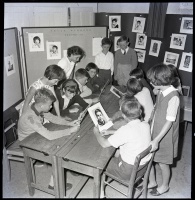
While the postwar years were a time of transition, it was also a period of innovation, marked by creative initiatives like a photography class led by headmaster and keen photographer J H Clark.
The children, aged 9 to 11, used everything from box cameras to 35mm models, and developed their images in the school kitchen, converted into a darkroom. Francine Miller recalls taking portraits of fellow classmates and family members which she kept in a scrapbook.
Other photos from the photography project include a trip to the Zoo, and of a school play, The Unhappy Princess, performed in winter 1961, in which Francine played the lead role.
The 1970s and 1980s
In 1972, a nearby property, Mandalay, was purchased and the land was used to expand and refurbish the school. During this refurbishment, a new floor was created allowing for more new classrooms to be built.
In 1983, Lady Whiteley, wife of the Lieut-Governor, unveiled a plaque marking this fresh chapter. That same year, St Luke’s formally amalgamated with nearby St James’s School, strengthening its position and securing its future as a primary school. This period was one of optimism and investment, reflecting a renewed belief in the school’s role and purpose.
-
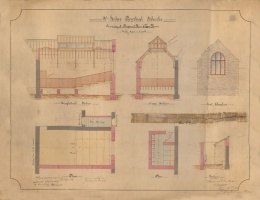 Drawing of proposed new class room for St Luke’s Parochial Schools, including cross sections, plans and elevations by Edmund Berteau, Architect, 30 May 1885.
 -
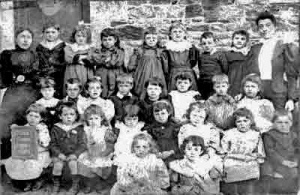 A mixed class at St Luke's School in 1897
 -
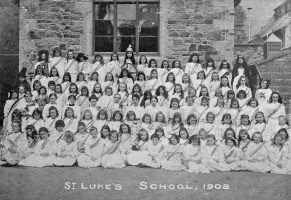 1902
1902 -
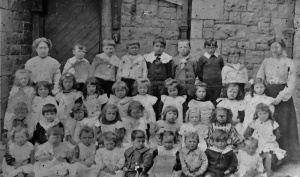 1905
1905 -
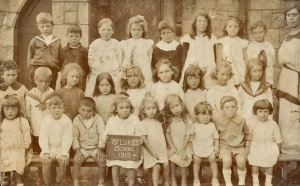 1919
1919 -
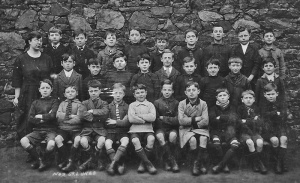 1920s
1920s -
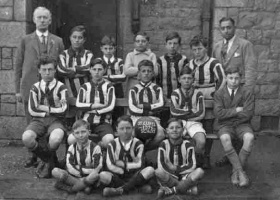 St Luke’s School football team pictured in 1926 with headmaster Thomas Stent and teacher Mr Anthony
 -
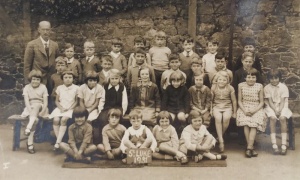 1931
1931 -
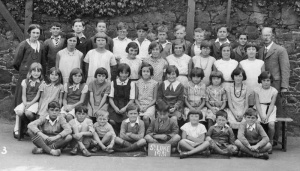 1931
1931 -
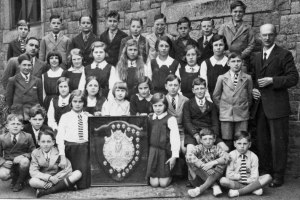 Trophy winning choir, 1933
 -
-
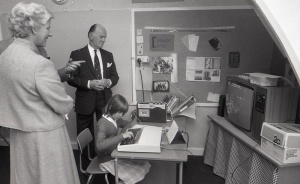 Lady Whiteley and headmaster Alec Shepherd watch pupil Louise Holley operating a new state-of-the-art computer installed in newly refurbished classrooms at St Luke’s School in June 1983 - Picture Jersey Evening Post


.jpg)


The school today
Click on any image to see a full-size version
File:StLuke'sSchool01.jpg File:StLuke'sSchool03.jpg File:StLuke'sSchool04.jpg File:StLuke'sSchool05.jpg