St Mark's School

St Mark's School

A visit by Lady Erskine, wife of Lieut-Governor Sir George, in 1958
St Mark’s School in Le Geyt Road was opened in January 1958, but the school’s history goes back over a hundred years earlier than that. The first St Mark’s School was originally opened in St Mark’s Road in the late 1850s and was associated with the church of the same name.

History
From a Jersey Heritage What's your school's story? presentation in 2025
On 20 September 1845 the Dean, acting in his role as incumbent of St Mark’s Church, together with the churchwardens, acquired in trust a plot of land next to the church. A sufficient area at the east end of the plot was to be set aside for the building of a public school funded by voluntary subscription.
The school was to have enough space for 200 children to receive a moral and religious education following the National School system. The building was also to form a convenable residence for the Master and Mistress in charge, who were also to attend the church regularly or form part of the congregation.
Scroll down to discover some of the records which reveal the history of St Mark’s School, the teachers and staff who worked there, and the pupils who studied there, and to find out about a FREE talk on the history of St Mark’s School.
=Early years
By the mid-1850s the original site, accessed by Byron Road, was overcrowded, and on 13 October 1856 the parish acquired premises in nearby Clearview Street from Edouard Mourant. Known as Clearview Street School, it remained in union with the National Society and served the parish’s poor and working-class children, with boys taught there and girls and infants at Byron Road.
From October 1862 official log books were required for all government-inspected schools, with separate volumes kept for boys, girls, and infants at St Mark’s. These, along with admission registers beginning in 1868, provide a detailed record of the school’s daily life. In 1872, responsibility for education passed from the UK to the States of Jersey, with St Mark’s appearing in official returns as 'St Mark’s National School'.
A reorganisation in July 1883 saw the infants’ classes separated from the Girls’ School to form their own department. From this date, the girls’ registers list only girls, while the boys’ log books continued without reference to this change.
Early 20th century
At the turn of the century, St Mark’s was shaped by major reforms in Jersey’s education system. Elementary education had been made compulsory in Jersey in 1894, and in 1912 the Loi sur l’Instruction Primaire brought elementary schools under States control. The following year, St Mark’s Girls’ School was transferred to the Public Instruction Committee, while the boys’ department at Clearview Street was listed separately in official returns.
School life in this period is vividly recalled by Grace Le Petevin dit Le Roux, who began as an assistant teacher at St Mark’s Girls’ in 1912 aged 21, earning £70 per year. She taught classes of 30 to 40 girls, with infants taught at the back of the hall, older girls at the front, and boys in the Clearview Street classroom. Each day began with prayers and fifteen minutes of singing before lessons commenced.
Grace spoke warmly of headteacher Katie Harriet Darling, who knew every child and family. After twelve years at St Mark’s, Grace left in 1924 to lead Gorey Village School.
Interwar change
St Mark’s School underwent several reorganisations during its history, with one of the most significant around late 1919 and early 1920. The Girls’ and Infants’ departments at St Mark’s were closed, and their pupils and staff transferred to Brighton Road School. Meanwhile, boys from Brighton Road moved to St Mark’s, leaving Brighton Road as a school for girls and infants only.
On 7 November 1919, St Mark’s Boys’ School amalgamated with Brighton Road Boys under headmaster John Charles Brine. Shortly after, on 1 February 1920, Clearview Street Boys merged with St Mark’s Road Senior Boys’ School. Mr Brine retired after 44 years, and Charles Bird took charge of the united boys’ school.
Logbooks suggest St Mark’s Road housed senior boys, with junior boys at Clearview Street, though records for the senior boys’ logbook are missing. Infants were typically taught within the Girls’ school classes during this period.
Occupation
The Occupation had a dramatic effect on school life. Pupil numbers fell sharply from 122 to 67, as many children evacuated the Island, and experienced staff such as Miss Amy Neel also left. In August 1940 headteachers and the Education Committee met to discuss saving fuel during winter, resulting in St Mark’s pupils and staff moving into La Motte Street School on 10 September 1940.
As the Occupation wore on, shortages of fuel and food affected the community and schools. By February 1945, schools were instructed to operate only in the mornings to ensure children could receive school milk and soup. After the Liberation, school life gradually returned to normal, but with only 74 pupils enrolled by October 1945, St Mark’s was closed and formally merged with La Motte Street School.
However, post-war overcrowding led to St Mark’s reopening in February 1947, with nearly 100 boys transferring from several overcrowded schools. Due to scarcity, the school was initially furnished with surplus equipment from other Island schools, highlighting the challenges of the post-war recovery period.
A new school
By the mid-20th century, overcrowding and outdated facilities at St Mark’s School had become significant issues. In response, the Education Committee purchased land on Le Geyt Road, near the base of St Saviour’s Hill, in 1955 to build a new primary school that could better serve the community’s needs.
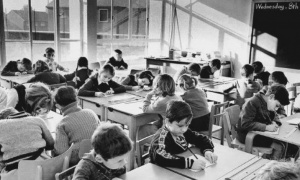
The new St Mark’s School opened on 8 January 1958 under the leadership of headteacher Arthur Bertram Carter. The Evening Post covered the event, capturing images of children engaged in lessons within the modern, well-equipped classrooms – a clear improvement from the cramped conditions of the old buildings.
The original school building was converted into St Mark’s Church Hall before being demolished and replaced by flats in the early 2000s, and the former Clearview Street School was also redeveloped for housing.
Activities, challenges, and closure of St Mark’s School
Mr Carter’s log book provides a detailed account of daily life at St Mark’s, with his annual prize-giving speeches highlighting the school’s achievements. The annual French trip was a popular tradition, notably the 1962 visit to St Malo and Cancale, praised for fine weather and excellent pupil behaviour. The school choir, formed in 1964, quickly gained success, winning the Junior Eisteddfod and performing at events such as the 1982 Making Music Festival. Sporting achievements included winning the Inter-Schools Netball Tournament in 1970.
Overcrowding remained a problem through the 1960s, worsened by nearby housing developments. In 1963 one class was temporarily held at a nearby tennis club until extra space was built. Remodelling and extension work was carried out on the building in the summer of 1983. In 2005, St Mark’s and La Pouquelaye Schools merged to form d’Auvergne School, with a final open day celebrating St Mark’s history and pupils’ work.
Though the school closed, the building continues to support the community. Since 2006, it has housed the Bridge Child and Family Centre and other agencies that assist parents, carers, children, and young people, maintaining its role as a key local resource.
-
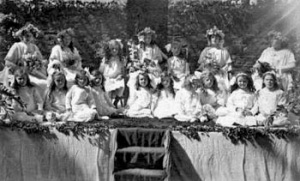 May Day celebrations at St Mark's School in 1917
 -
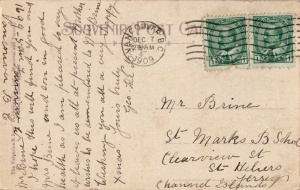 A postcard received when the school was in Clearview Street
 -
-
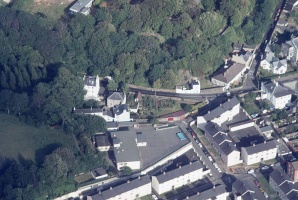 1977
1977


-
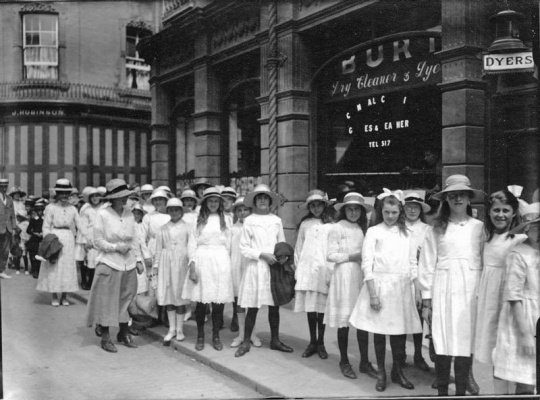 Pupils in Bath Street in 1912
 -
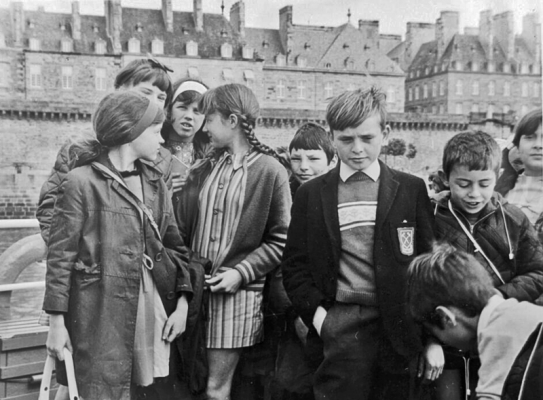 A school trip to St Malo in the 1960s