St Martin’s School

St Martin's School

The school in 1904
When the States passed legislation in 1894 requiring each of the parishes to provide education for their children, St Martin’s Parish School was housed in a boarded-off section of the chancel of St Martin’s Parish Church. The new law required each parish to provide a place of education, and that parents and guardians of children aged 5-12 should ensure this education, including reading, writing and arithmetic, took place in ‘conditions of sufficient morality and hygiene’.

Three years after the school started a Parish Assembly was called and it was agreed that a school must be built.
Committee appointed
In January 1897 the States offered to subsidise half the costs of construction of new schools, and a committee was set up to find a site, negotiate a price, prepare plans and estimates of total cost.
They reported back within three months and the parish decided to go ahead, voting £500 to cover the acquisition of three vergées of land at £153 and build a boundary wall. One pound notes guaranteed by the parish were issued to help raise the money. Architect Aldophus Curry drew up plans, which were modified by the Education Department in Whitehall.
It was not until 1899 that a tender by Springate and Baker, Gorey-based builders, was accepted in the sum of £2,836 10s and a further £3,000 was voted by the Parish Assembly. It was agreed to ask the States to pay £1,534, representing half the total cost.
A commemorative stone, which is set above the main door of the school, was laid by Constable Richardson Le Brun on 19 October 1899, and he was presented with a silver trowel to commemorate the event.
Numbers treble
The school opened on 1 October the following year, with 59 pupils, which was to treble within two years.
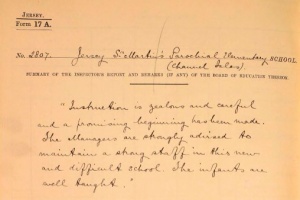
The first headmaster Mr Charles de St Paer reported his concern that many of his pupils could not speak English and school inspectors described the school as 'difficult' in its early years.
Quéruée School
The school merged at some point with a private establishment, Quéruée School, but it is not known where this was located
Absenteeism
Serving an almost entirely rural parish, the school suffered badly from absenteeism in the potato planting season in February and March, and the digging period of June, and on occasions the school would close altogether. This continued in several country parishes until the Occupation.
Extensions
Improvements to the building commenced in July 1980 and again in 1991. In 1980 most teaching areas were modified, indoor toilets installed, a staircase erected to give access to a new classroom in the loft, and a new hall built. The Commemorative stone was resited to allow a new entrance to be made. When removed, a small box was discovered containing artefacts from 1899. A similar box was made and filled with a collection of artefacts from 1980 and the two boxes now lie side by side behind the resited stone.
In 1991 two infant classrooms and an area to be used as a library were completed. This enabled the Infant department to be housed together in the eastern part of the school. Building work on a new detached nursery classroom with facilities was started on 3 September 1991, and completed at the end of February 1992. Two temporary classrooms were added in the summer of 1996, allowing for the relocation of the staffroom and the creation of a school library.
New Building
The idea of the new building became feasible in 2009 and in 2010 they got the funds to do it. Construction started in 2013 and the grand opening happened in 2016. The total price of the Building was 5.2 Million pounds. The old building has now been turned to Mercury Distribution and a vet, which opened on 8 January 2020.
Jersey Heritage history
This article is based on a Jersey Heritage What's Your School's Story presentation in 2025
Before 1900 there was no purpose-built school in St Martin, and children might have been educated in one of the parish’s private schools, such as St Martin’s Rozel School or St Martin’s Collegiate School
In the late 19th century, the States of Jersey offered to pay half of the costs of the building of any new elementary schools. With education now compulsory for children aged between five and twelve, St Martin quickly moved to take advantage of this offer.
In June 1897 a parish assembly agreed to buy three vergées of land from Charles Pallot for £459, or the equivalent value in rentes. Adolphus Curry, a local architect responsible for many notable Victorian buildings drew up the plans for the new school.
Construction, 1899-1900
In 1899 a parish assembly accepted the tender from Gorey builders Springate and Baker. The construction price of £3,000 (around £327,000 in 2025), included the construction of a wall to divide the school and its grounds from the neighbouring property of Charles Pallot.
In October 1899, the commemorative stone was laid for the new school building. The ceremony, attended by Constable Richardson Le Brun, and Adolphus Curry, featured the installation of a time capsule into which was put newspapers, almanacs, a rates list, stamps, coins, and acts of the parochial assembly having reference to the erection of the school.

First headteacher
Mr Stent, of St Luke’s School, was first offered the position of headmaster, but he declined the move after St Luke’s School increased his salary to £140 a year. The next candidate, Charles de St Paër, taught at St Matthew’s School, Millbrook. In accepting the headship, he and his wife Amy agreed to share their £140 a year salary, and moved to live at the school, together with their seven children.
He served as headteacher for over 15 years, dying in post aged just 55 during the Easter holidays of 1916. The school was closed to allow pupils to attend his funeral. His widow continued to teach at the school, and their youngest daughter Margaret followed her parents into teaching, later joining the staff of St Martin’s School.
Interwar years
During the interwar years, St Martin’s School continued to grapple with rural absenteeism, as many children were still required to work in the fields. The period also brought technological and cultural developments that began to reshape school life. In 1922 pupils attended a wireless telegraphy demonstration, and by 1927 children in Standards IV to VII were tuning in to BBC radio broadcasts for history lessons on Monday afternoons. Despite critical inspection reports in the 1920s, students found success in the Eisteddfod.
Under Charles Brine, the 1930s saw pupils from the Jersey Home for Boys and Teighmore join the school roll, transforming it into a more diverse institution. Brine was praised for managing this transition, as the school grew rapidly and evolved beyond its rural roots.
Early years and challenges
The school faced challenges from the very start. It opened on 1 October 1900, with 57 children enrolled. The new school building was not yet complete, and staff and students were forced to hold lessons in the Public Hall. Maintaining regular student attendance was a particular challenge. Illness frequently disrupted schooling, with one outbreak of measles in 1907 leading to a two-month closure. Weather conditions and events such as regattas, agricultural shows, and the Battle of Flowers also contributed to frequent absences.
The greatest disruption, however, came from Jersey’s rural economy, as children were often kept home to help with seasonal farm work, a factor repeatedly criticised in early 20th century inspection reports.
Occupation years
During the Occupation, the school, under the headship of Cecil Anthony, adapted to an era marked by uncertainty and hardship. In June 1940, Anthony reopened the school briefly to count how many children had evacuated – 20 had left the island. Attendance plummeted following the arrival of German forces.
The school quickly took on a welfare role, providing soup and warm meals as food shortages and poor footwear affected daily attendance. The teaching of German impacted students and teachers across Jersey’s schools, and by October 1942, 61 children were learning this new language at St Martin.
On 8 May 1945, children were dismissed early in expectation of the possible cessation of hostilities in Europe, and Cecil Anthony raised the Union Flag over the school. On 14 May, he remarked in the school logbook that: “The teaching of German in this school has finished.”
A new school
After the Liberation, St Martin’s School saw decades of growth and change. In 1946 an influx of boys from Faldouet led to building alterations, with the large west classroom split in two. As educational needs evolved, so too did the school’s footprint, culminating in major extensions in the 1980s under headteacher Enid de Gruchy, who praised her staff and pupils for managing the disruption.
From 1982 Keith Jarvis led the school, followed by James Speight in 1991. Much-loved teacher David Dugué remained a constant presence through these years, fondly remembered for his classroom beekeeping, complete with glass observation hive and hands-on lessons.
The 1990s brought further expansion, including a new nursery and temporary classrooms. By the 2000s, the old site could no longer keep pace. A new school opened in 2015, built on the playing field. The original building found a new life. In 2018 it was transformed into a community space known as La Vieille École: The Old School.
-
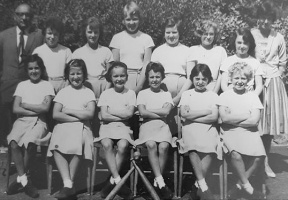 Rounders team in 1961
 -
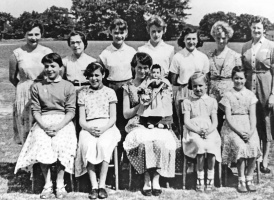 About 1959
 -
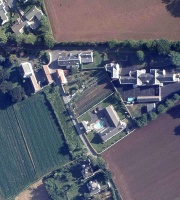 1977
1977 -
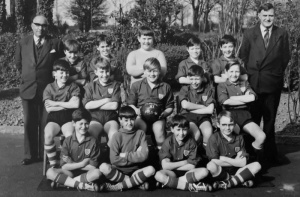 1965-66
 -
-
-
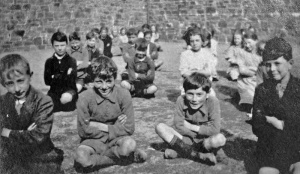 Class 3 in 1924 from a Noel family album
 -
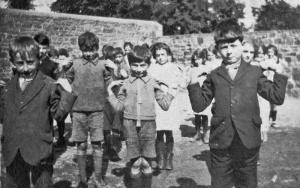 Class 3 in 1924
 -