What was on the menu?

What was on the menu
during the Occupation?
This article first appeared in the Jersey Evening Post in 2015 when an exhibition was held to mark the 70th anniversary of the Liberation

What was it like to live through the Occupation? In 2015, as part of the Liberation 70 celebrations, Channel Islands Occupation Society archivist Colin Isherwood organised a week-long event which gave visitors the opportunity to sample a range of authentic Occupation-era homemade food and drink.
Substitute foods
‘Substitute foods were essential to help bolster ever-dwindling rations during the Occupation,’ said Colin. ‘People were forced to improvise. By 1942, food and general goods were in such short supply that a black market emerged and bartering became the most popular method of obtaining produce or supplies.’
As a result, by 1944 an eight-ounce jar of Marmite could sell for as much as £8 – the equivalent of £350 in today’s money. Not surprisingly, Islanders took to creating their own drinks, preserves, soups and cakes – and it is these that Colin, alongside his parents David and Yvonne, recreated.
‘We’ve stuck strictly to the same ingredients and preparation methods that Islanders would have used during the Occupation,’ said Colin.
First up: carrot tea. ‘It’s really simple to make,. You grate the carrot, leave it to dry and then roast it. In truth, it doesn’t taste massively different from regular tea. The carrot taste is fairly mild.’
Parsnip coffee, on the other hand, is unlikely ever to be mistaken for a conventional cup of coffee, although it was surprisingly tasty.
'An old dear tried some earlier,' said David. 'Then she turned to me and said, "it tastes exactly the same as it did during the Occupation – bloody awful!"'
Parsnip coffee
David Isherwood was a young boy at the time and remembers all too well how he and his family used to prepare parsnip coffee. ‘We’d grate the parsnips and then leave them out in the sun to dry out, sometimes for several days. Then we’d stick the gratings in the oven and literally burn them.’
It wasn’t only coffee that inventive Islanders made from parsnips, but honey too. ‘There’s not much more to the honey than parsnip, boiled water, sugar and a tiny bit of ginger,’ said Colin. As of June 1941, only 1lb of jam was available on ration, and only once every eight weeks. Thankfully, Islanders soon resolved to make their own. ‘Again, it’s a simple recipe,’ explained Colin. ‘Grated carrots, boiled water and sugar – that’s it.’
A dollop of carrot jam adds some welcome flavour to the milk biscuits, which unfortunately taste exactly as you’d expect small baked blobs of flour and fat to taste. Smeared in sugar beet syrup, however, they’re lovely.
‘To make sugar beet syrup we’d get a big turnip, take the skin off and then boil it and boil it for hours,’ said David. ‘Turnips aren’t grown so much these days, not since the 1950s, but they were widespread back then.’
Curry powder was also often added to foods during the Occupation, especially when little salt was available and foods were in need of extra flavouring. One popular meal was curried limpet stew, which Colin and his parents have also Made, and tomato soup is on the menu.
‘Again, we stuck strictly to the same recipe as would have been used during the Occupation,’ said Colin. ‘To make it, you dissolve Oxo in water with onion and homemade tomato purée and then add a small amount of butter. They’d have had no olive oil back then so the butter would help to melt the onion.’

Fishing restrictions
‘There were so many fishing restrictions in place that seafood was only a small part of an average Islander’s diet,’ said Colin. ‘Germans were concerned that civilians would try to escape and fishermen were not allowed to take their boats out beyond one and a half miles from shore without an escort.’
In addition, permits were granted only to married men who had no relatives or children on the mainland, and 20% of everything caught had to be handed over to the German authorities.
‘Rod fishing was allowed, but only on certain days and at certain times,’ said Colin. ‘When the beaches were open and the tides were low, sometimes sand eels, razor-fish and cockles could be found.’
‘You have to remember that there were no eggs,’ said Colin, ‘instead people would use soda and a tablespoon of vinegar to make the cake rise.’
By the end of the Occupation, an adult in Jersey was consuming just 1,137 calories per day compared to an average of 3,500 calories per day on the mainland. The general pleasantness of the food and drink on offer is a testimony to the inventiveness and resourcefulness Islanders displayed in the face of wartime hardships.

Weekly rations
Weekly food rations from around the beginning, middle and end of the Occupation. As is apparent, by the end, supplies had become perilously low.
1940
- 4 oz butter or margarine
- 4 oz cooking fat
- 8 oz flour
- 4 oz sugar
- 2 oz salt
- 2 oz tea
- 12 oz meat
1943
- 2 oz butter or margarine
- Nil cooking fat and tea
- 7 oz flour
- 3 oz sugar
- 2 oz salt
- 4 oz meat
- 5 lb bread
1945
- Nil butter or margarine
- Nil cooking fat
- 7 oz flour
- Nil sugar
- Nil salt
- Nil tea
- 2 oz meat
- Nil bread
-
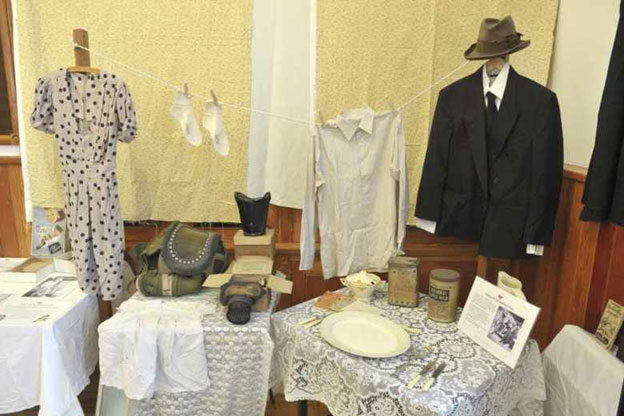 1941 clothing