Palace Hotel

Palace Hotel
Palace Hotel in St Saviour, previously a convent school and, before that, a substantial private home, was destroyed by fire after an explosion during the German Occupation |

|
The Palace Hotel, at Bagatelle, St Saviour - one of the island's finest in the 1930s - was being used by German troops planning a raid on Granville in 1945, when the Cherbourg Peninsular was in Allied hands.
Fire
A fire broke out and in a desperate attempt to put it out it was decided to use explosives and blow a fire-break. Unfortunately, the explosion caused much more damage than planned and much of the building was destroyed.
How the fire started was a mystery for many years. There had long been a suggestion that Norman Le Brocq and others started the fire at the Hotel as an act of resistance. This was the subject of ongoing debate until the release of a letter in 2024 by one of those involved confirmed that a Jersey resistance movement was behind the explosion and blaze.
The German who used explosives to put the fire out was explosives expert Hans Kableman, who was stationed at the Aberfeldy Hotel and was called to The Palace to help out. He miscalculated and ammunition stored partly for the Granville raid went up too.

2017 letter
This report appeared in the Jersey Evening Post in June 2024:
A confession letter from beyond the grave appears to have solved the near 80-year-old mystery of what caused a deadly explosion at a German base just weeks before Liberation. The destruction of the Palace Hotel in a series of blasts which left nine soldiers dead and dozens injured has long been subject to rumour and speculation.
But a hand-written letter by wartime carpenter Gordon Frederick Huish appears to have finally revealed the truth: the hotel was bombed by a resistance group with the help of a mutinous German soldier and Mr Huish – then aged just 17 – unwittingly delivered the detonating device.
In the letter, written on 7 March 2017, the former Islander describes in great detail the events which he believed led to the destruction of the grand 150-bedroom hotel, off Bagatelle Road, which had been requisitioned by the Germans and used in-part as a munitions store.
“As I am approaching my 90th year, and am the sole survivor who knows the true story of the events of 7 March 1945, which led to the destruction of the Palace Hotel, I will describe truthfully exactly how it happened,” he wrote.
Mr Huish explained how he was approached by Norman Le Brocq – a key member of Jersey’s loosely grouped resistance movement and a future States Member – who asked him if he would be willing to deliver a parcel. Two days later he handed the package to a German soldier known as “Willi”, who he had been introduced to the previous day.
“Willi was waiting at the entrance of the hotel,” wrote Mr Huish, who moved to New Zealand after the war and died last year. “When I gave him the parcel, which by its weight, and feeling the terminals through the thick brown paper, I thought was a car battery, he smiled and I kept walking up Mont Millais.
“Then I heard a very loud explosion. Shortly after, a lot of German field ambulances came tearing down the road. I began to feel uneasy and instinct told me in some way to get out of the area as quickly as I could.
“I have to state that when I picked up and delivered the parcel, I did not know the purpose for which it was intended.”
It is believed that in a desperate attempt to create a fire break to control the blaze, the Germans set off a number of explosions with disastrous consequences, ultimately leading to the total loss of the hotel.
Following the war, Mr Huish learnt that “Willi’s” real name was Obergefreiter Paul Mülbach, a German soldier and chemist who became an important figure in the resistance movement and was a known associate of Mr Le Brocq.
The letter publicly states for the first time that Obergefreiter Mülbach deserted the army after the incident and spent the rest of the war hiding out at 3 Hue Street – where the soldier met Mr Huish and Mr Le Brocq the day before the explosion.
Family account

Although there has long been speculation that Obergefreiter Mülbach and Mr Le Brocq had played some part in the destruction of the hotel, it is the first time the name Gordon Huish has been linked to the incident.
From her home in New Zealand, Mr Huish’s daughter, Anna Huish, said: “It was my father’s express wish that the truth be told. One day he said to me that he wanted to tell the story of what happened at the Palace Hotel as he thought it was important that the people of Jersey knew what had really happened.
“I said that he should write down his account as a first step. I think the reason dad had been quiet about it for so long was because he was afraid of repercussions and, indeed, when I read what he had written, I also thought there might be consequences, so I consulted with one of my university friends who is a lawyer and very interested in the history of the war. His advice was to wait until dad died before showing the letter to anyone.”
She added: “A few years later, my friend changed his mind and thought it would be all right to go ahead as it was unlikely that anyone who had an interest in the hotel, for example the insurers, would still be in existence, but by that time dad and I were occupied with other things.”
Ms Huish, who handed the letter to Jersey Archive during a recent visit to the Island, said that she “wasn’t particularly surprised” when she read her father’s account of what had happened, and had been told the story previously by another family member.
“Dad had been arrested twice by the Germans – once for stealing bread and another time for trying to chop a tree down. Also, he and some of his friends decided to escape from the Island on a boat. When my grandmother heard of the plan, she asked the police to lock him up for his own safety, which they duly did.
“I did ask him why the Communist Resistance had chosen him to carry the parcel and he said it was because of his political beliefs – dad became a communist during the war and remained so for the rest of his life. I personally think it was because they knew he was a rash young man.”
Historian Ian Ronayne said that the letter may have finally solved one of the mysteries of the Occupation.
“It is known that the Germans were training up there [the hotel] for a raid in Granville, so it was thought that it could have been an accident. But there has always been an air of mystery over what exactly caused it.
“If this letter is true – everything in it seems to fall into place – then the mystery may finally be solved.”
Damages claim
After the Occupation the owners claimed for the damage to the hotel under the Channel Islands Rehabilitation Scheme. It had been more or less destroyed by fire after the explosion - and the claim was for £50,374 3s 10d, plus one or two other minor claims for outbuildings, etc.
The bang was big - Charles Langlois, near Swiss Valley, claimed £30 for damage to his greenhouses from the blast - a fair way away from the blast site.

History
The demise of the hotel during the Occupation has been well documented, but the earlier history of the premises is not so well known. What became a hotel started life as the residence of Philippe d'Auvergne, a prominent figure in Jersey's history, was then rebuilt by an affluent Bailiff of Jersey, before becoming a convent school.
The foremost Jersey historian of the 20th century, the Rev George Balleine wrote in an article in the Annual Bulletin of La Société Jersiaise in 1959 that Philippe d'Augergne, the so-called Prince de Bouillon:
- 'Bought a house in Jersey, about a mile from the Town, which he called Bagatelle. A contemporary calls it "a truly elegant and splendid residence"'.
- 'He had deer browsing in his grounds, and at first he opened them to the public, but in 1808 he announced “with pain, that, owing to the damage done, he was forced to make certain rules". One was that visitors must not cut up his gravel paths by wearing pattens.'
Balleine's article was probably based on a 1947 biography by Philippe Le Geyt dit Rauvet, also published in the Annual Bulletin, which stated:
- 'After France's naval power was crushed at Trafalgar he took up residence at La Bagatelle and enjoyed considerable popularity as chief man in the Island.'
Belvedere
The first house here was called Le Belvedere and was built by Francois Marett on land called La Vallée Colette which he acquired from Louis Nathanael Jean Brohier, probably on 25 October 1800. Brohier was then 41 years old, and single, and it would be another 12 years before he married, and two years after that before an heir, also Daniel, was born.
Francois Marett lived less than two years after building the house, and it was inherited by his nephew, also Francois Marett. There are so many Maretts named Francois in records of this era that we have not been able to establish with certainty where these two fit into the family trees.
However, the only relevant burial record at this time is Francois Marett of St Lawrence, buried on 2 June 1801. There is a Francois in the Avranches Manor branch of the family who died in that year, and he had a nephew Francois (1773-1850), eldest son of his eldest brother Philippe. So it seems reasonable to assume that these were the owners of Belvedere.
Philippe d'Auvergne
The younger Francois sold the property on 17 April 1802 to Son Altesse Serenissime Philippe d'Auvergne, Prince et Duc Souverain de Bouillon etc, who was represented in Court by his Advocate, Thomas Le Breton. d'Auvergne was a high ranking naval officer and heir to the duchy of Bouillon, and a considerable fortune, as explained in detail in a number of articles in this website.
D'Auvergne first appears in the land registry in September 1798, when he sold a house in Rue de Derriere (later King Street), St Helier, (adjacent to a house which had belonged to Charles d'Auvergne, his late father) at which time he was also described as "Capitaine de [illegible] de l'Armée Navale de sa Majesté Brittanique.....". He had evidently inherited this and other property from his father Charles prior to September 1790 and, by no later than December 1799, was married to Rachel d'Auvergne, née Payn, who owned land in St Ouen.
He spent so much on a legal action to try to secure his French inheritance, after the Duchy had been abolished and all its assets declared communal during the French Revolution, that he died penniless in 1816. His lawyer was clearly alert to the situation because on 20 October 1817 Thomas Le Breton acquired Bagatelle and the surrounding land from d'Auvergne's creditors.
The attorneys of the creditors had taken a transfer of the property from Edouard d'Auvergne, principal heir in the collateral succession of Philippe d'Auvergne, by an Act of Court dated 19 April 1817, which enabled them to sell it on to Le Breton. Le Breton acquired other pieces of land from 1817 onwards, expanding the size of the property.
It appears that Edouard D'Auvergne was the younger half-brother of Philippe, by their father's second wife. Philippe had three elder brothers, who had presumably predeceased him, and there was one other younger half-brother, Corbet James d'Auvergne
Thomas Le Breton
The house was eventually rebuilt by Bailiff Thomas Le Breton, and subsequent photographs indicate that the home created for him would continue to stand at the centre of a much enlarged building in later years. After his death, the property was sold on 4 April 1840 by his son Thomas, to Francois Godfray, another prominent lawyer. Bagatelle was obviously a substantial holding as the land was described as being in excess of 56 vergées.
On 29 August 1859 the property was sold by Francois Godfray to Isaac Pothecary. When he was later declared bankrupt, Francois Godfray, as principal creditor, retook ownership of Bagatelle. He died within days and in 1868 his son Francois Amiraux Godfray, sold Bagatelle to Elizabeth Noel, who in turn sold it two years later to Mary Elizabeth Ainge and Juliana Pitchers Ainge. Mary Elizabeth and William Ainge Gunner, Juliana's principal heir, sold the property in 1880 to Angelina Marie Levrel, nee Rousseau, wife of Louis Julien Levrel.
School
The sisters of the Faithful Companions of Jesus (FCJ) originally ran a school at St Matthews, Coin Varin, St Lawrence, before closing it and concentrating on Val Plaisant, in the town of St Helier, and Bagatelle. The sisters who came to Jersey, eventually established Beaulieu Convent.
Property ownership by the Catholic Church is somewhat confusing, because early transactions involved individuals on behalf of a single order.
Daniel Joseph O'Sullivan, Maurice Slattery and Stephen Kyne acquired the property on 19 December 1903 from Angelina Marie Levrel, nee Rousseau. The priests were not resident at the time, being represented in Jersey by those holding powers of attorney on their behalf.
When the property was transferred in 1914, the nuns all appeared in Court personally, so they were in the island, but the priests not so as they were represented by the attorney. There is no mention of any particular religious order in any of the contracts. It was quite usual at that time for real property to be acquired in the personal names of various priests/nuns although the practice could be fraught with difficulty. If one died intestate, his/her share could devolve to their heirs-at-law and not the remaining co-owners. It later became practice to acquire property in the name of some form of body corporate or religious trust.
It appears that the property was used for religious purposes between 19 December 1903 and 10 August 1929. It was a substantial educational establishment which issued prospectuses presumably designed to attract pupils from outside the island.

Hotel
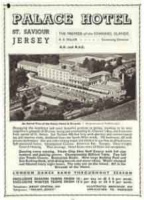
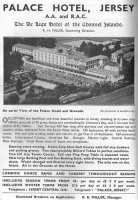
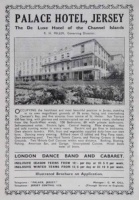
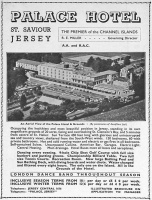
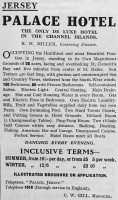
Bagatelle was eventually closed as a school in or about 1927 and on 10 August 1929 Robert Henry Miller bought the property from Mary Kennedy, Anastasia Lambert, Margaret Gleeson, Mary Ann Devine, Ellen Carlin and Violet Spicer. His plans to turn the school into a hotel must have developed rapidly because it had been converted no later than 15 February the following year, when Robert Millar sold the property (described for the first time as "a certain house or houses now called 'Palace Hotel' recently built by the Vendor and in which is incorporated the main house called 'Bagatelle'...") to "Palace Hotel (Jersey) Limited".
On 25 May 1935 Millar sold the remainder of the property he had acquired to the same company so that all the property he had originally bought was reunited into the name of the holding company. The company was represented by one of its directors, Robert Edwin Millar, perhaps Robert Henry Millar's son.
In October 1942 Robert E Millar was also named as director of the company when agreeing to a grant of drainage rights through part of the company's land to a third party, so the family connection appears to endure into the German Occupation.
After an 18-year gap in the land registry, the company sold the sites of the hotel and other buildings on 8 October 1960 to Associated Builders and Contractors Limited ('flats formed in part of an old hotel building') and 'a certain ruined building (formerly the 'Palace Hotel') to Palace Investments Limited on which was built a couple of housing developments.
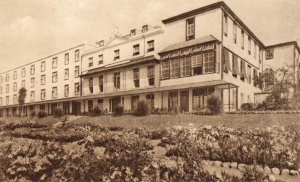
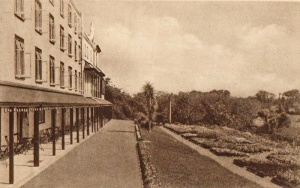
Pictures of Bagatelle as a school and then as a hotel indicate that all that happened was that a large extension, housing bedrooms, was added at one end of the existing building, which itself consisted of the Thomas Le Breton house and an extension on the right.
-
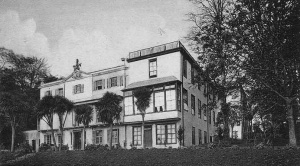 FCJ at Bagatelle. The original house is on the left, and the extension built for the Sisters to the right
 -
-
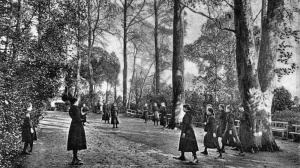


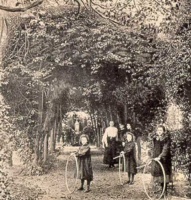
Pictures from a prospectus for the school at Bagatelle


-
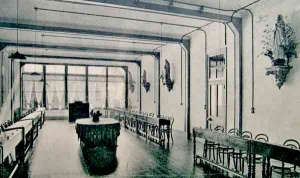 Study areas at the boarding school
 -
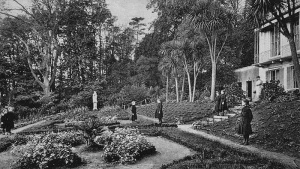 The gardens at Bagatelle
 -
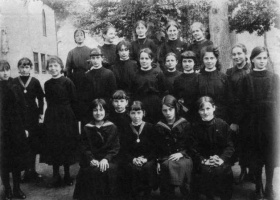 1917
1917 -
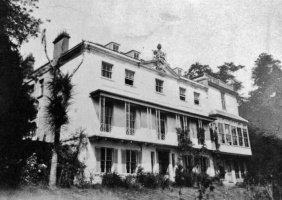 The convent before conversion to a hotel
 -
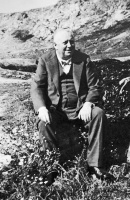 Robert Henry Miller, who turned the former convent into a hotel
 -
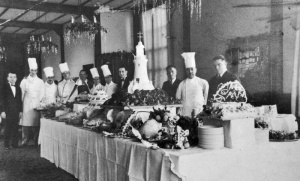 1930s
1930s -
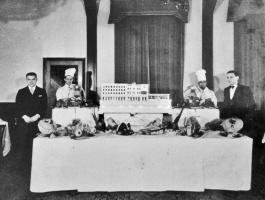 1930s
1930s -
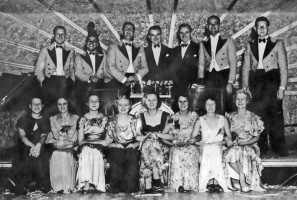 A hotel cabaret
 -
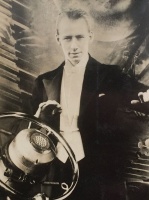 Ray Noble, a friend of the owner and regular performer at the hotel
 -
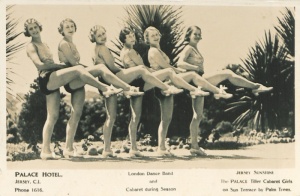
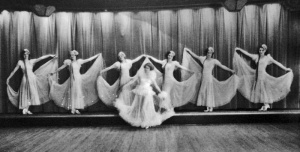 Tiller Girls at the hotel in the 1930s
 -
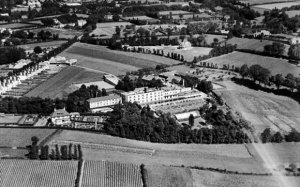 1933
1933 -
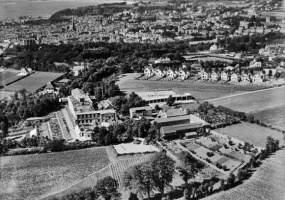 1933
1933 -
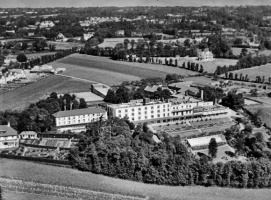 1933
1933 -
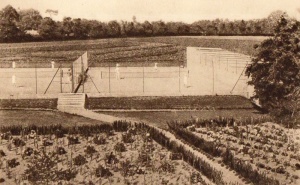
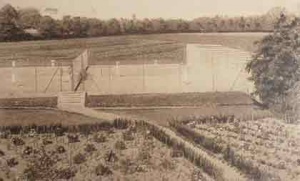 Palace Hotel tennis courts
 -
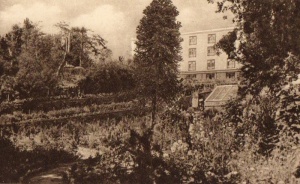
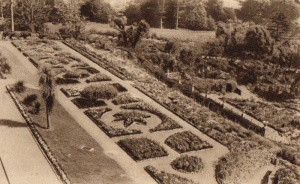
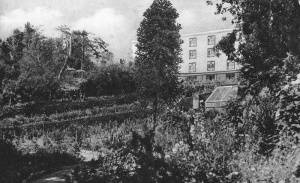 The hotel gardens
 -
-
-
-
-
-
-
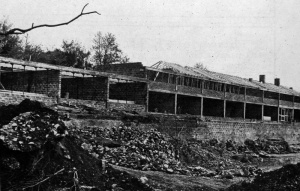 Building houses in 1965
 -
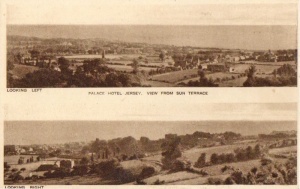
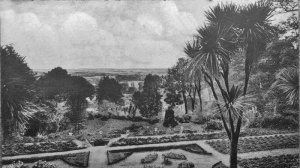 View of the hotel gardens and beyond
 -
-
-
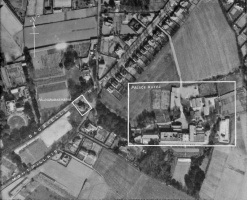
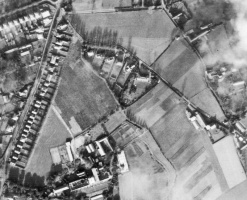 A 1945 aerial photograph
 -
-
-
-
-


-
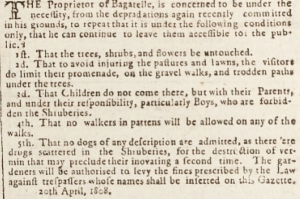 The owner advertised the terms under which he was prepared to allow public access to his land in Gazette de l'Ile de Jersey in 1809