Privateering

Privateering

Privateering can sound glamorous, but it was nothing like it
for the crews of the vessels involved
Many people wonder how Jersey, a small island in the English Channel, could have developed into such a wealthy community over the centuries. One important answer is that much of it was plundered on the high seas by privateers operating out of the island.
Islanders had long dreaded the periods of war between Britian and France, which put them at risk of invasion by enemy forces who destroyed buildings, demanded large ransoms and generally raped and plundered. Some enterprising islanders began to realise that they could put periods of conflict to their advantage by operating as privateers, harrassing and capturing enemy vessels and their valuable cargoes in the waters of the English Channel. These licensed pirates - sometimes they operated on the borderline of legality without the proper authority of the English King - brought their booty back to St Aubin, then Jersey’s main port.
Timeline
- 1642-1651 English Civil War: 12 privateers licensed by Sir George Carteret take 125 prizes
- 1689 William III bans all trade with France
- 1692-97 Eight Jersey privateers captured 46 prizes
- 1703-1711 38 Jersey privateers took 151 prizes
- 1757 Captain Le Cronier of La Defiance captures 9 prizes worth 486,440 livres
- 1778 According to a French Commander in Cherbourg over 150 prizes were taken by Jersey privateers this year. The Lively, a Jersey privateer, was captured and the crew were held prisoner in La Rochelle
- 1793-1795 42 Jersey boats were captured by French privateers. This was two thirds of the island's shipping
- 1798 The privateer Herald engages three French ships in the Bay of Naples
- 1806 258 Jersey seamen held as prisoners of war by the French
- 1807 In two months Robert Surcouf, a corsair from St Malo, captured prizes worth nearly 30,000 livres
- 1856 Declaration of Paris specifically bans privateering

Civil war
Privateering was essentially an activity permitted when Britain was at war with another country, but the first Channel Island privateers were active during the English Civil War, when Jersey's Royalist Bailiff and Lieut-Governor assembled a fleet which attacked Parliamentary vessels, partly as what Carteret saw as an act of war, partly to fund his fight against Parliamentarians in Jersey, and undoubtedly partly to help him amass a personal fortune.
These activities were not immediately brought to a halt when Sir George was forced out of Jersey following a parliamentary invasion, because he was able to base his fleet in the French port of Brest, until various treaties meant that he could no longer operate what had become something of a one-man war.
Foreign wars
Whether Sir George Carteret's maritime exploits in the English Channel during the 1640s and '50s can properly be termed privateering (his enemies referred to him as a pirate), it was not until 1689 that privateering by Channel Island vessels was internationally recognised when William III cancelled the neutral status of the islands, which dated back to a Papal Bull in 1483, and allowed Letters of Marque to be issued to island-based vessels. The intention was that any person whose property had been seized by an enemy would have an opportunity to recoup their losses, but effectively any authorised vessel was given a free hand to attack any enemy vessel, or vessels trading with an enemy. The fact that the enemy was usually France over the next 125 years or so opened the door wide for enterprising Channel Island shipowners and their captains.
Island shipowners were quick to take up the chance and during the French wars (1692-1697) there were 22 Guernsey ships engaged in privateering and only eight from Jersey, although this small fleet managed to capture 46 prizes over five years. The oldest recorded Letter of Marque referring to Jersey was granted to Jean Mauger in 1692 for his 30-ton boat Jersey Sloop.
During the war of 1703-1711 the number of Jersey privateers had risen to 38, between them capturing 151 prizes. But Guernsey had a richer merchant class at the time and a better harbour and its much larger fleet took 608 prizes.

18th century
Jersey privateer activity was at it peak in the 18th century, when Britain was at war nearly half the time with various European maritime nations, 36 years with the French. The most respectable of island businessmen, including Jurats and States Members, seized the opportunity to assemble a fleet of privateers as soon as war was declared and make as much money as they could, as quickly as possible.
Theirs was the financial risk; it was their captains and crews who ran the risk of being captured by the French and languishing in prison, often for many years, until a peace treaty allowed their release.
Not all Jersey vessels which took enemy vessels set off from port with this objective in mind. Most merchant vessels carrying out normal trading voyages would be heavily armed as a defence against enemy privateers and when a suspicious vessel was encountered, enterprising captains would either sense that attack was the best form of defence, or simply seize the opportunity to add to their incomes, and those of their owners.
St Malo was a renowned privateering centre, and many Jerseymen ended up as prisoners-of-war of the Breton corsairs. In the first two years of the French Revolutionary Wars (1793-1795), 42 island vessels and 900 crew members were captured by the French. This represented two thirds of the Island's shipping and not an insubstantial proportion of the Island's population. The loss of a vessel, sunk or captured by an enemy ship, was a major financial blow to her owners. Some of them undoubtedly made fortunes, others were bankrupted.
But overall there is no doubt that privateering, alongside general maritime trade, was a major contributor to the affluence of a small island community which had previously relied on farming and fishing to survive. How much of the wealth accumulated by the successful privateer owners actually filtered down to the community at large is a different issue, however.

Privateering in detail
Many records of privateering activities survive in various archives, including the library of La Société Jersiaise, which includes documents relating to the interrogation of the captains of captured vessels, inventories of cargoes and prices achieved at auction. Many of the following articles are based on these records.
- The Corsairs of Jersey a 1930 article from the Annual Bulletin of La Société Jersiaise Added 2016
- Privateering in the Civil War
- Civil War privateer Thomas Amy Added 2019
- Philippe Dumaresq, privateer, a Jerseyman who became an American privateer against the Spanish
- Sir George de Carteret's privateers attack shipping in English coastal waters from the 19th century history of Jersey by the Rev Alban E Ragg
- Sir George Carteret, a biography of the privateering pioneer
- Letters of Marque list
- A privateer's tale A narrative of a privateer's life by Captain Philip Besom 1760-1836

- Contemporary reports of privateering involving Captain Le Cronier
- Thomas Pickstock, a famous Jersey privateer
- Daniel Messervy, shipowner, the Jurat who assembled a large fleet of privateers during the Seven Year War with France
- Pierre Labey, privateer
- Barnaby Vicq, a tale of privateers, captured vessels and court hearings
- The rules governing privateering
- Prize courts and distribution of spoils
- Lively
- Charming Nancy
- Iroise
- Heart and Dragon
- Pastris
- Vulture
- Neptune
- Charming Betty
- The Peter
- Notes on privateering in the Seven Year War
- Noisy welcomes for privateers annoy the States
- Privateers' passport trick backfires
- A chance capture
- Clement de Quetteville
- Privateers and St Aubin
- Privateer Jean Syvret Added 2016
- Privateers in French prisons Added 2016
- Jersey ships sailing from Honduras were frequently captured by foreign privateers Added 2016
- Payments to privateers in French prisons Added 2024
Guernsey privateers
See Guernsey Letters of Marque for a full list of Guernsey ships issued with Letters of Marque during the 18th Century.
-
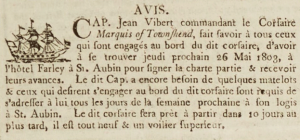 Capt Jean Vibert asked all those engaged as crew of the corsair Marquis of Townshend to sign their charter and receive their advances at Hotel Farley at St Aubin in ‘’Gazette de l’Ile de Jersey’’ in 1803
 -
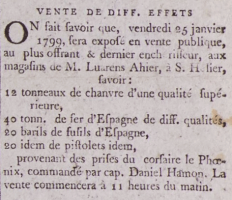 Daniel Hamon, captain of the privateer Phoenix, offered hemp, Spanish iron and rifles and pistols taken by the privateer Phoenix, in Gazette de l'Ile de Jersey in 1799
 -
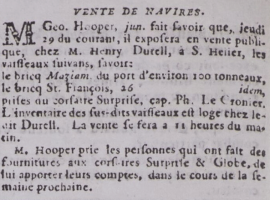 George Hooper advertised the sale of the brigs Maziam and St Francois, taken by Capt Philippe Le Cronier's 25-ton privateer Surprise in Gazette de l'Ile de Jersey in 1798
 -
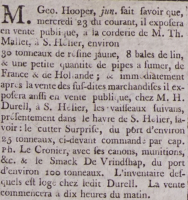 The following year he advertised a sale which included resin and linen, followed by the Surprise and the captured 100-ton smack De Vrindshap
 -
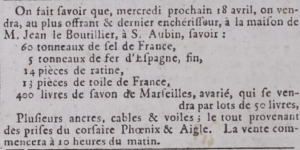 Jean Le Boutillier, of St Aubin, advertised in Gazette de l'Ile de Jersey in 1799 60 tons of French salt, five tons of Spanish iron, Marseille soap and other items captured by the privateer Phoenix and Aigle
 -
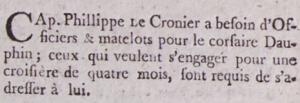 Capt Philippe Le Cronier advertised for officers and sailors for a four-month voyage on his privateer Dauphin in Gazette de l'Ile de Jersey in 1799