Robbers transported to Tasmania

Robbery with violence in St Saviour in 1848

Two 17-year-olds convicted of robbery and attacking a mother and daughter in their St Saviour home in 1848 are known to have been transported to Tasmania. Their two 20-year-old co-accused were sent to a convict hulk in Bermuda
In the early hours of 16 May 1848 four young men armed with pistols broke into a cottage on St Saviour's Hill and terrorised the occupants, a mother and her daughter, making threats to kill them if they did not hand over their valuables.
After tying their victims up with cords, they ransacked the house and then escaped with money, a silver plate and spoons, and the rings the women were wearing.
14 years transportation
They were soon captured and found guilty of robbery with violence by a Royal Court jury in August the same year. Each was sentenced to 14 years transportation.
Two of them were sent on a convict ship to Australia, one with his sentence reduced to seven years, and the other two were sent to a prison hulk in Bermuda, eventually to return home.
The robbery was reported in the Jersey Times of 19 May 1848 and was the lead story in the fourth edition of our digest of that newspaper's content in December 2019. Their conviction and sentence was reported in a very brief item in the eighth edition in January 2020.
Since then we have been trying to piece together more details of the lives of the robbers, both before their shocking attack on the mother and daughter, and after. They were 17-year-olds Edward Boudet and James Walker, and 20-year-olds Edward Quenault and James Lancaster. The two teenagers were sent to Australia, the older men endured the much harsher conditions known to have faced convicts sent to Bermuda.
The house they broke into was occupied by 65-year-old Elizabeth Anthoine, nee Payne, the daughter of Philippe and Jeanne, nee du Fresne, and her daughter Ann Cloak (43). Elizabeth was the widow of Nicolas Anthoine, who died in 1827.
Jersey Times report
The Jersey Times report described the events of the night as a 'diabolical deed - one of the most daring and audacious robberies ever committed in the Island ', and continued as follows:
- "On Tuesday morning last, at about two o’clock, Mrs Cloak, residing with her mother, Mrs Anthoine, in a cottage near the Tapon in the Parish of St Saviour, fancied she heard a noise in the house, and by way of precaution got up and barricaded the door of their bedroom. Shortly afterwards, the door was tried and Mrs Cloak, opening the window, jumped out into the garden, but had hardly stepped in when she perceived a man approaching her having his face blackened. She instantly drew back and returned into the room, where three fellows, having all their faces blackened, entered after her, and drawing out their pistols, threatened to shoot both mother and daughter if they uttered the least cry.
- "They immediately asked the alarmed inmates for money, plate and other valuables in the house, which was complied with, and Mrs Cloak was allowed to go alone and fetch the plate which was kept in an adjoining room, they knowing that she could not escape, as one of the robbers had been left outside in charge of the other door.
- "Mrs Cloak, taking advantage of this moment of liberty, hid her gold watch and a small quantity of money in the ashes under the grate. On her return, she gave the money and the plate to the villains, but they, being provided with a dark lantern, perceived some rings on her fingers and demanded them.
- "Not being able to remove them fast enough, one of the brigands threatened to cut off her finger if she did not hurry herself, and drawing a razor out of his pocket compelled her to fall on her knees and, unfastening the strings of her cap, told her he would cut her throat if she made the least noise.
- "The lady, nothing daunted, cried out: ‘Kill me, if you wish, but for the love of God, spare the days of my old mother.’ Mrs Cloak, having given up her rings, the three robbers bound the two ladies together with cords and proceeded to ransack the house, from which they abstracted, besides the money, six silver soup spoons and twelve teaspoons. They then left the house, taking with them a bundle supposed to contain linen. On leaving they ordered the ladies not to stir or utter the least cry, for if they made the least noise for the next hour and a half they would return and shoot them like dogs.
- "The individuals spoke in English and seemed to be under the command of a leader. The unfortunate ladies remaining in this situation until nearly five o’clock in the morning, in the greatest dread of the return of their barbarous visitors, when Mr Thomas Filleul, passing by, seeing the door open, and hearing the cries, entered the house and liberated them. Mrs Anthoine was most dreadfully frightened and was so ill in consequence that her friends have been compelled to call in medical aid.
- "The police of St Helier and St Saviour have been in active pursuit ever since, and we understand that very strong suspicious are entertained of certain parties as being the probable authors of this diabolical deed."
Whether or not those suspicions were well-founded, the four men were apprehended and appeared before the Royal Court in August, being found guilty and sentenced on the 8th of the month. The Court's Transportation Register, which is now held by Jersey Archive, records the judgment, which was confirmed by Bailiff Sir Thomas Le Breton three weeks later.


The men
Details of the men, convicted of 'burglary and theft and having entered the house armed and put two ladies who occupied the same in bodily fear, appear in the register as follows:
- Edward Boudet (17) - One previous conviction for theft; Parents respectable but poor; shoemaker, single; reads well, writes imperfectly; of a taciturn disposition but imperfectly acquainted with the principles of religion
- Edward Quenault (20) - parents poor, brother and sister bad characters; brickmaker, single; reads and writes well; of a taciturn disposition but imperfectly acquainted with the principles of religion
- James Walker (17) - parents respectable but poor; single, barber; reads and writes well; seems to be well acquainted with the principles of religion. Temper rather sullen
- John Lancaster (20) - father dead, mother respectable but given to drinking; single, printer; Reads and writes well; seems to be well acquainted with the principles of religion. Temper seems to be good
The Australian Convict Transportation Registers show the names of those arriving in the country as convicts between 1791 and 1868. There are only 66 men and three women convicted in Jersey who appear in these registers, and among them are Boudet and Walker, who were among 300 men sent to Australia on the convict ship Nile on 27 June 1850. UK records show that they were given prisoner numbers 15586 and 15588, respectively, and that soon after their conviction they were transferred on 14 October 1848 to Parkhurst Prison on the Isle of Wight, to await transportation. It seems that they remained there for nearly two years until the Nile sailed.
Convicts' records
Edward Boudet
Edward Boudet may have been baptised Edouard, because there is a baptism record for Edouard Jean Boudet in St Helier on 7 September 1828. This Edouard was the son of Edouard Boudet and Therese, nee Beaudrie.
Boudet's 14-year sentence, the maximum, was very unusual. Only two others among the 300 had a sentence this long. Most of those on the ship had been sentenced to terms of seven or ten years. The fact that his co-accused, Walker's, sentence was commuted to seven years, would suggest that Boudet was considered to have been the ringleader, but in the absence of a full report of their trial, that can only be supposition.

The Nile took its cargo of convicts to Van Diemen's Land (Tasmania). Convict records from there show that Boudet (his name was recorded as Edouard Boudett) arrived on 3 October 1850, over two years after his conviction, and was given his ticket of leave on 31 January 1854, just under four years into his 14-year sentence.
His record shows that at the age of 19 he was only 4ft 11½ inches tall. His time as a member of a convict gang was not without incident. Only weeks after his arrival he was found to be absent from his gang on 9 December 1850 and sentenced to hard labour. The following year he was twice recorded as having absconded.
His ticket of leave in 1854 would have released him from the convict gangs and given him the freedom to find paid work elsewhere in the community. The ticket of leave had to be carried at all times and the convicts had to remain in a specified area, report regularly to local authorities and attend divine worship every Sunday, if possible. They could not leave the colony. It was unusual for someone serving a 14-year sentence to be given a ticket of leave as early as Boudet - six to eight years was more normal.
A certificate of freedom was issued at the completion of a convict's sentence, as proof that they were free to travel anywhere, and could return home, if they could afford it. They had to save to pay for their passage.
We have not yet been able to discover what happened to Boudet/Boudett after the issuing of his ticket of leave. The name does not appear in further Australian records under either spelling. [1]

James Walker
James Walker is not an uncommon name among those living in Australia in the mid-19th century and it has not proved possible to identify the Jersey convict in other records. We have also been unable definitely to identify him in Jersey records before his conviction. There is no matching baptism record and he was born before birth registration was introduced.
His convict record is brief, indicating that he was not much taller than Boudet, at 5ft 3¾ in. It records that his burglary conviction was discharged in May 1851, only seven months after his arrival in Tasmania. But even with a ticket of leave, he was required to present himself at an annual muster, which was obligatory for all convicts and ex-convicts. He was absent from muster in 1853 and had his ticket of leave revoked on 29 March. The record does not indicate whether he was found after this absence and returned to a convict gang - perhaps not.
Edward Quenault
UK records show that Edward Quenault was taken to Bermuda on the convict ship Neptune, leaving England on 8 February 1849. Convicts sent to Bermuda had the option of seeing their sentences reduced if they agreed to be transferred to a penal colony in Australia, and were generally expected to remain in Bermuda if they opted to be sent home on the completion of their sentence. Those sent to Australia could only return home if they could save enough money for the fare.
Whether or not the newly arrived Quenault was given the option to continue on the Neptune is not known, but the voyage of the ship is interesting, because she next headed for South Africa, with 286 prisoners on board, the intention being to establish a new penal colony there. But opposition in the country caused the plan to be aborted and Neptune took its prisoners to Tasmania. Quenault was not among them.
He was the son of Jean Quenault and Elizabeth Laderman, of St John, where he was baptised on 5 October 1827. Jean was descended from a St Saviour family whose ancestry has been traced back to the 16th century. He and Elizabeth had 14 children, baptised in five different parishes over a period of 26 years. Edouard, as he was baptised, was the eleventh of them.
He clearly did not complete his 14-year sentence because, on 8 May 1855, at the age of 26, he married Sophia Martin, who was 14 years older according to the marriage register [2], in St Helier. The marriage record shows him as Edward, a bricklayer or brickmaker, and his father as John, a gardener. Sophia was the daughter of shoemaker John. Their married life turned to tragedy some years later because in 1867 they were charged with starving a daughter to death. Apparently, from newspaper reports, another child died in the same way two years before. There seems no doubt that this Edouard Quenault was the convict, because the newspaper report says that he was a bricklayer and a ticket of leave man.
The case was widely reported in the UK press. One article reads:
- "Starving a child to death
- "At the Police Court of St Hilier's (sic), Jersey, a few days ago. Sophia Quenault, wife of Edward Quenault, a brickmaker and a ticket-of-leave man, was charged with having caused the death of her infant child by starvation.
- "On the 13th of May she was charged at the same court with drunkenness and neglect of the child. On that oacasion the child was exhibited in the court, and the sight caused a sensation of horror in all who witnessed it. Although five months old, it measured only 17in in length and weighed 2 lb 10 oz. Its legs were no thicker than a good-sized man's finger, and the poor child looked more like an animated doll than a human being. The former on that occasion was sent to gaol for a week, and the child was taken to the general hospital (the workhouse). For two or three days the child could not retain its food, but it gradually recovered strength, and by the end of the week was able to eat well. At the expiration of her imprisonment the prisoner claimed her child, and it was given to her. Two days afterwards the police were informed that the child was dead, and on going to the house where the prisoner lived, found her dead drunk, and the child lying on a table, the room containing nothing else but a handful of straw. On a post mortem examination being made, the stomach of the child was found to be quite empty, the medical officer declaring that death had resulted from starvation. The husband of the prisoner told the police that she had killed her first child in the same way, and he hoped she would be hanged. The prisoner, who had nothing to say to the charge, was committed for trial on the charge of murder."
The only children of the couple we have found in our database of church records were twins Ann Sophia and Edward George, born on 5 January 1867 and baptised in St Helier two days later. A Sophie Quenault, born in St Helier in 1867, was buried there on 27 May that year. [3]
The 1861 census shows the couple living alone at Faldouet, St Martin. Sophia is shown as being two years younger than Edward. The 1871 census shows the couple living in the Cholera Ground, at Cheapside, St Helier, again with no children in the houshold and Sophia shown as being two years younger than Edward.
John Lancaster
John Andrew Lancaster was baptised in St Helier in 1828, the son of James and Mary. James died in 1831 and his widow and 13-year-old son John are shown living in Bond street in the 1841 census. John's occupation was given as pastry cook and his mother was recorded as being of independent means.
His mother petitioned the Home Secretary the January following her son's conviction, claiming that his sentence was both excessive, and also illegal, because 'transportation beyond the seas had never been enacted by any law or statute which extends to Jersey and is unknown to the ancient customs and usages of Normandy'. Her plea was clearly rejected, but her son did not serve his full term of 14 years because he had returned from Bermuda by March 1855 and was held in Portsmouth Prison, where he was recommended for licence. Somewhat surprisingly, only five months later, in August, the St Saviour's Church register shows him being married to Harriet Hunter. He had been discharged and returned to Jersey.
 The record of the convicts' arrival in the UK prison system |
 and their moves |
-
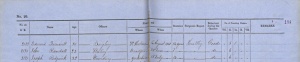 A record of Edward Quenault's time on the Bermuda convict hulk. In 1853 he was transferred from the hulk to the island of Boaz in Bermuda, where the convicts had built barracks. They were all gradually transferred from the hulks, on which conditions are known to have been terrible, with prisoners' beds crammed into confined spaces, with as little as five feet headroom
 -
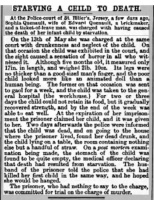 A newspaper report of the appearance of Edward Quenault and his wife's appearance in Court, charged with murdering their baby child
 -
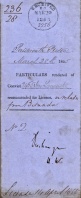 Edward Lancaster's discharge papers
 -
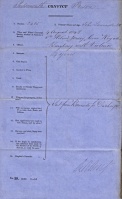 Edward Lancaster's discharge papers
 -
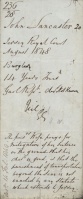 Mary Lacaster's petition
 -
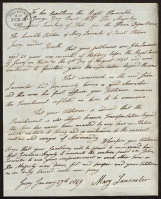 Mary Lacaster's petition
 -
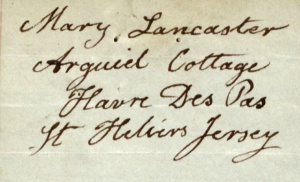 Mary's address from the petition


Notes and references
- ↑ It was quite common for discharged convicts to change their names on release, and many headed for the Australian mainland, where, at this time, the gold rush was at its height. Some made their fortune, others died violent deaths.
- ↑ Later census returns suggest that she may not have been 40, as shown, but only 24
- ↑ We have so far been unable to discover the outcome of the case, although it is believed that Edward was also charged with causing the baby's death. His reference to the death of an earlier child suggests that it was never baptised and may have been disposed of by the couple without the authorities becoming aware