Roebuck

ss Roebuck'

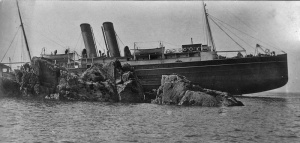
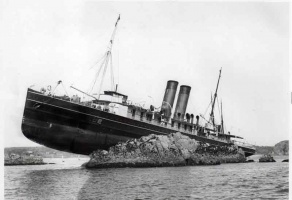
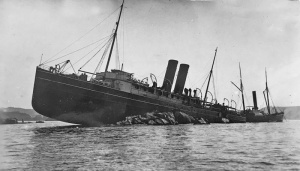
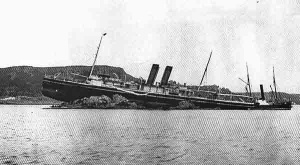
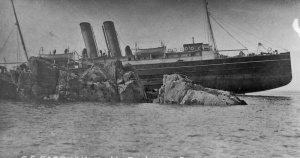
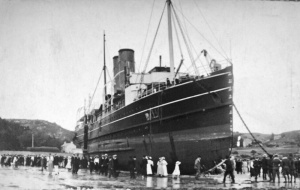
ss Roebuck struck rocks off St Brelade in July 1911. Crowds visited the Roebuck beached in St Brelade's Bay

On 19 July 1911 the Great Western Railway steamer Roebuck, which had been on the Channel Islands route for 14 years, left St Helier Harbour for Guernsey on what should have been a routine voyage.
Calm conditions
There was no wind, the sea was calm, but there was a thick sea mist and after rounding Noirmont Point, the ship, with experienced Captain John Le Feuvre at the helm, struck the Kaines rocks off Fliquet Bay, between St Brelade's Bay and Corbiere.
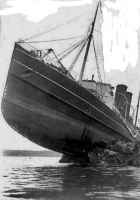
Capt Le Feuvre had miscalculated his position and maintained a speed of 17 knots despite the visibility. His crew lookout spotted swirling water which was the tell-tale sign of submerged rocks, but he turned too late towards open sea and the ship struck the rocks and stayed there, 200 of its 280 feet firmly stuck to the reef, and a 100 foot gash in its side.
Shore out of sight

The shore was less than 300 metres away, but out of sight in the dense mist. Distress flares were let off and the ship's lifeboats were launched and soon joined by the lifeboat and States tug Duke of Normandy from St Helier. Within an hour all the passengers were safely ashore and so calm was the sea that the Duke of Normandy went alongside the stricken Roebuck to take off the passengers' luggage.
A further 20 tons of cargo were taken off the ship, which remaind stuck fast on the Kaines for eight days. The ship was a sensation for locals, who flocked to see it. Vain attempts were made for four salvage vessels to pull it clear of the rocks on high tides from 21 to 23 July, but a pinnacle of rock was penetrating the hull and making it impossible to move.
Beached in St Brelade's Bay
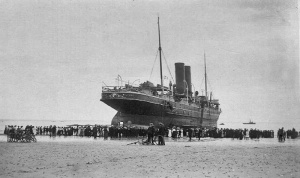
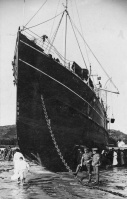
Temporary repairs were made to the hull with wood and cement to allow it to float higher and on 28 July it was finally moved to a safer position on the sands of St Brelade's Bay, enabling curious residents to walk around the massive hull at low tide and have some amazing souvenir photographs taken, many of which survive to this day.
Further repairs were made but on the first attempt to tow the Roebuck back to St Helier she took on too much water and had to be beached in Belcroute Bay. It was not until the middle of August that she reached St Helier Harbour, eventually to be towed to Southampton for permanent repairs.
After a Board of Trade inquiry Capt Le Feuvre's master's ticket was suspended for only three months, despite this being the second time that a Great Western steamer under his command, had hit rocks off Jersey's south coast. Fourteen years earlier he lost his ticket for six months after the Ibex, which had apparently been racing a rival vessel, hit a rock off Corbiere.
The Roebuck returned to the Channel Islands route in 1912 and was then recquisitioned by the Navy in 1914, and renamed HMS Roedean. She sank a year later in 15 fathoms of water at Scapa Flow, after dragging her anchor.
Newspaper report
This information is drawn from an article published in the Jersey Evening Post in 2018, itself based on the newspaper's contemporaneous reporting of the shipwreck
The sight of the Great Western Railway Company's magnificent steamer, the Roebuck, wedged on a reef off Jersey's south coast whipped the island into a frenzy.
Thousands went to see it, either on foot, by bicycle, horse-drawn carriage or car. Within just a few days Jersey Railway estimated that it had taken at least 3,000 passengers to La Moye or Don Bridge stations to behold the sight.
On one afternoon alone 2,000 people were counted on the headland above Beauport. The small steamship Courier began running 'Roebuck Excursions', and the owner of the Alhambra cinema took himself off to the scene, filmed the vessel, and showed the footage at a charge to all those who were unable to get themselves to St Brelade.
Incredible sight
It was an incredible sight, talked up by all who had seen it. Even the Evening Post was seemingly swept away with the hysteria, writing:'There she lies like a great stricken colossus.'
The Roebuck inadvertently ended up becoming the island's star attraction on 19 July 1911, shortly after leaving Jersey for Weymouth, via Guernsey, when, in thick fog, she crashed into the Kaines rocks, 300 yards from the shore near St Brelade's Bay.
The 280-foot vessel was carrying 260 passengers and 44 crew, as well as 20 tons of cargo. Many of the passengers were tourists returning home to England or on a day trip to Guernsey.
Departing St Helier in calm conditions but poor visibility, Captain John Le Feuve set the ship at 17 knots. The fog momentarily lifted, giving the passengers and crew a glimpse of rocks that were closer than many had expected, before the visibility once again reduced.
From the bridge swirling water could be seen a short distance ahead - a sign of rocks - and although the captain ordered an immediate turn to port, moments later there was a violent shock, a long scraping sound and the ship heeled over to starboard and shuddered to a halt, wedged on a substantial rock.
Although badly holed, the ship was stuck fast and in little danger of becoming fully submerged.

The Evening Post quickly dispatched a reporter to St Brelade's Bay by car. He chartered a rowing boat to the scene and penned a detailed description of the ship and the frenzy of excitement which surrounded its predicament.
The perils of fog
Under the headline 'The perils of fog at sea' the paper reported:
- "Great excitement prevailed early this morning, not only in St Helier but throughout the island, when it became known that the Great Western steamer Roebuck had struck a group of rocks known as the Kaines.
- "The Roebuck presented a pitiable sight, Her deck near the bows was almost level with the water's edge, and she gave the impression of being a total wreck. On board the scene was one of desolation."
The passengers, all of whom were unharmed, were taken ashore and back to St Helier in a procession of horse-drawn carriages.
Passenger Mr S Leary, of Bristol, said:
- "I was talking to a friend on deck when, all of a sudden, and before you could say 'Jack Robinson', there was a terrific jar, which shook the vessel from stem to stern. She seemed to crash over one rock to another.
- "There was no panic, and I cannot speak too highly of the courage displayed by the ladies."
Other passengers reported that the fog thickened after Noirmont Point and large rocks could be seen on the starboard side, before the vessel crashed into rocks ahead.
No panic
Harry Eccles, from London, said:
- "There was absolutely no panic, although it took some 18 minutes to get the boats out. The officers and crew behaved very calmly, particularly chief officer Mr Allen, who displayed great coolness in the work to disembark 200 passengers. The experience is one which I shall never forget."
After being patched up and pumped out, attempts to refloat the Roebuck on 21, 22 and 23 July failed. On 28 July, with crowds at every viewpoint from La Moye to Ouaisne, and both the Bailiff and Lieut-Governor watching, the ship was towed, largely submerged, to the beach in St Brelade's Bay.
This heightened the hysteria and queues had to be organised to allow everyone to walk safely past the ship, which still had some of the Kaines rocks inside it.
On 14 August another bid was made to bring the vessel back to St Helier, but the first attempt failed and the Roebuck was beached at Belcroute.
Later that day it arrived back at the town harbour and was eventually taken to Southampton for repairs. An inquiry found that Captain le Feuvre had not followed the proper course and that the vessel was travelling too fast in the poor visibility.
After taking into his account his unblemished career, his master's certificate was suspended for three months.
The Roebuck returned to service in January of the following year. At the start of the Great War she was commandeered by the Royal Navy and renamed HMS Roedean. On 13 January 1915 she became the first railway ship to be lost in war service when she sank off the Orkney Islands after dragging her anchor and hitting another vessel. No efforts were made to raise her.
Jersey Heritage report
This report was published by Bailiwick Express in 2021
On Wednesday, 19 July 1911, the Great Western mail boat steamer, SS Roebuck, left St Helier Harbour at 08:30, with over 200 passengers on board. She was bound for Guernsey before heading to Weymouth after a brief stop. Unfortunately, she didn’t make it. Fog descended on the ship as it went past Portelet. Despite this, the ship continued at full pace. About 20 minutes into its journey in calm seas but thick fog, a shout went up that rocks had been sighted. Evasive action was attempted but it was too late. The Roebuck ran aground on the Kaines reef, off St Brelade.
Flares were released and lifeboats launched to offload the passengers, with nearby vessels going to assist. A newspaper report at the time stated that this was done in an extremely efficient and composed manner. Women and children were sent onto the boats first and, despite some tearful goodbyes, families were soon reunited. The tranquil seas meant that all passengers were rescued with no loss of life.
A message was sent to the Harbour Office that a large steamer was on the rocks off Portelet, but the fog meant that it was difficult to identify which vessel it was. Soon, another call was received confirming that the Roebuck was the ship that was in trouble.
Ships were sent from the Harbour to give aid and after all the passengers were rescued, the decision was taken that as the ship was so securely aground, luggage and cargo could be retrieved.
Local interest in the event was at fever pitch by this point. The Evening Post dispatched reporters to the scene and, as well as talking to the crew and passengers, they chartered a rowing boat to go out to the ship and take photographs.
Meanwhile, the railway worked non-stop ferrying spectators to St Brelade so that they could take in the amazing spectacle. A Mr Le Gallais put a notice in the newspaper warning that after 22 July, if anyone trespassed on his property at Beauport, near the La Moye Signal Station, in order to look at the Roebuck, they would be prosecuted.
Soon enterprising businessmen were at work and a new film called The Wreck of the Roebuck was shown at the Alhambra theatre in Phillips Street, St Helier, with the advertisement saying that it was “taken at great risk”. Postcards were also created to celebrate the event.
Salvage operation
At this point, it was unknown whether the ship would be able to be floated again. The Svitzer Salvage Company, of Copenhagen, was employed to attempt to rescue the vessel and they brought over the steamer E M Z Svitzer to help. Representatives of the London Salvage Association also came to the island.
On 22 July, an attempt was made to take the ship off the rocks but the damage was too extensive for it to succeed and the ship was left to settle back down. Further attempts were made in the following days and work was undertaken at low tide to shore up damage caused by the rocks, with the War Department tug Sir Redvers Buller and States tug Duke of Normandy ready to assist if needed.
Various local dignitaries including the Lieut-Governor Sir Alexander Rochfort and Jurat Falle, President of the Harbours Committee, went to witness the attempts, together with thousands of onlookers.
Finally, on 28 July, the Roebuck was towed and beached at St Brelade’s Bay so that more repairs could take place. Captain Shotton, of the London Salvage Association, declared the successful operation, “a proud moment in my life.”
On 31 July, a newspaper report estimated that at least 20% of the island’s population had gone to St Brelade’s Bay the previous day to see the Roebuck on the beach. Trains were packed to double their capacity, cyclists were out in greater numbers than had ever been seen before and the roads were teeming with horses and carts.
A couple of weeks later, the salvage team decided to move the ship to St Helier Harbour. The operation started well but when she started listing heavily to starboard she was beached once again at Belcroute Bay. It was a temporary stop and the ship was moved to St Helier later that day. She was taken to Southampton on 29 August to be fully repaired.
An investigation followed and on 14 September, the master of the vessel, Captain John Le Feuvre, was called in front of a Board of Trade Inquiry. Although the inquiry had some sympathy with him, it concluded that he was wholly at fault, due to the fog and overconfidence in the local waters. His certificate was suspended for three months.

Gallery
-
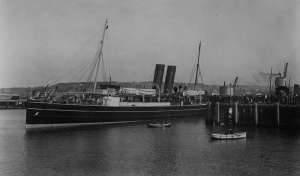
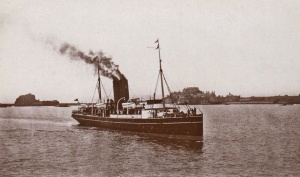
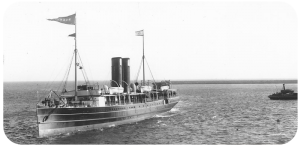 Roebuck approaches St Helier Harbour in 1897
 -
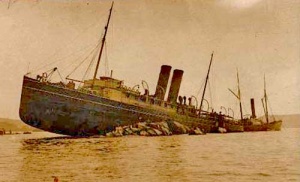 Stuck fast on the rocks off Jersey's south-west coast
 -
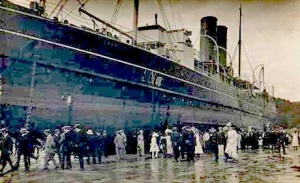 Crowds flocked to visit the beached vessel
 -
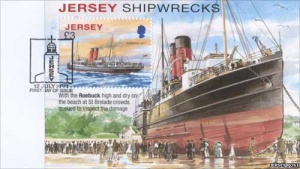 Jersey Post Office has issued a set of stamps commemorating shipwrecks in 2011 to coincide with the Roebuck disaster
 -
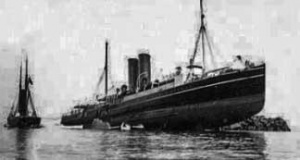 A tug and four salvage vessels could not move the Roebuck at first
 -
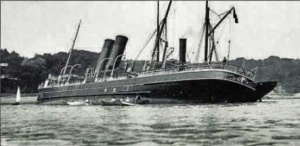 The severely samaged ship heeled to starboard but did not break up, despite spending ten days on the rocks
 -
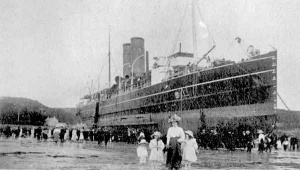 The wider scene as crowds gather in front of the stranded Roebuck
 -
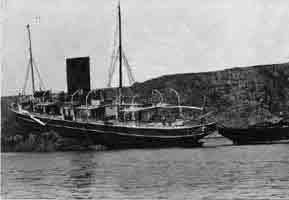
-
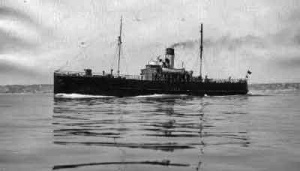 Maiden voyage in 1897
 -
-
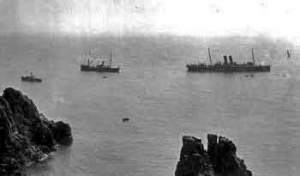 Salvage operation
 -
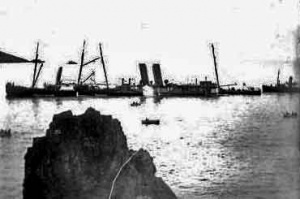 Salvage operation
 -
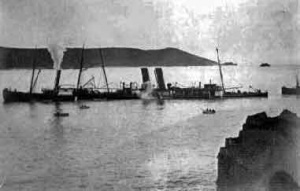 Salvage operation
 -
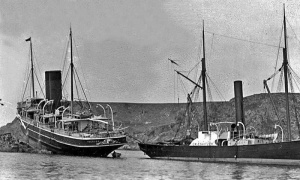 Taken in tow by the Emsvitzer
 -
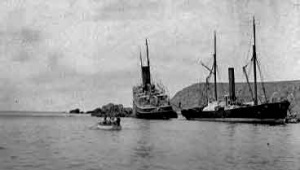 The tug Emsvitzer takes the Roebuck in tow
 -
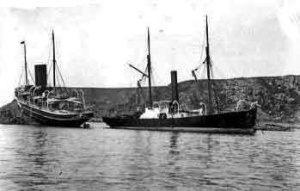 The Emsvitzer and the Roebuck
 -
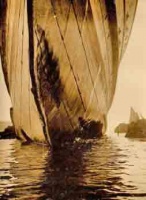 A close-up of the hull, showing the damage
 -
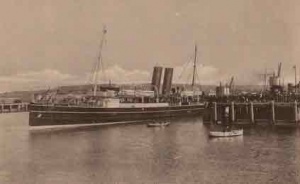 The Roebuck arrives at St Helier
 -
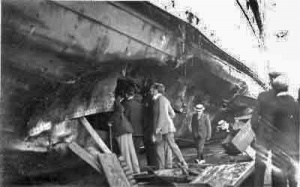 Examining the damage to the hull
 -
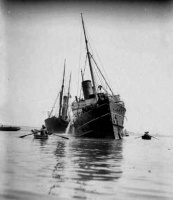 Francis Foot photograph of attempt to refloat the vessel
 -
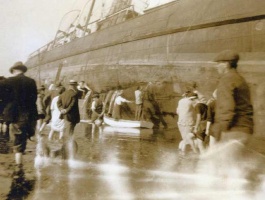 Examining the hull
 -
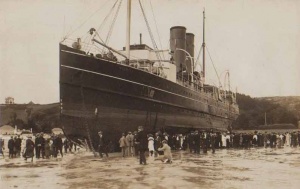 On the beach
 -
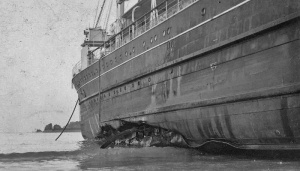 The damage to the hull
 -
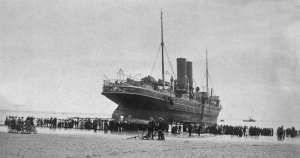
-
-
 Roebuck on the rocks
 -
 The first Roebuck on the rocks


-
 The Roebuck aground on rocks in Ouaisne Bay
 -
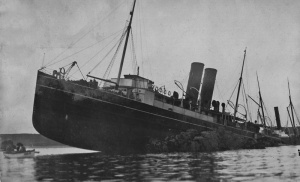 The Roebuck in July 1911
 -
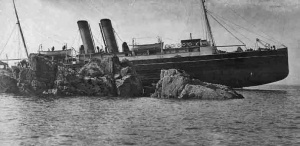 Roebuck
 -
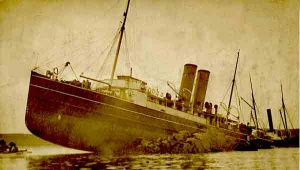 Roebuck
 -
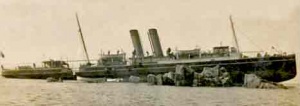 Roebuck
 -
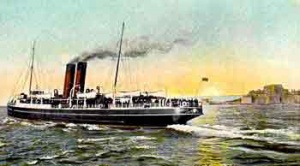 Roebuck in 1907
 -
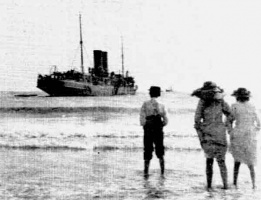 Roebuck beached
 -
-
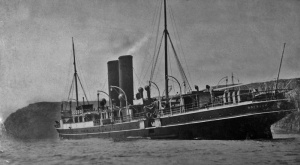
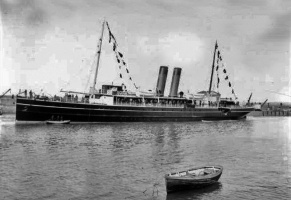 Roebuck dressed overall, probably on her maiden voyage to Jersey, photographed by Philip Morel-Laurens
 -
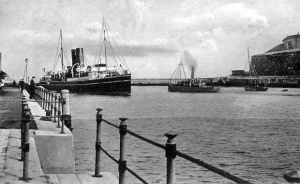 Roebuck at Weymouth
 -
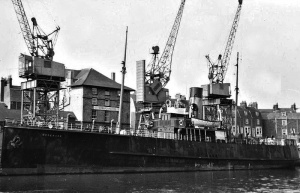 Roebuck
 -
-
-
-
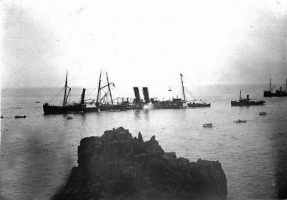 Salvage operation
 -
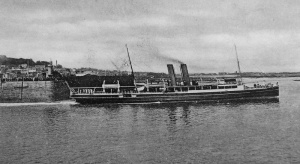 Leaving St Peter Port, Guernsey
 -
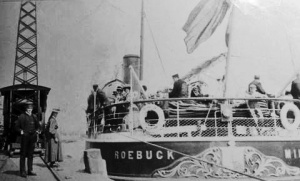 Roebuck at Weymouth
 -
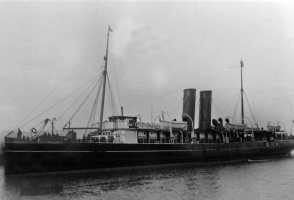 1897
1897 -
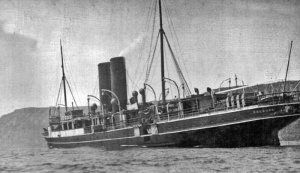
-
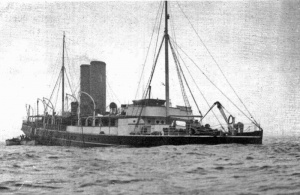
-
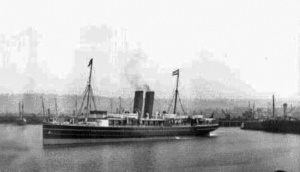
-
 JWS postcard
 -
-
-
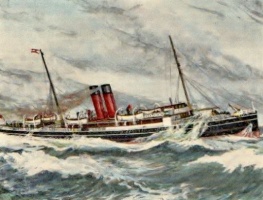 A cigarette card
 -
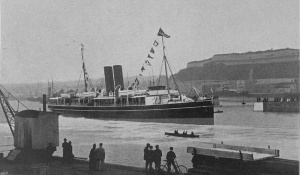 Roebuck in 1897
 -
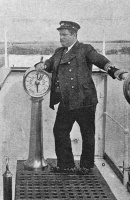 Capt Romsey, 1897
 -
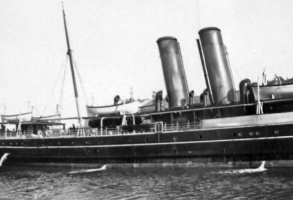 1910 photograph from amateur photographer G W McDougal's album held by Jersey Heritage