Saint Ouen

Saint Ouen

A group of ladies outside the Parish Hall in 1916
Saint Ouen is one of the 12 parishes. It is in the north west of the Island. It is the largest parish by surface area, covering 8,341 vergees

This is reputed to be the most traditional of the parishes, being the farthest from Saint Helier and with much of the territory of the parish forming a peninsula. Its manor - the seat of the De Carteret family for over eight centuries - is the senior fief in the island, and the influence of that family has also been a factor in the parish's independent-minded approach to its affairs.
Culture
A number of the most influential writers of Jersey have been St Ouennais. George Le Feuvre (1891 - 1984), who wrote under the pseudonym George d'la Forge, was one of the most prolific authors of Jèrriais literature of the 20th century. Frank Le Maistre (1910-2002), compiler of the Dictionnaire Jersiais-Français (1966), did much to standardise the St Ouennais dialect of Jèrriais as a literary language. Edward Le Brocq (1877-1964) wrote a weekly newspaper column from 1946 to 1964 recounting the lives and opinions of two St Ouennais characters, Ph'lip and Merrienne.
The traditional nickname for St Ouennais is Gris Ventres (grey bellies) - a reference to the custom of men from the parish to wear jerseys of undyed wool, which distinguished them from men from other parishes who generally wore blue.
A number of prehistoric sites are located in St Ouen, including the dolmen des Monts Grantez, located at Le Chemin des Monts; the dolmen des Geonnais; and the prehistoric site at Le Pinacle, which also contains one of the very few identifiable Gallo-Roman sites to be seen in Jersey, the foundations of a fanum (small temple).
Helier de Carteret, the seigneur of the parish, received a charter from Queen Elizabeth I to colonise Sark with 40 families from the parish on condition that he maintain the island free of pirates. Sercquiais is therefore a very old offshoot of St Ouennais.
In the north west, the ruins of Grosnez Castle are a landmark which also features on the Jersey 50 pence coin. The Island's racecourse is also to be found at Les Landes.
Twin towns
Saint Ouen is twinned with:
- Coutances in France
Cueillettes
Unlike the other parishes of Jersey, the subdivisions of this parish are not named vingtaines, but cueillettes. Vingteniers are still elected, however, in the cueillettes.
- Petite Cueillette
- Grande Cueillette
- Cueillette de Grantez
- Cueillette de Millais
- Cueillette de Vinchelez
- Cueillette de Léoville
St Ouen forms an electoral district with St Mary and St Peter, which elects four Deputies.
Constables


-
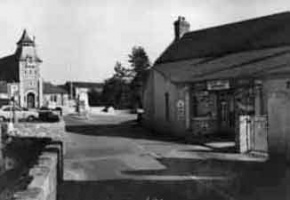 St Ouen’s Parish Hall
 -
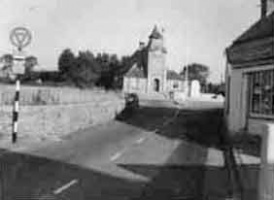 St Ouen’s Parish Hall
 -
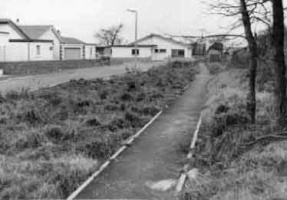 St Ouen’s Village 1972
 -
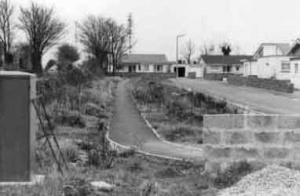 St Ouen’s Village 1972
 -
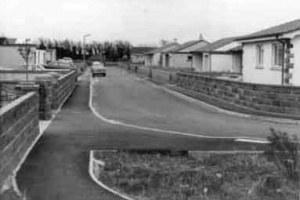 St Ouen’s Village 1972
 -
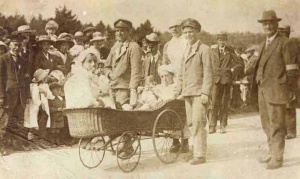 St Ouen's Fete 1907
 -
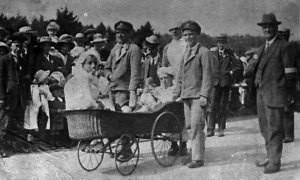 St Ouen's Fete 1907
 -
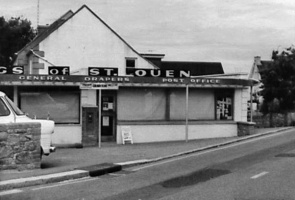 Post office
 -
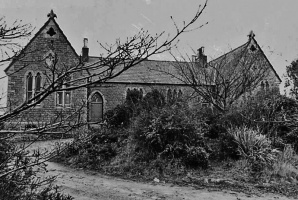 Parish school
 -
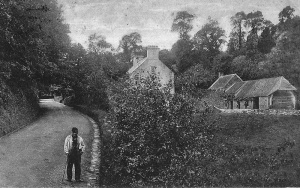 A lane in the parish
 -
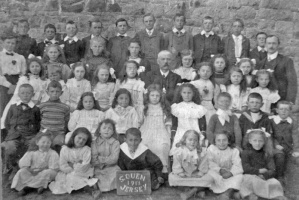 St Ouen Sunday School pupils in 1911
 -
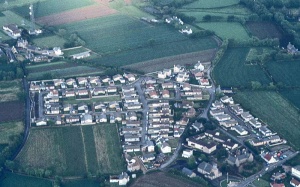 St Ouen's Village from the air in 1977
 -
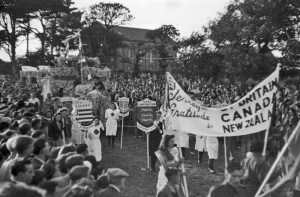 Carnival at Trodez in 1946
 -
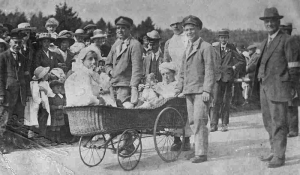 St Ouen Fete 1907


Planning Office pictures
These photographs of St Ouen's Village and the roads approaching it were taken by the Planning Office in 1978 as part of a detailed review of the area, with recommendations for further development and the planting of trees to improve the aspect of several open roads.


Links
Notes and references
- ↑ Also Jurat, from 1505, and Lieut-Bailiff in 1532. One of the younger sons of Seigneur of St Ouen, Philippe de Carteret and Marguerite, nee Harliston. Died in office
- ↑ Married Guillemine Herivel, daughter of Nicolas. Died about 1543. Partage in 1543 involving Jacques, Simon and several minor children
- ↑ Exact dates uncertain. Elder son of Pierre, above. Jurat in 1549
- ↑ Son of Benest Le Brocq and daughter of Laurens Costil, son of Drouet. Father of Richard, married to Jeanne, daughter of Samares Seigneur and Jurat Clement Dumaresq
- ↑ Son of George (but which one? Probably the 1546 Constable). One-year term, initially, as prescribed at the time by Royal Court rules
- ↑ Sworn in 13 May 1587. His grandson Philippe, son of Mathieu, would be one of Cromwell's Jurats. The Rev J A Messervy described the election to replace Helier as mouvementee - hectic. Seigneur of St Ouen, Philippe de Carteret, declared that Jean de Carteret, son of George; Mathieu Le Broc and Servais Le Cerf had been nominated as candidates, and that de Carteret had most votes. Sitting Constable Le Febvre declared that Mathieu Le Broc had no votes. All manner of claims and counter-claims were made but eventually Jean de Carteret was sworn in for a second term. Matthieu Le Brocq having to wait another three years before being elected
- ↑ Second term
- ↑ Sworn in 30 September 1592 at an advanced age and died in office, allowing Jean de Carteret to return for a third term
- ↑ Third term
- ↑ Replaced the aged Jean de Carteret. Married the younger daughter and co-heir of Richard Le Brocq, son of Mathieu, former Constable.
- ↑ Son of Francois. Sworn in on 12 May 1610. Left 40 ecus to the poor of St Ouen and 30 to those in Southapmton
- ↑ Son of Michel. Previously Centenier. Sworn in 18 April 1618. First of eight members of this family to be Constable in 17-19th centuries. Had a dispute with parish Rector Etienne La Cloche in 1627
- ↑ Sworn in 24 October 1629. Elder son of Helier Le Montais, Constable in 1610. Jurat in 1640; died November 1642
- ↑ Sworn in 15 November 1632. Son of Jean (son of George) Constable in 1590
- ↑ Sworn in 13 January 1637. Son of Elie, Seigneur of Vinchelez de Bas, Jurat and Lieut-Bailiff. Resigned 11 May 1644.
- ↑ Former Centenier. Sworn in on 16 May 1644. Son of Jean, Constable in 1618. above. Royalist whose term of office was interrupted between 1651 and 1660 by Parliamentarians
- ↑ Parliamentary Constable, appointed Jurat by Cromwell in 1655 Son of Mathieu, Centenier in 1618, and Elizabeth, nee de La Haule, daughter of Guillaume. Mathieu was the son of Helier Le Febvre, St Ouen Constable in 1587.
- ↑ Previously Centenier from 1652. Replaced as Constable at Restoration
- ↑ Sworn in 7 March 1663. Sworn in as Jurat 9 December 1655
- ↑ Of Le Coin, younger brother of Jean, Constable in 1644, above. Allowed to retire in 1687 during his second term in office
- ↑ Sworn in on 20 May 1671. Died in office later in the year Deputy-Viscount at same time. Grandson of Philippe de Carteret, Constable in 1632.
- ↑ Elder son of Jean d'Auvergne, Constable in 1644. Drowned on 6 March 1682 with his wife and several other St John parishioners
- ↑ Sworn in 21 April 1687. Son of Amice, Constable in 1663
- ↑ Younger brother of Jean, the Constable who drowned in 1682. Moved to St Helier in 1694
- ↑ Of Le Coin, son of Philippe, Constable in 1665. Died in office on 10 December 1701
- ↑ Sworn in 16 December 1701. Seigneur of Vinchelez de Haut , heir and brother of Francois, son of Jean. Resigned on 23 November 1706
- ↑ Son of Elie. Sworn in 26 November 1706 at States Sitting. Belonged to a branch of the Vinchelez de Bas seigneurs. Resigned 31 May 1712 when appointed Denonciateur. Died 28 January 1719 after three months illness
- ↑ Former Centenier who had 250 votes more than his opponents when elected on 1 June 1712. Also appointed procureur du bien public in 1719. Married Rachel Dauvergne. Died in office
- ↑ Sworn in 16 February 1730. Son of former Constable Philippe d'Auvergne; grandson of another Philippe, former Constable
- ↑ Son of Elie, son of Philippe, appointed Jurat in 1744. Married Marie Robin in 1735. Father of Sir Jean Dumaresq, Lieut-Bailiff
- ↑ Sworn in 26 May 1744. On 28 April 1750 he left office having been sworn-in as a Denonciateur of the Royal Court. Receiver-General in 1757 and Jurat in 1762. Son of Francois, Constable in 1712, and Rachel, nee d'Auvergne
- ↑ Centenier from 1748. Seigneur of Niemes, son of Jean, son of Edouard, son of Thomas; descended from Jurat Richard Payn, 1533, and his son Richard, Rector in 1546. Served second term but appointed Jurat in 1771, less than a year after being elected
- ↑ Younger brother of Edouard, Constable in 1744
- ↑ Formerly Centenier. Sworn in 2 February 1771. Three Jean de La Perrelles served as Constable between 1771 and 1783, apparently all different persons. The Rev J A Messervy only provided sketchy details in his ABSJ listing and we have not been able to place any of them in our family trees
- ↑ Son of Jean. Seigneur of Vinchelez de Haut. Died in 1785, less than two years after his re-election
- ↑ Son of Philippe. Sworn in 7 May 1774
- ↑ Son of George. Sworn in 29 April 1780. Centenier in 1775. Married Elizabeth Dumaresq of St Mary in St Peter in 1757
- ↑ Elder son of Charles, Constable in 1758. Left office when he was appointed Rector of St John in 1790. Later Rector of St Peter, then St Ouen. Also served the Church in Jamaica. Died in 1823 and the age of 73
- ↑ Seigneur of Vinchelez de Haut, Jurat in 1795
- ↑ Centenier in 1788. Elder son of Jean and Ester Jeanne, nee de Quetteville, daughter of Thomas of St Martin. Elected Jurat in 1809 and died in 1819
- ↑ Elder son of Philippe (son of Edouard), Deputy-Viscount 1758-1761, and Jeanne, nee Ricard. Elected Jurat in 1815
- ↑ Elder son of Elie Le Maistre and Jeanne Dumaresq, Dame of St Ouen. Charles became Seigneur of St Ouen. He did not complete his third term as Constable having been elected Jurat in 1813
- ↑ Previously Procureur du Bien Public. Sworn in 14 August 1813. No other details known
- ↑ Procureur du Bien Public following Philippe Syvret, above, in 1813. Sworn in as Constable 24 August 1816. Son of Jacques, of St Peter. Acquired property in St Ouen from the children of Edouard Jean. Not placed in any of our family trees. Stood again in 1819 and lost by 134 votes to 117 to Philippe du Heaume. Arthur challenged the result, a common practice in most country parishes but hitherto unusual in St Ouen. What was more unusual is that the resulting legal dispute occupied the Royal Court for 17 years, during which time Centeniers Francois Arthur (1819-1830), Edouard Le Rossignol (1830-1832) and Daniel Dumaresq (1832-1836) were in charge of the parish as Chefs de Police.
- ↑ After he and Jean Arthur withdrew their challenges the Court ordered a new election which du Heaume, of La Robeline, won. Philippe was the son of Edouard (son of Jean) and Catherine, nee Syvret, daughter of Elie. Part seigneur of Fief Haubert in 1828, and later bought from Jean La Gerche, the fiefs of Morville, Robillard and Douze Mancels.
- ↑ Philippe du Heaume was challenged by Philippe Le Cerf when he stood for re-election in 1839. He lost by 95 votes to 98 and, unsurprisingly, challenged the result. This time it took three years before he lost an appeal against a Court ruling and withdrew his challenge. Le Cerf was Centenier in 1835 and was sworn in as Constable in 1842
- ↑ Philippe du Heaume stood again as Constable in 1845 and beat Daniel Dumaresq by 135 votes to 101. Dumaresq challenged the result but du Heaume was adjudged to have received the majority of legal votes. The affair had dragged on to 1849, leaving the parish without a Constable for another four years, making a total of 24 in the 19th century. Then du Heaume withdrew leaving Dumaresq to be elected. He was sworn in on 20 January 1849 and served a single term
- ↑ Sworn in for first time on 31 January 1852. Served three three-years terms, then a further two from 1875. Died the year after leaving office, in 1883, at the age of 61
- ↑ First sworn in 2 March 1861. Second term cut short when he was elected Jurat in 1866
- ↑ Served three terms from 21 April 1866
- ↑ Served four terms from 28 January 1882
- ↑ Served three terms from 31 MArch 1894. Died aged 58 in 1908
- ↑ Brother of Francis Vibert Le Feuvre, Constable of St Peter
- ↑ Died in office, succeeded by his son
- ↑ Son of previous Constable