Saint Peter

Saint Peter

The parish church is in the heart of the village
A large portion of Saint Peter, a parish in the west of Jersey, is occupied by Jersey Airport. It is the only parish with two coastlines, stretching from St Ouen's Bay in the west to St Aubin's Bay in the south. The parish is the fourth-largest parish by surface area, covering 6,469 vergees


The building is first referred to as a parish hall in the minutes of the Shed Committee meeting of 17 June 1842. Despite this, acts of the parish assembly show that meetings of the Constable and his officers often continued to take place in local taverns throughout the 1840s.

The traditional nickname for St Pierrais is ventres à baînis (limpet bellies).
Vingtaines
The parish is divided into vingtaines:
- Vingtaine du Douet
- Vingtaine de St. Nicolas
- Grande Vingtaine
- Vingtaine des Augerez
- Vingtaine du Coin Varin
The parish forms one electoral district with St Mary and St Ouen which elects four Deputies
- A history of St Peter's Village Added 2016
Parish church
Twin town
St Peter is twinned with St Hilaire du Harcöuet in the Normandy Department of Manche
External links
Art
The parish has two oil paintings on display in the Parish Hall, featured in the Your Paintings project.
Click on any image to see a full-size version
-
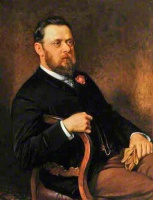 John Francis Giffard (1847-1919), a portrait by William Hay. Giffard, a Solicitor of the Royal Court was first elected Deputy of the parish in 1881. Four years later he was elected Constable but he only served one term before being elected again as Deputy in 1888. In 1910 he was elected Deputy in St Helier, and in 1914 he was elected Jurat, serving until his death five years later
 -
 Mont St Michel; Yann Le Francois


Constables


-
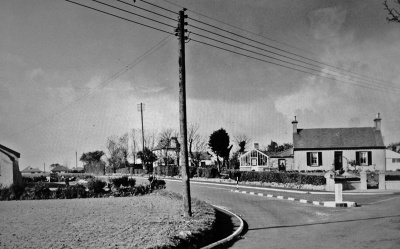 Route de Beaumont - this junction has now disappeared as the Airport has expanded
 -
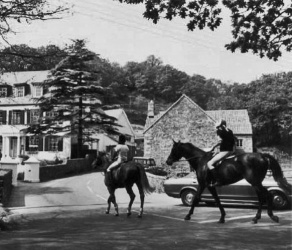 Mont Fallu
 -
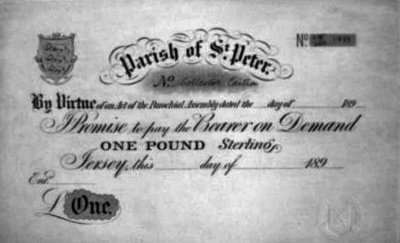 A parish banknote
 -
 St Peter's Village
 -
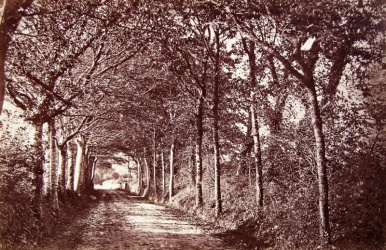 La Hougue 1880s
 -
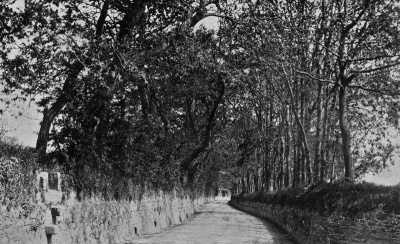 1880s
1880s -
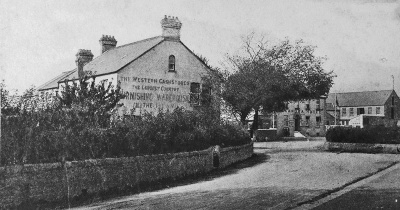 The centre of the village in the late 1940s
 -
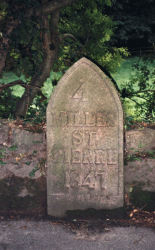 A parish milestone
 -
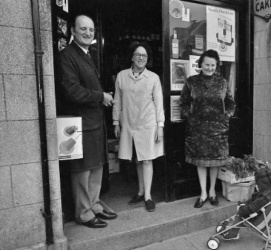 Le Brocq shop
 -
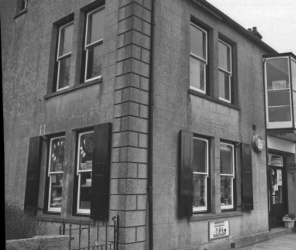 Le Brocq shop
 -
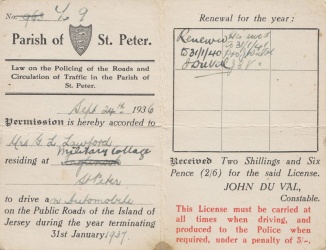 Driving licence issued to Mrs Greta Lawford in 1936
 -
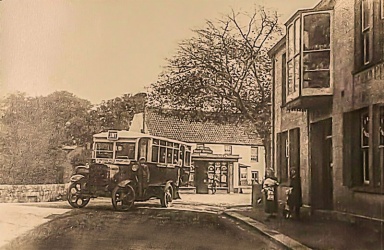
-
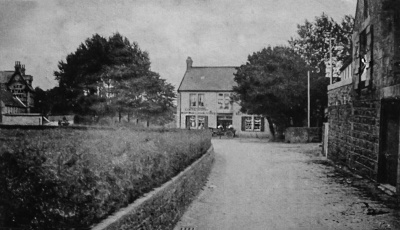 The village
 -
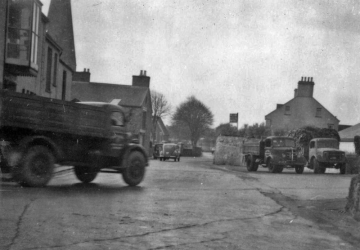 Route de l'Eglise, 1950s
 -
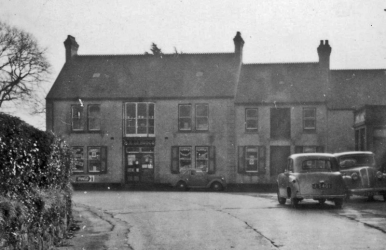 Le Brocq's shop in the 1950s
 -
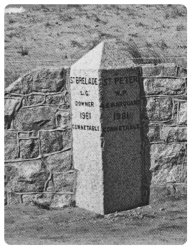 This stone marks the boundary with St Brelade - picture taken in 1981
 -
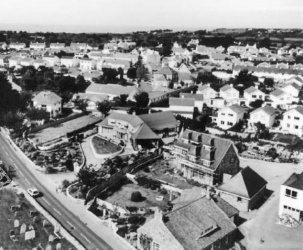
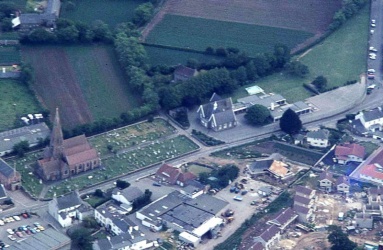 This 1977 aerial photograph shows the parish church and school, with building work on the new village development under way in the foreground
 -
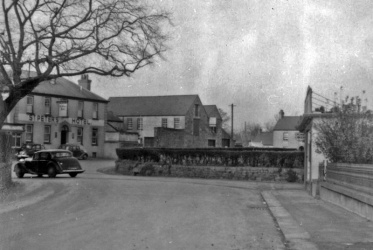 1950s - Picture Jersey Evening Post
 -
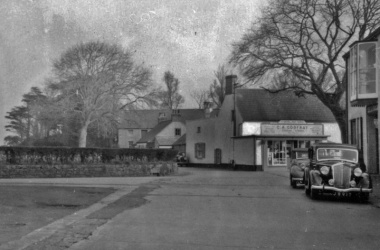 1950s - Picture Jersey Evening Post
 -
 1899 Evening Post advert
 -
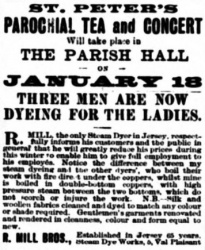 1899 Evening Post advert
 -
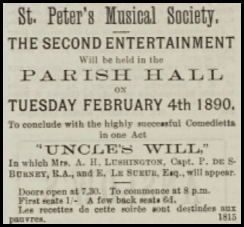 1890 Chronique de Jersey advert for a music evening


.jpg)
2.jpg)


Notes and references
- ↑ As with all earliest constables, dates uncertain. Mentioned as Constable in a Court act shortly after April 1524. Wife Marguerite mentioned as widow in 1536
- ↑ Constable in the 1531 Inquisition. Seigneur of Fief-au-Hormans and Jurat about 1534. Son of Nicolas. Died 1536
- ↑ Son of Pierre, Constable above. His daughter and heir Marguerite married Francois de Carteret, son of Jurat Richard, and was mother of Helier, Seigneur of La Hague, Attorney-General 1590 and Jurat
- ↑ Ancestor of the Anley family of Les Aix which gave several constables to the parish. Married Denise Sarre, daughter of Simon, Constable of St John
- ↑ Married the eldest daughter and principal heir of Jacquet Fallu, of St Peter. Died in office
- ↑ Elder son of Jean, Constable in 1557. Married Mabel Costil, daughter and co-heir of John, of St Clement. Succeeded by their son
- ↑ Elder son of Richard, who preceeded him. Married Sara de Caen, eldest daughter and principal heir of Francois, son of Jacques, son of Jean, Constable of St Ouen in 1542
- ↑ Seigneur of Fief es-Hormans. Sworn in on 7 May 1586 for one year, as permitted by the Royal Court. Not put off by his short tenure and served a further 31 years from 1590.
- ↑ Son of Pierre. First cousin of his predecessor. Resigned in 1590 but then re-elected in 1627 for another nine years. Appointed Attorney-General in 1636
- ↑ Seigneur of La Hague and eldest son of Helier, Constable in 1587. Elected Jurat in 1627.
- ↑ Second term
- ↑ Of Alva. Jurat in 1644
- ↑ Son of Helier, of Les Landes, Constable of St Ouen in 1610. Married Rachel de Carteret, sister of George, in 1636, and settled in St Peter at Mont des Vignes, which he bought from his brother-in-law. Jurat in 1647 and died in 1651
- ↑ Younger son of Philippe, Constable in 1632, Married Judith Pipon, daughter of Pierre. Interrupted his role until Restoration in 1660
- ↑ Parliamentary constable, son of Nicolas and Sara, nee Payn, daughter of Nicolas, Chef Sergent of St Peter.
- ↑ Resumed office at the Restoration and continued as Constable until his death in 1673
- ↑ Sworn in 3 June 1673. Remained in office until elected Jurat in 1676
- ↑ Not a descendant of Sylvestre Le Maistre, as shown in the Armorial, but the son of Jean, son of Jean, son of Nicolas, and a member of a long-established St Peter branch of the family. Allowed to resign in 1689
- ↑ Sworn in 3 September 1689. Son of Raulin, Constable in 1673. Became Jurat in 1700 and Lieut-Bailiff from 1713 to 1715, Judge Delegate in 1730. Died in 1731
- ↑ Son of Philippe. Sworn in for first time on 26 April 1694
- ↑ Younger son of Elie, who bought the Fief de Noirmont in 1695. Seigneur of Le Hougue. First sworn in on 4 March 1708 at a States Sitting. Served for 19 years before appointed Jurat in 1727
- ↑ Elder son of Philippe, above, Constable in 1694. Sworn in for first time on 6 April 1727. Left office in 1740 on election as Jurat. Described by Attorney-General Jean Le Hardy in a petition to the Privy Council as 'a gentleman of years and of discretion and of very good substance, credit and understanding
- ↑ Sworn in for the first time on 16 June 1740. In 1742 he was also Procureur du Bien Public. Seigneur of La Hague, he was the elder son of Thomas, Dean and Rector of St Mary. He married Alice Anley, daughter of Philippe and sister and heir of Philippe, former Constable
- ↑ Previously Centenier. Elder son of Elie (son of Nicolas) and Anne, nee de Carteret
- ↑ First sworn in 9 May 1770. Son of Amice (son of Edouard, of Vinchelez de Bas) and Marie, nee Marett. Jurat in 1795
- ↑ Served 25 years, first sworn in 18 June 1776. Son of Jean, son of Elie. Had to resign as Constable in 1801, shortly after again being re-elected, following his appointment as Attorney-General
- ↑ Previously Centenier he was first sworn in as Constable on 21 April 1801. Born in 1769 he was the fourth son of Thomas (son of Josue) of La Moye, Lieut-Bailiff in 1801. He settled in St Peter after his marriage to Jeanne Le Breton, Dame of La Hague, only daughter and heir of Thomas Le Breton. He died in 1829
- ↑ Beat Jean Le Brocq, son of Jean, son of Edouard, by 79 votes to 47 in the election. Le Brocq challenged the result claiming irregularities committed by his opponent, but soon withdrew, leaving him to be sworn in on 7 September 1816. Born in 1781, the son of Amice and Judith, nee Le Couteur
- ↑ Of Hamptonne, St Peter, born in 1788, son of Philippe and Elizabeth, nee de Carteret, daughter of Jean and Anne, nee de Carteret, Dame of Vinchelez de Bas. Philippe was appointed an Advocate of the Royal Court in 1816. He was one of the leaders of the Rose party. In 1834 he beat his challenger Philippe Bigrel, Sergent de Roi in St Peter, by 115 votes to 10, but the result was still challenged, and there was a two-year delay before Bigrel withdrew and Le Couteur could be sworn in again. He died in office two years later after a long illness
- ↑ It took four elections before Philippe Le Feuvre, of La Hougue, son of Philippe and Anne, nee Le Bas, could be sworn in. An election was ordered for 20 November 1838 but it was cancelled because of an 'informality'. In a second election the following day, Le Feuvre beat Jean Simon by 82 votes to 65, but the result was challenged and the poll annulled because of irregularities by the Chef de Police, Centenier Thomas Blampied. Another poll was organised and both candidates received 85 votes. It was 12 months before Simon withdrew and Le Feuvre could be sworn in
- ↑ After his failure to be elected in 1838, Simon stood again, won, and was Constable for ten years in his first term, and another nine later
- ↑ Previously Constable of St Brelade 1832-1844, sworn in for St Peter on 24 January 1852. Died in 1857
- ↑ Sworn in 5 March 1864 and 16 March 1867. Died July 1901 at the age of 95
- ↑ Sworn in on 15 April 1873 but did not complete term because he was elected Jurat by 944 votes on 24 April 1875. (1840-1877), son of Edouard and Mary Elizabeth, nee Asplet. Died on 3 December 1877 aged 37.
- ↑ Constable for just over a year before appointment as Greffier of the Royal Court. Attorney-General in 1885 and Bailiff in 1899
- ↑ Later Inspector of Fisheries
- ↑ Solicitor of Royal Court. Became Deputy of St Peter in 1888
- ↑ First sworn in 5 October 1888