Descendants of Charles Pallot - 2


Adeline Annie Pallot (1873-1946), Sister, Princess Christian`s
Army Nursing Service, during the Boer War and Great War
This tree was added to the site in 2018 and has been reviewed several times since, by Mike Bisson and Guy Dixon. In a further review in 2023 an extra generation was added at the top by Guy Dixon
The page was expanded and more photographs added in 2025 following the return of the Pallot/de Gruchy archive collection from Canada to Jersey Archive and its appearance online in the Jersey Heritage website with information assembled by Archive archivist and medieval history graduate Jane de Gruchy. Much of what she added when cataloguing the Pallot/de Gruchy collection has been combined with the existing content on this page written by Guy Dixon

The faded St Saviour gravestone of Charles Pallot (gen 3)
and his wife Mary Ann, nee Giffard. In April 1897 their son
Charles Giffard Pallot, then still a minor, sold to the Parish of
St Saviour the field on which the Parish School now stands.
Pallot family page and links to other trees
In common with the majority of our trees, this descendancy has been subject to regular review by site editors and checked against Jersey church records. Trees including French ancestry have also been checked as far as possible against French primary records. It is not always possible to carry out such checks on sections of trees with United Kingdom and/or colonial content
If you want to search for records for any name in this family tree, or for any other family name, just click below on the first letter of the family name you are interested in. This will open a new tab in your browser giving you a list of family names beginning with that letter, for which there are baptism records in our database of half a million church and public registry records.
You can also select marriages or burials. Select the name you want and when the list of records is displayed you can easily refine the search, choosing a single parish, given name(s) and/or start and end dates.
The records are displayed 30 to a page, but by selecting the Wiki Table option at the top left of the page you can open a full, scrollable list. This list will either be displayed in a new tab or a pop-up window. You may have to edit the settings of your browser to allow pop-up windows for www.jerripediabmd.net. For the small number of family names for which a search generates more than 1,500 records you will have to refine your search (perhaps using start or end dates) to reduce the number of records found.
A--B--C--D--E--F--G--H--I--J--K--L--M--N--O--P--Q--R--S--T--U--V--W--X--Y--Z
More information on our 2018/2019 and 2025 reviews of family trees
A blue link anywhere in the text will lead you to another page with more information on this family
If you spot any errors in this tree or are able to provide additional information, either click on the Discussion tab at the top of the page and leave details there (you need to be a registered user) or send an email to editorial@jerripedia.org. Registered users can also edit this tree, and are welcome to add additional information. However, if you think there are errors, please contact us first so that your proposed adjustments can be discussed with the original submitter of the tree

The family who owned and lived in Beau Desert, St Saviour, and emigrated to Canada
- 1 Jean Pallot (1770- ) [1]
- 2 Charles Pallot (1805-1840) (Tr) [2] m (1830) Rachel de Gruchy (1808-1872) daughter of Jean, of La Chasse, Rozel, Trinity and of Rachel de Gruchy (1777-1829), daughter of Thomas and of Rachel Remon
- 3 Rachel Pallot (1831-1920) (Tr) m Charles de Gruchy (1818-1899) [3]
- 3 Charles Pallot (1832-1894) (Tr) [4] m (1872, St S) [5] Mary Ann Patty Giffard (1847-1926) daughter of Philippe (1817-1893) [6] and Mary Ann, née Bott (1826-1873), daughter of Nicolas and Marie Marguerite, née Delerée
- 4 Adeline Annie Pallot (1873-1946) (St S) [7] m (SA) Martin Haarseth ( -1927) (Norway) [8]
- 4 Cecile Louise Pallot (1874-1944) (St S) [9]
- 4 Charles Giffard Pallot (1876-1948) [10]
- 4 Ethel Lucie Pallot (1881-1970) [11]
- 4 Herbert John Pallot (1882-1964) [12] m Alice Gertrude Cupper (1883-1978) (Alberta)
- 4 Harold Eugene Pallot (1884-1966) [16]
- 4 Blanche Pallot, died in infancy
- 4 Alfred Pallot, died in infancy [17]
- 3 Suky Pallot (1834- )
- 3 Elizabeth Pallot (1835- ) (Tr)
- 3 Jean Pallot (1837- ) (Tr) [18]
- 3 Marie Anne Pallot (1841-1848) (Tr) [19]
- 2 Charles Pallot (1805-1840) (Tr) [2] m (1830) Rachel de Gruchy (1808-1872) daughter of Jean, of La Chasse, Rozel, Trinity and of Rachel de Gruchy (1777-1829), daughter of Thomas and of Rachel Remon
Notes and references
- ↑ Although online trees show Charles born in Trinity in 1805 as the son of Jean, none have any source for this claim. There was no Charles baptised in Trinity in 1805. The two closest baptisms in the Jerripedia database are of Charles, in Trinity, in 1804, son of Philippe and Jeanne Mollet; and Charles in St Martin, in 1806, the son of Jean and Elizabeth Perchard. Several suspiciously similar online trees identify this Jean as father of Charles, but he was a twin, privately baptised and dying soon after, so he cannot be the Charles, son of Jean, recorded as buried in Trinity in 1840
- ↑ Died by 11 April 1841. He was buried in Trinity as Charles Pallot, son of Jean, aged 35, on 25 April 1840. An online tree has him as son of Jean. Charles should not be confused with another Trinity Charles Pallot (1803-1855), who married Douce Nicolle in that parish in 1827. He was a shoemaker, as was probably his namesake, and was described as marchand on burial. Charles Pallot and Rachel de Gruchy, his wife, were godparents in 1836 of Rachel, daughter of Jean Pallot and Nancy Penwell. Nancy, another daughter of the latter couple, had as godparents in 1830 Charles Pallot and Douce Nicolle. It is likely that they were related as well as being fellow Trinity parishioners
- ↑ Owner of Mont Mado Quarry, St John. Parents of Charles de Gruchy of Wandsworth, professor of architecture, Royal Academy of Arts
- ↑ Shoe manufacturer of Halkett Place, St Helier, employing 22 men and 2 boys (1861 St Helier census); Owner (1872-1879), with his father-in-law, Philippe Giffard, of the 144-ton brigantine Industry. On the retirement of Giffard, the co-owner was Blampied; Owner (1868-1894) of Beau Desert, St Saviour, where he lived in 1881, farming 65 acres (census): The British Press and Jersey Times Royal Almanac (Jersey, 1873), 178, Jersey Shipping, (List corrected to 20 December 1872), subsequent almanacs and directories to 1894. Also J. Jean, Jersey Sailing Ships, (Chichester: Phillimore, 1982), 143, Jersey Sea Captains: Philip Giffard, "UK and Ireland, Masters and Mates Certificates, 1850-1927", at www.ancestry.com; UK Census entries for Philip Giffard
- ↑ Charles Pallot and Mary Anne Giffard were married on 31 August 1872 at St Saviour’s Church. Charles died on 9 September 1894, Annie on 7 August 1926. Two of their children died as babies, Blanche Matilde in 1878 and Alfred John in 1880. Adeline Annie (Adèle) was born in 1873, Cécile Louise in 1875, Charles Gifford (Charley) in 1878, Ethel Lucie (Lucie) in 1881, Herbert John (Bert) in 1882 and Harold Eugene (Harry) in 1884. Charley, Bert and Harry all emigrated to Edmonton, Alberta, Canada.
- ↑ Master mariner, and then merchant and shipowner (1872-1879)
- ↑ RRC Sister, Princess Christian`s Army Nursing Service (Reserve). See full biography below
- ↑ Lieutenant, King`s African Rifles, then tobacco farmer in Nyasaland
- ↑ Of The Cottage, (formerly Union Cottage), Le Hocq Lane, St Clement; Governess in Austria and linguist, who concealed throughout the German Occupation her fluent German; Information: Herb Reynolds and Betty Bois, her former neighbour. Unmarried - Will: D/Y/A/112/36
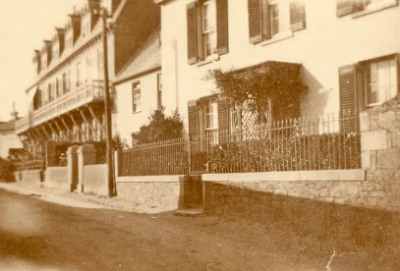 The cottage, Le Hocq Lane
 - ↑ Educated in England. His family is believed to have experienced financial losses as a result of the failure in 1886 of the Jersey Banking Company. He nonetheless inherited Beau Desert, St Saviour, which he let for many years to tenants, while contemplating a return from Canada, where he had settled. He finally decided, however, to remain there, farming in 1906 at Ashmont in Alberta and in 1920 selling Beau Desert. He died unmarried. He was the ultimate heir of the de Gruchys of La Chasse, Rozel, whose deeds from the 14th century he inherited. These were in the safekeeping of the survivor of his aunts at Le Hocq until 1970, and are now preserved by his brother`s family, in Alberta
- ↑ Of The Cottage, Le Hocq Lane, music teacher at Jersey Ladies College, unmarried - Will: D/Y/B1/145/32. Her principal heir was her niece, Elsie Mary Pallot, wife of Lloyd Reynolds. Known as Lucie, she was, like her two older sisters, well-brought-up and well-educated; before the Great War she lived in Austria for a time. Her sisters' letters sometimes show concern about her ability to care for herself - for example, in 1918 Adèle wrote that Lucie had been “starving herself” and expressed concern about her ability to hold down a permanent job. Despite these challenges she lived a very long life, dying aged 89 in 1970. She looked after her mother for a time, and she and Adèle lived together for the last few months of Adèle’s life, in 1946. She was the only Pallot still living in Jersey when Bert and his wife Gertie visited the island in 1950
- ↑ OV. Known as Bert, he worked for Petter’s of Yeovil, Somerset, before moving to the firm’s branch in Toronto. After very unexpectedly meeting Charley in the street in Strathcona, Canada – Bert had not even known that Charley was in Canada – the brothers decided to homestead near Ashmont. They built a cabin together in 1906. In Autumn 1907 Bert’s fiancée Gertie arrived from England and the two of them were married. Bert and Gertie moved to Edmonton, where Bert continued his engineering work alongside agricultural work. He returned to Petters in Yeovil as the Foreman of the engine testing department, to help with the war effort during the Great War, and brought his family over to England with him. A family story relates that the family was at a Labour Party rally in 1915 at which Dorrie, then aged two, was hoisted into the air by Clement Attlee, who shouted to the crowd, “This is what we’re fighting for!” Perhaps during this time, Bert and Gertie’s family came to Jersey to meet their aunts and grandmother. After the war, Bert and his family returned to Canada. He got a job working in the boiler room of the MacDonald Hotel in Edmonton, where he became a founding member of the Hotel and Barworkers’ Union. During the Second World War, he went to sea, working on Merchant Navy freighters in the Pacific. He continued to go to Ashmont twice a year for planting and harvesting until his death in 1964. He and Gertie had two daughters, Elsie and Dorrie; the family’s archive contains frequent letters to Dorrie from their aunts in Jersey
- ↑ School Principal, Alberta
- ↑ Of Edmonton, Alberta. They sold, with their Gads co-heirs in 1973, The Cottage, Le Hocq, to Anthony Joseph Sullivan of Jersey
- ↑ Professor, then Associate Dean of Engineering, University of Alberta
- ↑ OV. Known as Harry, he was the youngest sibling. He followed in Bert’s footsteps and worked in engineering. He joined his two brothers in homesteading near Ashmont in 1907, where he worked for mining camps alongside his homesteading. He volunteered with the Canadian Expeditionary Force in 1915 and served in France. He was wounded twice and was eventually sent to England, where he used his mechanical skills to help test the first generation of army tanks. After demobilisation in 1919 he returned to his single-room cabin in Canada, where he lived and worked for the rest of his life, never marrying. Harry and Bert set up Pallot Brothers Thrashing in 1920, after buying a steam tractor and threshing machine. Harry remained self-sufficient, living alone in his cabin without insulation, a well or electricity, until his last few months. He died in January 1966 aged 81.
- ↑ With his sister Blanche, Alfred is commemorated on his parents grave in St Saviour
- ↑ Shoe manufacturer of 26 Halkett Place, St Helier (1861)
- ↑ Baptised on 11 April 1841 as daughter of the late Charles Pallot and Rachel, nee de Gruchy

-
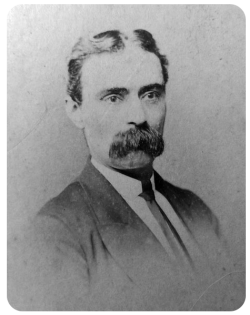 Charles Pallot (1832-1894) of Beau Desert, St Saviour
 -
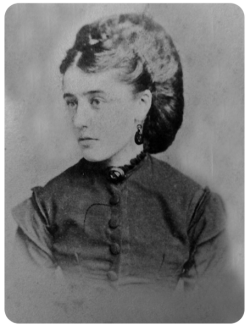 Mary Ann Patty Pallot, nee Giffard (1847-1926), wife of Charles Pallot, of Beau Desert
 -
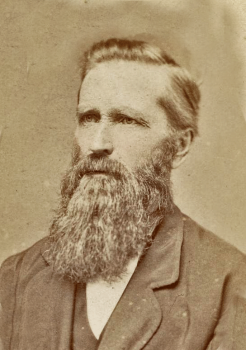 Capt Philip Giffard, father of Mary Ann, wife of Charles Pallot
 -
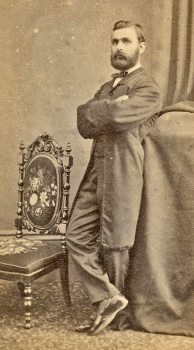 A younger Philip Giffard (1818-1893)
 -
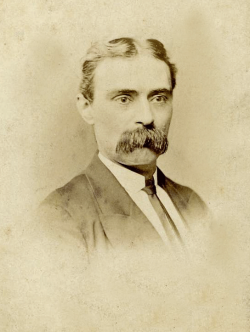 Charles Pallot (1832-1894) photographed, aged about forty-five, in the 1870s by Asplet and Green
 -
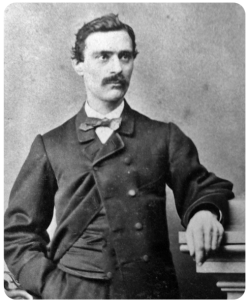 Charles Giffard Pallot (1876-1948) owner of Beau Desert, nurseryman and emigrant to Alberta
 -
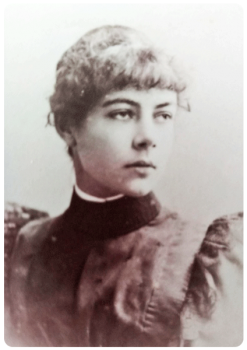 Cecile Louise Pallot (1874-1944), linguist and governess in Austria, of The Cottage, Le Hocq, St Clement
 -
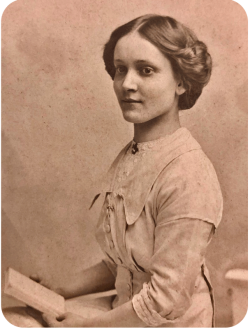 Ethel Lucie Pallot (1881-1970) Of Le Hocq, music teacher, Jersey College for Girls; the last of this family in Jersey
 -
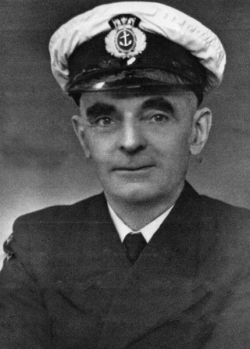 Herbert (Bert) John Pallot (1882-1964) Emigrant to Alberta, in his Second World War Canadian Merchant Navy uniform
 -
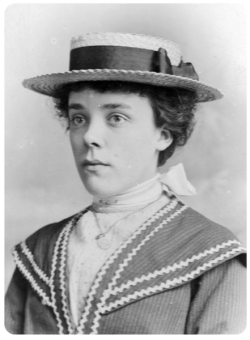 Alice Gertrude Pallot, née Cupper (1883-1978), wife of Herbert John Pallot, of Alberta
 -
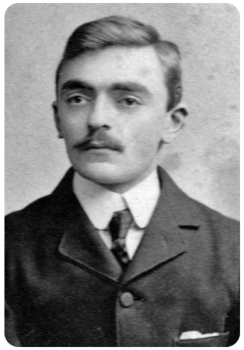 Harold Eugene Pallot (1884-1966) Emigrant to Alberta; rancher
 -
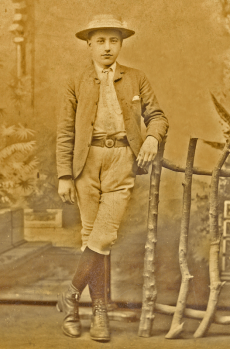 A teenage Charles Pallot in the 1880s
 -
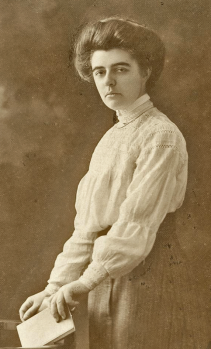 Cecile Louise Pallot (1874-1944) photographed in Budapest in 1910
 -
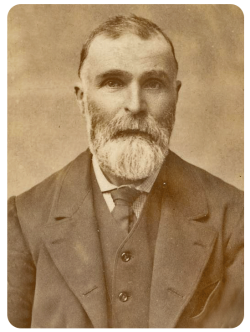 John Pallot (1837- ), who lived in latter years at Beau Desert, photographed by Ouless
 -
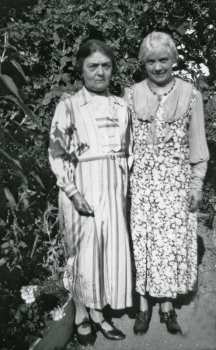 Adele and Cecile Pallot in 1941

Pallot(Giffard)(1847-1936)a.png)


1883-1978.png)


-
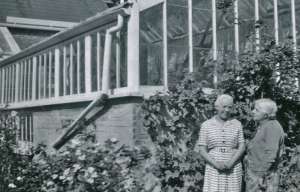 Alice and Ethel Lucie Pallot in 1950, photographed by Bert on a visit to Jersey
 -
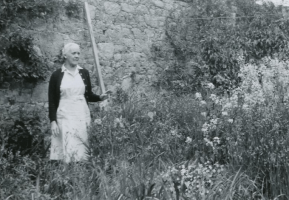 Alice Gertrude Pallot, nee Cupper, in 1950, photographed by her husband Bert on a visit to Jersey
 -
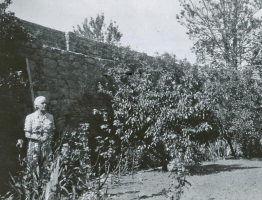 Alice, photographed by Bert on a 1950 visit to Jersey
 -
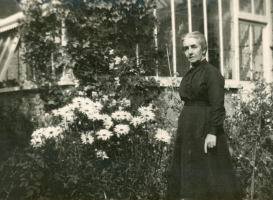 Mary Ann Pallot, nee Giffard
 -
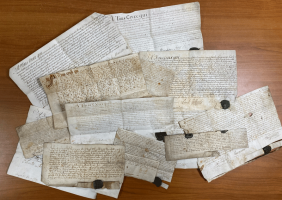 The Pallots` contracts collection of mostly de Gruchy of La Chasse deeds, now at the Jersey Archive
 -
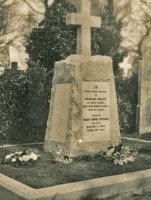 Pallot gravestone at St Saviour
 -
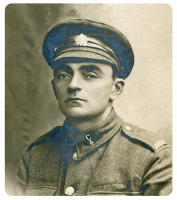 Harry Eugene Pallot
 -
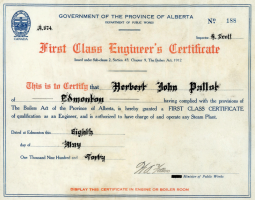 Herbert Pallot's engineering certificate
 -
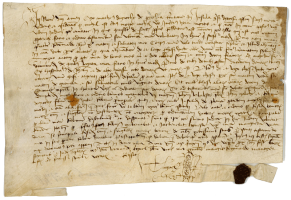 Mathieu de Gruchy's 1502 will which, transcribed and translated into French, was published by De La Croix, in Jersey: ses Antiquités....., Volume II, (Jersey: C. Le Feuvre, 1860), 63-5. De la Croix however, omitted the surname of the testator`s "vicar", Sire Leonard Triguel, which features in this, the original.
 -
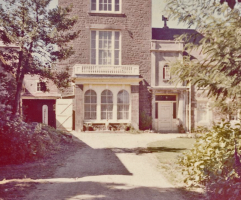 Beau Desert in 1959


2.png)


Letter to 'dear little Dorrie'
Cecile Pallot, who lived with her mother Mary Annie, nee Giffard, until her death in 1926, wrote to her niece Dorothy 'little Dorrie' in Canada, who had exchanged letters in the past with her grandmother


Sister Adeline Annie Pallot

Adeline Annie Pallot had a distinguished career with Princess Christian`s Army Nursing Service. She trained at the Royal Hampshire County Hospital, Winchester and joined the Army Nursing Service. She was actively involved in the Boer War. She also served in the Great War, mentioned in despatches for 'gallant and distinguished services in the field', in 1915 and 1917. She was also a recipient of the Royal Red Cross (RRC), awarded to military nurses for exceptional bravery or devotion to duty.
Jersey Heritage history
This biography combines a history of Adèle added by Jane de Gruchy to the Jersey Heritage website in 2025, and information already included in this page by Guy Dixon. Material derived from Adèle`s letter, written on the 25th September 1914, at the height of the East African campaign, to her mother and siblings, which was sent by Herb Reynolds to Guy Dixon, is also included.
Adèle started life as a privileged daughter from a large, rich, family in St Saviour, but her life was far from the predictable life of respectable gentility that might be expected. Much is known about her life through her family papers, which have been transferred to Jersey Archive from the University of Alberta, Canada.
Adeline Annie Pallot, as she was baptised, was born on 7 March 1873, the eldest surviving child of Charles Pallot and Mary Anne (Annie) Giffard. She had three brothers and two sisters, all born into a wealthy family living at Beau Desert, St Saviour. Adele – as she was always known within the family – was well-educated, going to school in France and travelling around Europe, as did her sisters. In 1891, presumably soon after finishing her education, she was working in St Helier as a governess. But she decided to go into nursing as a career and trained at the Royal Hants County Hospital in Winchester.
She served from 9 March 1900 as a military nurse in the Army Nursing Service Reserve, during the Anglo-Boer War, serving in Wynberg in Natal, at Norvals Pont and at the No 5 Stationary Hospital, Bloemfontein, South Africa: (https://www.britisharmynurses.com/Adeline Annie Pallott; RAMC Army Nursing Service (Reserve) and British Army Medal Rolls). She received two campaign medals for this work, the South Africa Medal and the King’s South Africa Medal.
After the Boer War, she returned to England and in 1903 qualified as a midwife. Her entries in subsequent Midwives Rolls, 1904-1959 reveal that just before the Great War, she was working as a colonial nurse/midwife at the Government Hospital, Lokoja, Northern Nigeria. </ref>
She was still in Nigeria when the Great War broke out. Within days, she was deployed to the field as part of the Princess Christian Army Nursing Service Reserve. She was sent to Nyasaland (now Malawi), which was then a British Protectorate, to serve in the East African Campaign. This campaign involved troops from across the British Empire, who were sent to aid the King’s African Rifles, mostly fighting in German East Africa. The campaign devastated the area, causing enormous numbers of civilian deaths through famine, as well as the deaths of about 95,000 local men who had been conscripted to work as porters.

Nyasaland
When Adèle arrived in Nyasaland as a 41-year-old professional nurse in September 1914, she was not to know any of this. She was sent to set up a field hospital, and in a letter written on 25 September 1914 she vividly described her first experiences of the war there. She recounted leaving Fort Johnstone, Mangochi, Malawi and sailing up Lake Malawi “in a boat swarming with cockroaches” to Karonga, where she and her fellow nurse (and their servants) were taken to a “dirty, empty house” which they were to turn into a hospital.
They worked for two days, cleaning and setting up beds, but then had to evacuate to a place further away from the conflict, and had to start setting up all over again in another location. They had a ‘boma’ – a kind of fortified enclosure – for safety, and a few days later they had to take shelter there from a German military assault. “For the next three and a half hours a perfect hailstorm of bullets” followed, and the women spent the time “crouching at the foot of a brick wall”, the top level of which began to disintegrate under the gunfire. One man from her party was shot dead. Adèle said: “The noise was deafening, I don’t think I shall ever forget the sound of a Maxim gun if I live to be a hundred.” The hard work of nursing the wounded began, and for the following ten days she and her colleagues were rushed off their feet, scarcely having time to sleep. She assisted in the trephining of a German soldier and the tracheotomy of another. They were then evacuated to another, more fortified hospital, where, she said, they were left “with only the Red Cross flag” to guard them.
She was mentioned in Despatches for her “assiduity in the care of wounded in hospital after Karonga was attacked on 9 September 1914” and was mentioned in Despatches again in 1919, for “gallant and distinguished services in the Field” in 1917. Both citations were signed by Winston Churchill, who was then Secretary of State for War. She was also a recipient of the Royal Red Cross (RRC), awarded to military nurses for exceptional bravery or devotion beyond the normal call of duty. Adeline Annie Pallot, RRC, features on the List of Officers of the Nyasaland Protectorate, 1918-1919, as a nursing sister, Nyasaland Nursing Service, giving the date of her appointment as 18 June 1910. She was awarded the three First World War service medals, to add to the two she had already earned: the 1914-15 Star, the British War Medal and the Victory Medal. She lived, many years later, in retirement at Green Hill, St Martin, Jersey</ref>
She loved living in Africa. In 1937, then living in Jersey, she reminisced in a letter about the scenery in Africa – “so beautiful that it absolutely squeezes one’s heart” – and in another letter wrote about being able to read by moonlight there. Her relationship with Nyasaland blossomed for another reason, too: it was there that she met her husband, Norwegian Martin Haarseth who, 1894 (aged 30) had emigrated to Cape Town, intending to work as a clerk. In April 1915, aged 51, he enrolled in the 1st Battalion, King’s African Rifles, in the Nyasaland Volunteer Reserve, serving as a Quartermaster and Lieutenant. It is assumed that Adele and Martin met during their time in military service.
In July 1918 she was back in Jersey, after a spell in St Helena, but she returned to Nyasaland in March 1919, and by the early 1920s she and her husband were living on the Mafinjo tobacco-growing estate, Cholo District, Nyasaland. Meeting so late in life, Adele and Martin had under ten years of marriage before Martin died in 1927.
Return to mother
Adèle may have been called back to Jersey to care for her ageing mother, and she returned in May 1925, a year before her mother Annie's death. Adele’s three brothers had all emigrated to Alberta, Canada, leaving their widowed mother and sisters behind. Adèle seems to have returned to Jersey permanently in 1926 or 1927, living quietly in a cottage at Gorey and looking after her sisters and friends. She despaired when war broke out again, commenting in a letter to one of her Canadian nieces in 1939 that Science, instead of being used for making weapons of man and fireworks, should be used in the making of a better world, better conditions, a place in the sun for everybody.
Much of what is known about Adèle’s life comes from the letters she wrote to her Canadian relations. Her next letter was after Liberation when she worried about how Europe would be fed now that war was over, but delighted in the ever-improving conditions in post-war Jersey: “Every week sees some fresh blessing arrive. Last week it was half a pound of chocolate for each of us, the week before 21 tons of fish arrived in the Island” and writing, “Some of us, from miserable skeletons, are getting so fat that it is laughable.” The Christmas parcel sent from Canada in 1945 sent her into raptures of delight; it included bloater paste, tea, cough drops, a cookie and hot chocolate. By then, she was unwell, suffering from heart trouble.
In early 1946 she moved in with her youngest sister, Lucie, at The Cottage, Le Hocq, their other sister having died in 1944. Adèle died on 6 March 1946, the day before her 73rd birthday, after a life divided between the small Island of Jersey and the enormous vistas of Africa.
-
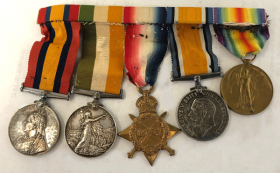 Queen`s South Africa Medal, King`s South Africa Medal, for service during the Boer War; 1914-1915 Star, British War Medal, Victory Medal, for the Great War
 -
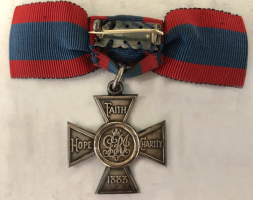 Royal Red Cross Medal awarded to members of the Nursing Services of the Armed Forces in recognition of devotion, acts of bravery, and meritorious service
 -
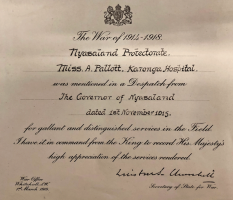 1915 Nyasaland mention in despatches, signed by Winston Churchill, Secretary of State for War
 -
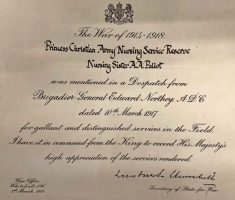 1917 mention in despatches, signed by Winston Churchill, Secretary of State for War
 -
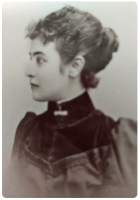 A youthful Adeline Annie Pallot (1873-1946)