Jersey Evening Post


Walter Ernest Ingram Guiton, always known as 'W E', recognised as the newspaper's founder
The Jersey Evening Post is the island's only daily newspaper and has been for many years. It was founded in 1890. Following the closure of the Morning News in 1949, the Evening Post has been without a regular English-language competitor, and the closure of the French-language newspaper Les Chroniques de Jersey at the end of 1959 left the Evening Post as the only newspaper of record in Jersey to publish the Jersey Gazette of official notices and promulgation of laws. In 1967, the newspaper's name was changed from Evening Post to Jersey Evening Post

Early days
The beginning of the Jersey Evening Post was modest.
Only weeks after its launch by H P Butterworth, it was acquired by Walter Guiton, the man whose small business printed it. The first edition of the Evening Post, as it was then called, was published on 30 June 1890. Carrying only advertising on its front page, the paper was produced sheet by sheet on a flatbed press.
That technology ruled until 1926, when the first rotary press was introduced, an operation which was proudly overseen by Mr Guiton, who remained very much in charge as proprietor and editor until the following year, when his son-in-law, Arthur Harrison, succeeded him in those roles. Mr Harrison held both positions until he was succeeded by his son, Arthur G Harrison, in 1944.
Occupation years
The period when the two Mr Harrisons were in control might not have seen much in the way of technical change but part of it was undoubtedly the most trying and testing in the newspaper’s history.
From 1940 to 1945, the Channel Islands were occupied by the German armed forces, and although publication of the paper continued, it was produced under the supervision and strict censorship of the occupying forces.
After the Liberation on 9 May 1945, Jersey prospered, thanks largely to a burgeoning tourist industry. The newspaper also grew, and in 1957 it became the key element in a new business entity called W E Guiton and Co Ltd.
It can be argued that the shift from a purely traditional family-run firm to a modern commercial undertaking was completed in 1973, shortly after the paper was advertised for sale by Mr Harrison, who had been stunned and disillusioned by the prospect of a threatened printers’ strike.

Takeover
It was at that point that Frank Walker, great-grandson of Walter Guiton, stepped in, determined that control of the newspaper would remain in the Island. Sufficient shareholders supported his takeover bid and he duly became managing director.
Mr Walker realised that hot metal technology made the JEP vulnerable to more advanced competition, so in May 1977 three crucial moves were made.
The entire operation was shifted from its old buildings in Charles Street, Saint Helier to new premises at Five Oaks. At the same time, the format was changed from broadsheet to tabloid and the latest photocomposition technology was introduced.
New technology
Since then, the JEP has kept pace with changes in newspaper production, introducing a Norsk Data electronic editorial system in the late 1980s and full-page makeup, based on a Quark Xpress pagination system, plus in-house colour scanning in the early 1990s.
That process continued in February 2002 with the introduction of the Edit.works editorial system which, for the first time, provided the JEP with comprehensive text management of articles from the point of creation through to page make-up.
The editorial system was upgraded again in 2007. Quark Xpress was retained for making up newspaper pages, but new software, called Adapt, was introduced for handling the flow of copy and planning the positions of advertisements.
Expansion
The Guiton Group, meanwhile, continued to expand its interests in publishing, newspaper distribution, retailing and information technology. At the end of 1998, it made its first newspaper acquisition with the merger of the Guernsey Evening Press and Star, the JEP’s equivalent in the second largest of the Channel Islands.
As part of the Guiton Group. the Jersey Evening Post and its sister newspaper in Guernsey, the Guernsey Press and Star, were taken over by the Wolverhampton based Claverley Group in 2004.
Claverley, a privately owned group with interests in publishing, printing and computer systems, was already firmly established as a major Guiton shareholder when the JEP’s founding family decided to relinquish control of the newspaper after 113 years.

Editors
- 1890-1927 Walter Guiton
- 1927-1944 Arthur Harrison
- 1944-1973 Arthur G Harrison
- 1973-1990 Michael Rumfitt
- 1990-1992 Mike Bisson (Appointed managing director)
- 1992-2014 Chris Bright
- 2014- Andy Sibcy
Circulation
The Jersey Evening Post's audited daily circulation, as of July 2007, was 21,376, a decline of 2.2% on the previous year. In 2008 circulation fell by 4.9% to 20,070, and by 2013 it had fallen to 17,000. Circulation figures are no longer published, but the daily sale of the paper is now believed to be well below 15,000

Jèrriais
Since 1915 the newspaper has had a regular column written in Jerriais - Jersey's native language - accompanied by a précis and vocabulary in English.
In 1911 Philippe Le Sueur Mourant (1848-1918) launched a new series of stories in the Morning News relating the adventures and opinions of Piteur Pain, supposedly a former country blacksmith turned foreman of the printing shop, and his family. This series of stories then moved to the Evening Post.
Following the closure of Les Chroniques de Jersey, the Ph'lip et Merrienne articles started appearing in the Evening Post from 2 January 1960. Written by Edward Le Brocq (1877-1964), who had worked for the Evening Post before becoming editor of the Morning News, they took the form of a letter to the editor supposedly written by an old farming couple from Saint Ouen commenting on personalities, events and elections laced with humorous observations on Jersey history and traditions.
Following the death of Edward Le Brocq, George Francis Le Feuvre (1891 - 1984) contributed a Lettre du Bouonhomme George under the pen nameGeorge d'la Forge. Since he had emigrated to North America after the First World War and subsequently taken United States citizenship, most of the letters had either an international flavour, commenting on life and politics in America, or nostalgia for the Jersey of Le Feuvre's boyhood.
Following the death of George d'la Forge, Sir Arthur de la Mare (1914 - 1994), a retired ambassador, took over the task of contributing regular columns to the newspaper. Written in the Trinity dialect, as distinct from the Saint Ouen dialect used by George d'la Forge, Sir Arthur's articles included reminiscences of his life as a diplomat, especially in the Far East, as well as comments on events and politics in Jersey.
Photographic archive
On 30 June 2015 the Jersey Evening Post celebrated its 125th birthday.
In January that year it donated its photographic archive of 1.5 million images to the Island. The archive – a collection of glass plates, negatives and prints which record the richness and variety of Island life since the paper was founded in 1890 – will be conserved and digitised by Jersey Heritage so that they can be accessed and enjoyed by Islanders for ever. In March 2015 the JEP launched their 125th anniversary exhibition at the Jersey Museum entitled Your Story, Our History: 125 Years Through a Jersey Evening Post Lens.
- A history of the ''Jersey Evening Post'', from 1966
Gallery

Click on any picture to see larger version
-
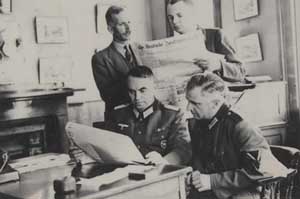 German troops with the newspaper's wartime owner, Arthur Harrison
 -
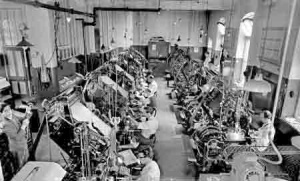 The newspaper's Linotype machines in 1960
 -
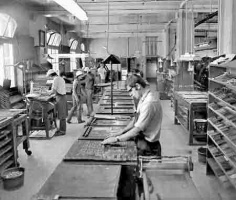 Long-serving employee Dave Le Var in the composing room
 -
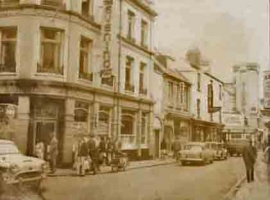 The Charles Street offices in the 1960s
 -
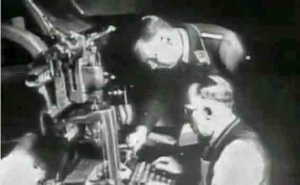 A linotype operator supervised by a German during the Occupation
 -
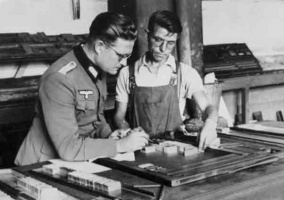 More Occupation supervision
 -
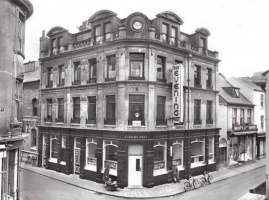 On the corner of Bath Street and Charles Street
 -
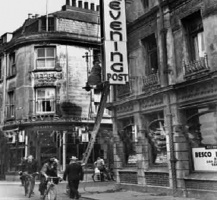 Another view of the Charles Street offices
 -
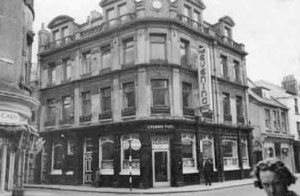 45 Bath Street in the 1960s
 -
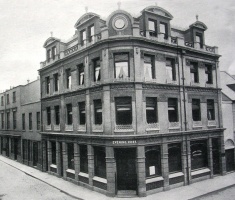 The Bath Street offices in 1900
 -
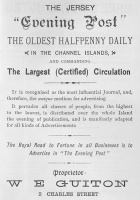 1895 advert
 -
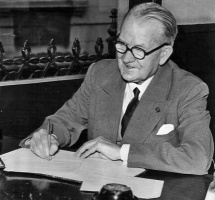 William Troy, known as 'Billie', was news editor during the Occupation years
 -
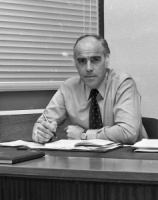 Michael Rumfitt, editor from 1973 to 1990
 -
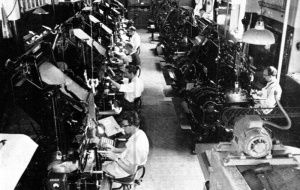 Linotype machines in 1966
 -
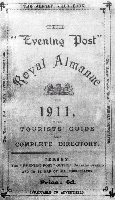
-
-
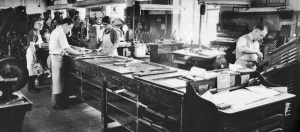 The composing room in the 1960s
 -
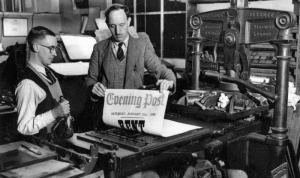 A poster advertising the day's edition is printed in 1950
 -
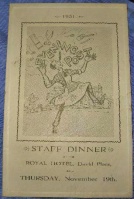 1931 staff annual dinner menu
 -
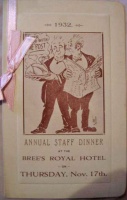 1932 staff annual dinner menu
 -
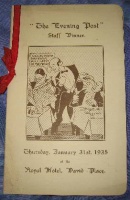 1935 staff annual dinner menu
 -
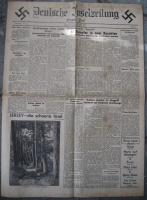 Deutsche Inselzeitung, published by order of the Germans from 1940 to 1945
 -
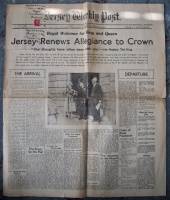 Jersey Weekly Post edition for the Royal Visit in 1945
 -
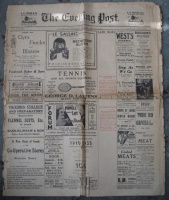 1935 edition
 -
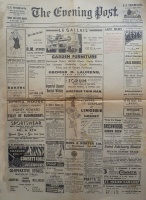 1940 edition
 -
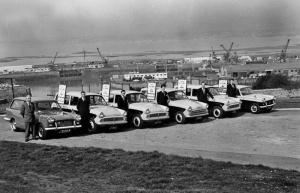 New delivery vans photographed at South Hill in the 1960s
 -
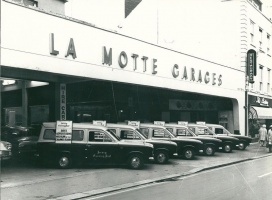 A new fleet of delivery vans from La Motte Garage in the 1970s
 -
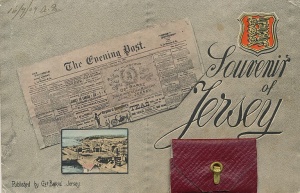 A postcard promoting the newspaper in 1907
 -
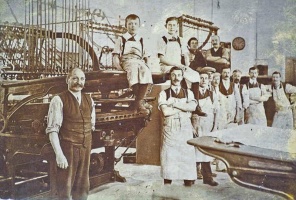 The crew of the first press
 -
 A 2020 article on newspaper production in 1938 - not 60 years earlier, despite what the headline says!
 -
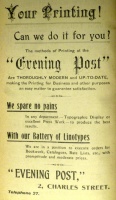
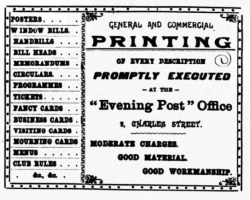 The newspaper business started out as a printer and offered jobbing printing services until it moved from Charles Street to Five Oaks. This is an advertisement from the newspaper in 1899
 -
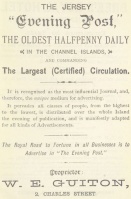 1896
1896 -
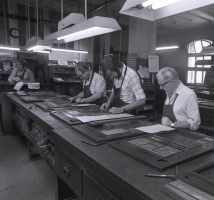 Composing room in 1976
 -
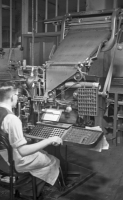 1939
1939 -
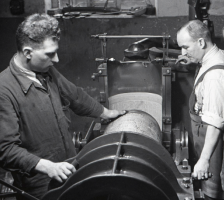 1939
1939 -
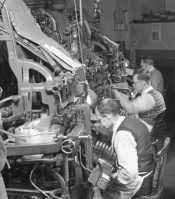 1939
1939 -
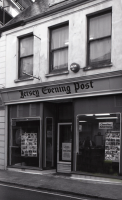 The town office at No 43 in 1978
 -
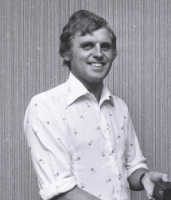 Long-serving production worker Dave Le Var in 1977


Five Oaks offices
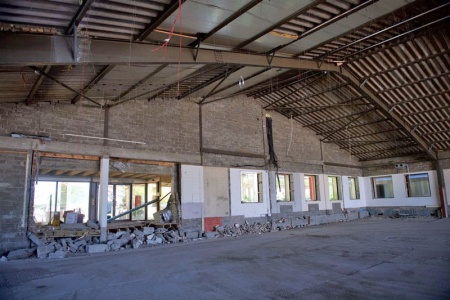
In 1977 the newspaper moved from its town-centre offices over the previous 87 years to a converted agricultural packing shed at Five Oaks. A reduction in staff numbers through the 21st century and the move offsite of printing facilities led to a move back to Bath Street and the Five Oaks premises were sold. Demolition started in June 2021
-
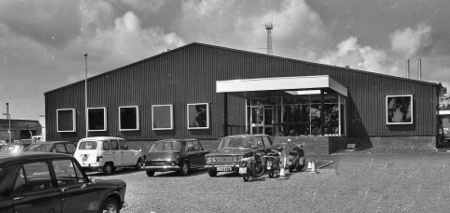 1977
1977 -
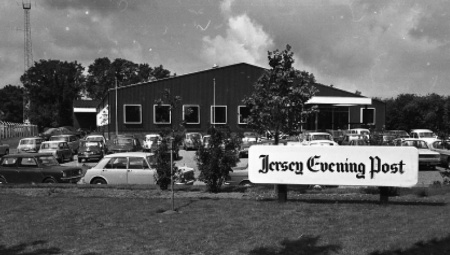 1977
1977 -
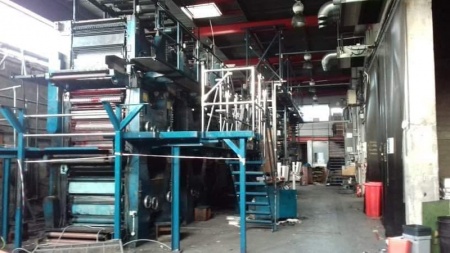 The printing press which was scrapped before demolition started
 -

-