Trinity

Trinity

Mont Pellier, a little known valley in the centre of the parish
Trinity is one of the twelve parishes of Jersey. It is in the north of the island and is considered to be the most rural of Jersey's parishes, being the third-largest parish by surface area with the third-smallest population. The parish covers 6,817 vergees

The coat of arms of the parish shows the Shield of the Trinity diagram.
The Parish church has a distinctive white pyramidal spire.
The Le Vesconte memorial (erected 1910) takes the form of an obelisk at a crossroads commemorating Philippe Le Vesconte (21 December 1837 - 21 August 1909) who was 10 times elected Constable between 1868-1877 and 1890-1909.
In folklore, the area of Bouley Bay has been reputed to be haunted by the Tchian d'Bouôlé (Black Dog of Bouley), a phantom dog whose appearance presages storms. The story is believed to have been encouraged by smugglers who wanted to discourage nocturnal movements by people who might witness the movement of contraband at the harbour in Bouley Bay.
Trinity Manor is the home of the Seigneur of Trinity. One of the feudal duties of the holder of this fief was to present the Monarch with a pair of mallards when he or she visited the Island. However, the ceremony was discontinued with the visit of Charles III in 2024.
History
- From the parish magazine Trinity Tattler
It is easy to forget, with today's stringent planning laws, that in the not too distant past, people could build a house anywhere they wanted to. Given that freedom, how were the first building plots chosen? Why build here and not there? Perhaps it was not quite so simple. When the fiefs were active the Seigneur would surely have had a say. Later the choice may well have had much to do with the availability of fresh water, shelter and the type of land most suited to the dominant agricultural trade of the time.
Access to such roads as there were would have been important for merchants and traders.The Duke of Richmond’s map was drawn in 1787 and published in 1795. A political ally of Pitt the Younger, the 3rd Duke was a progressive and reformist Master General of the Ordnance and was responsible for laying the foundationof what was to become the Ordnance Survey map of Great Britain. This map shows all dwellings in the island at the time and is an important indicator of the main areas of collective occupation at a time just before the threat emerged of a possible invasion by Bonaparte.
Orchards
One of the most striking things about this map is the large number of orchards which supported a thriving cider-making industry. For instance, Ville-a-l'Evecque's eleven dwellings, were almost totally surrounded by orchards. By showing every orchard across the island, Richmond was clearly making a statement about the economic importance of the industry. Another area with a significant number of dwellings, also surrounded by orchards, was just north of what is now Woodside Farm.
Away from the orchards it can be seen that that there were at least nine dwellings at the junction of what is now Vieille Charriere and Rue de l’Epine. They must surely have been somehow associated with fishing and the important trading routes between Bouley Bay and the Cotentin Peninsula. Historian Joan Stevens recorded the existence of a property called La Binaud, now demolished, with 16th century features at the bottom of Rue de l’Epine. Richmond shows the road from the bottom of Vieille Charriere, across the hillside past the lavoir and connecting with Vieilles Charrieres on the other side and up to where The Mount now stands.
The lavoir is inscribed with the initials of those who were permitted to use it. There is no road recorded from here to the bay, so it must have been no more than a footpath at best, probably an extension of the perquage from the parish church. There are quite a few dwellings also in the other direction along l’Epine towards Rue des Fontaines, which suggests that this was a main road leading to the parish church from the bay at that time. The abundance of freshwater springs in the area allowed the steep, narrow lane to have at least two drinking troughs for horses.
Four dwellings are shown at Egypt, but there is no indication on this map, or any later ones, of the existence of a dwelling on the track from Egypt to Petit Port. The remnants of this house are still visible. Given its isolated situation and obvious importance, judging by the corbelled fireplace remnants, the mystery surrounding this ancient house is intriguing. Moving inland, the next sizeable collection of dwellings is around the church, but the road from the top of Bouley Bay Hill which follows the modern Route de Boulay, Rue du Carrefour and Rue du Travers, was, for its time, quite densely populated with many of the dwellings no longer in existence.
Important thoroughfare
It is tempting to conclude that this was an important thoroughfare between Bouley Bay and St Helier before General Don built his more direct military roads. The construction of the new road from St Helier to Trinity Church and beyond in the Napoleonic era would have made this old route much less travelled and properties that might have been old and insubstantial would probably have been abandoned in favour of new sites on busier highways. There was another cluster of dwellings along the section of the St Helier road between Rue Jacques and Les Ifs, which retained their importance when the new road went directly past them. [1]
The Hugh Godfrey map drawn 60 years later shows all dwellings in the island and the names of their owners. By this time, thanks no doubt to the General, the road went all the way down to Bouley Bay. A five-mile stone is indicated just above the harbour and the harbour wall is shown. The new road to Rozel had also been completed. The houses along Rue du Travers were still shown on this 1859 map, but there was still no sign of the school. Approaching the church was Vue du Temple on the corner opposite Maison Maret. This is believed to have been a shop, where there now stands a fine horse chestnut tree and below this is a property called the Drill Hall, which became The British pub before disappearing.
Ville ès Normans is shown, but with the road passing much closer to the houses than it does nowadays. No fewer than four of the six dwellings shown here were owned by P Norman and a fifth by I Norman. The parish boundary with St John at Hautes Croix seems to be ananomaly given that the rest of the border runs along Rue du Bechets ès Cats and Grande Route de St Jean. The story has it that this area was ceded to Trinity by St John in lieu of an unpaid debt. Revenues from the rates presumably being the crux of the deal.
The number of properties had increased over the years but there was still no particular density of occupation which could be thought of as the heart of the parish. This was to change when Victoria Village was built, but it was village in name only, lacking any of the amenities normally associated with a village. Ironically the two small shops which predated the development are now both gone. Much more in the village tradition is the area around the church which now includes Le Grand Clos, for first-time buyers, and Les Maisons Cabot for more senior parishioners, as well as a thriving pub and village shop, one of the last remaining convenience stores in the parish. Within living memory there were four small shops on Route de Trinité and one at Le Vesconte Monument, as well as this one.
Subdivisions
Trinity is divided into the following vingtaines:
- Vingtaine de la Ville-à-l'Évêque
- Vingtaine de Rozel
- Vingtaine du Rondin
- Vingtaine des Augrès
- Vingtaine de la Croiserie
- 1532 Trinity trésor roll, a list of 16th Century residents of the parish
- 1613 Trinity Census a list taken at Easter Communion
- A history of Trinity
- Trinity fiefs Added 2023
- Trinity war memorial
- Trinity residents' Occupation memories
Twin town
Trinity is twinned with Agon-Coutainville in Normandy
Links
- Victoria Village Added 2018
- Trinity Official Parish website
Constables
Jardin d'Olivet follies


-
-
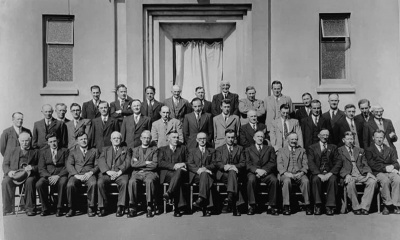
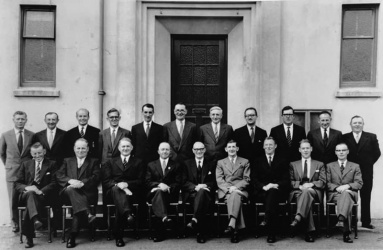
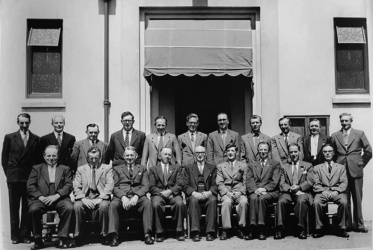 Unfortunately we have no dates for these three group photographs of parish officers
 -


-
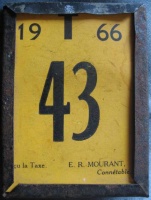 Bicycle licence
 -
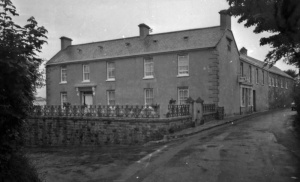 Victoria Village
 -
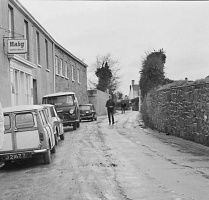 Victoria Village
 -
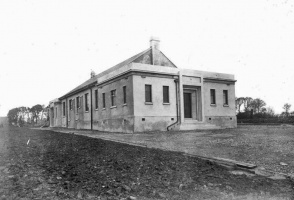 The parish hall
 -
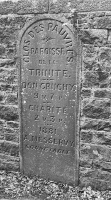 The parish Clos des Pauvres
 -
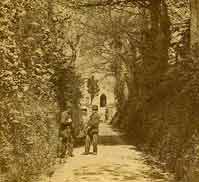 Lane leading to Trinity Church
 -
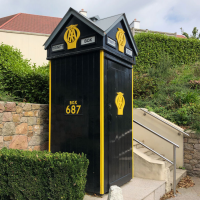 AA box opposite the church
 -
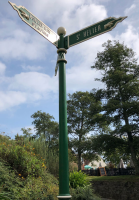 Traditional signs
 -
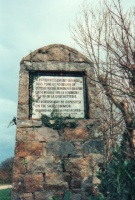 A sign at an entrance to Commune de La Gruchetterie, commonly known as Jardin d'Olivet
 -
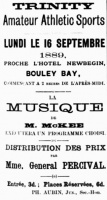 1889 Nouvelle Chronique advert for parish event. But where was the Hotel Newbegin?
 -
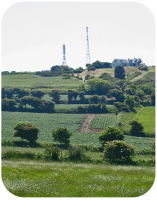 Les Platons telecoms and television masts


Coach home
For some 30 years Adele Melanie Martret lived on the heights of Les Platons in a wheel-less Tantivy bus. She became so famous that she warranted the attention of even the Lieut-Governor, who made a special visit to see her in her unconventional home.
This fiercely independent woman had lived for some time with her father in a small dwelling on the north coast, but after his death in the 1950s, Rediffusion purchased the land the house was built on and demolished it. Adele was forced to find somewhere new to live.
It came as a total surprise to locals when, soon afterwards a bus appeared in the old quarry with Adèle in residence. Perched on breeze blocks and looking from a distance for all the world like a round-Island tour parked up for a scenic stop the bus in its distinctive Tantivy colours became a familiar sight to all passers-by on the coast road. Adele by now lived alone except for her dogs. Ruth Picot whose husband Len, one time Connetable of Trinity, remembers there were seven at one point and drew the attention of her own house dog, a bulldog, which had frequent altercations with those in the bus. Len visited her often and kept a close eye on her welfare throughout always making sure he visited on Christmas morning when he and Adèle would toast each other over a festive tipple.
Eventually Adele had a telephone which she used extensively, enabling her to keep in close contact with her friends.
Very little of what happened in the Parish escaped her attention and she could be relied upon to give the up-to-date account of any ongoing situation. She could be seen often going down to the shop with her bike, at first riding it but later when she could no longer do so, pushing it with her bags hanging from the handlebars.
The bus could have afforded very few home comforts, especially in the depths of winter but there were lights powered by car batteries and, eventually, even a television. For Adele life would no doubt have been a little easier in the summer months, when she loved to sit outside in the sunshine and fresh air with pot-grown vegetables and flowers decorating the area around.


Notes and references
- ↑ It is mere supposition that buildings were abandoned because traffic routes changed. Throughout the island there are long-standing buildings linked to farming which are well off the beaten track
- ↑ Combined duties of Constable and Jurat. Exact dates not known
- ↑ Seigneur of Vinchelez de Bas and Leoville. Constable and Jurat. Died January 1557 and buried in the centre of Trinity Church
- ↑ Constable and Jurat
- ↑ Son of Helier, former Constable, above
- ↑ Lived at Les Cateaux
- ↑ Died in office
- ↑ Son of Michel, Seigneur of Dielament, Jurat in 1592
- ↑ Son of Jean, former Constable, above. Married Jeanne Lempriere, daughter of Thomas. Partage in 1609
- ↑ Son of Philippe, Viscount and Jurat. Served two terms totalling 34 years, before being allowed to resign on age and health grounds
- ↑ Son of Philippe; probably former Constable, above. Resigned
- ↑ Procureur du bien public for several years before resigning in 1634 on age grounds
- ↑ Son of Philippe
- ↑ Younger son of Hugh, Seigneur of Dielament, former Constable, above, Jurat and Lieut-Bailiff. Served for six months before dying in office
- ↑ Elder son of Martin, former Constable, above. Royalist who was replaced by Parliamentarians. Believed to have resumed office at the Restoration in 1660. Jurat 1663
- ↑ Parliamentary supporter
- ↑ Exact dates not known. Replaced at Restoration
- ↑ Eldest son of Jacques, of Le Catelet, Receiver-General, and brother of Deans Philippe and Clement Le Couteur. Settled at La Fontaine after his marriage to Marie Rachel Romeril, the daughter of Jurat Edouard Romeril. Advocate
- ↑ Son of Jean and Rachel, nee Romeril, sister of Jurat Edouard. Died in office
- ↑ Born in 1654 when his father Philippe, above, was Constable
- ↑ Eldest son of Josue, son of Jean, Receiver-General and Constable of Trinity. Lieutenant in Militia East Regiment. Died 1705
- ↑ Brother of predecessor. Allowed to resign in 1697 and died a few months later. Buried in Trinity
- ↑ Previously Centenier. Son of Thomas of Augres. Died in office
- ↑ Advocate. Son of Jurat Elie Dumaresq, Seigneur of Augres, son of Elie. Elected Constable of St Martin in 1714 but refused to take office, preferring to remain in Trinity. Jurat in 1740
- ↑ Previously Centenier. Elder son of Charles Maret, Constable in 1690. Died in 1734
- ↑ Son of Philippe, Constable in 1682. Died 1745
- ↑ His grandfather and namesake was appointed Jurat by Cromwell but, although his family were staunch Parliamentarians, he refused to take office
- ↑ Elected in August 1742 but Jurat Elie Dumaresq opposed his appointment on the grounds that he was Deputy-Viscount and that was incompatible with the office of Constable. The Court ruled otherwise and Marett was sworn in on 4 September. Seigneur Des Arbres and son of the 1725 Constable, above. Exempted from serving also as Procureur in 1746. Died in 1765
- ↑ Seigneur of Trinity. Son of Charles and Marie Francoise, nee St Paul. Married Elizabeth Le Couteur, daughter of Francis, Rector of St Martin. Found dead near the home of Daniel Lempriere in 1761.
- ↑ Grandson of Philippe, Constable in 1731, above
- ↑ Seigneur of Fief des Arbres. Denonciateur 1771. Died in office, 1779, six months after third re-election. Monument in his honour at parish church
- ↑ Younger son of Jurat Philippe Le Geyt, son of Matthieu. Settled in Trinity following his marriage to Sara Guerdain, daughter and heir of Denis. Died without issue in 1797
- ↑ Second term, see above. Died 1801
- ↑ Replaced his father. Died in office in 1797, while his father was still alive
- ↑ Son of Philippe and Jeanne, nee Joubaire, daughter of Pierre. Bought Les Cateaux from George Hamon
- ↑ Son of Charles, son of Michel; and Betty, nee Romeril
- ↑ Previously Centenier. Lived in La Chesnee Farm, Vingtaine de la Croiserie. Son of Charles and Jeanne, nee Deslandes. Married Betty Larbalestier, sister of predecessor as Constable
- ↑ Son of Francois and Elizabeth Jeanne, nee Dupre. Earlier Centenier. Defeated when standing for third time in 1818 by 139 votes to 113 by predecessor as Constable Charles Larbalestier. Challenged result, but eventually withdrew challenge. Re-elected three years later to serve second term. Beat Jean Benest in election for Jurat in 1831 but not sworn in until 1835, following Order in Council. Died in 1853, aged 71
- ↑ Second term
- ↑ Second term
- ↑ Son of Clement and Elizabeth, nee Perchard. Lived near Trinity Church
- ↑ Of Haut de l'Orme, previously Centenier
- ↑ Third term
- ↑ Originally of St Helier. Solicitor. Married the daughter and heir of his predecessor and lived at Bras de Fer, her Trinity property
- ↑ Second term
- ↑ Lived at Woodlands Farm
- ↑ Second term
- ↑ Son of Philippe, of La Porte, and Marie, nee Marett
- ↑ Son of Francois and Elizabeth, nee Le Maistre
- ↑ Lived at Beau Desert, Augres. Deputy 1857 until elected constable
- ↑ of Champs Clairs. Eldest son of Charles and Marie, nee Larbalestier. Appointed Jurat in 1868, died 1900
- ↑ Elected eight times in two separate terms
- ↑ Son of Clement, of Ville-a-L'Evecque, and Souky, nee Du Feu. Jurat in 1884
- ↑ Solicitor. Son of Capt Charles Larbalestier, of La Garenne, Augres
- ↑ Son of Philippe, of Ville es Normans. Lived at Crossbow House
- ↑ Roadside monument erected in his honour, a short distance from the Parish Hall, and unveiled in 1910
- ↑ (1858- ) Married Harriet Jane Le Vesconte (1863- )