One hundred views of St Helier

One hundred views
of St Helier

The imposing King Street entrance to de Gruchy's Arcade - the acceptable face of St Helier ...

... and the unacceptable - a giant mural on the gable wall of a building in what is now Rue de Funchal
Jerripedia editor Mike Bisson, on one of his infrequent visits to the island he left 20 years earlier, took his camera on a tour of St Helier in August 2018 to view some of its older buildings and see what remains relatively unchanged after decades of redevelopment and rebuilding. He took several hundred photographs and has chosen 100 of them to illustrate his very personal views on Jersey's capital town
There is no denying that St Helier has changed over the years; but so has any town of comparable size in virtually any part of Europe, and further afield. In recent years the most dramatic changes have been on the town's south-west waterfront, which has moved some distance seawards following the reclamation of large tracts of land during the 1970s, leaving behind a landlocked Weighbridge and Esplanade, whose old granite buildings have largely been demolished and replaced by concrete and glass.
Much of that has happened since I moved permanently from the island to settle in France at the turn of the century, after a few years moving backwards and forwards between Jersey and the French mainland. My return visits have been few and far between, most of them very brief, just long enough to confirm in my mind that I made the right decision when I abandoned the island where I was brought up, educated and spent most of my working life.
Walk through the heart of town
During a very brief stay in August 2018 I decided to take my camera with me on a walk through the retail and residential heart of the town, ignoring the waterfront, which would only have depressed me, to see how much of the St Helier I knew and loved remains relatively unchanged.
I found much, even if it was necessary most of the time to point my camera upwards and view old buildings at first floor level and above.
References in the captions to 'Brett' are to the National Trust for Jersey's review of St Helier's buildings, written for them in 1976-77 by C E B Brett. Brett was an Ulsterman, a solicitor by profession, and apparently something of an enthusiast for buildings as a sideline. His work had little impact at the time, and given the number of important town buildings which he either ignored, or gave only a passing mention, has unsurprisingly proved of only passing interest to historians and much less to town planners.
References to 'Stevens' are to Joan Stevens' two volumes of Old Jersey Houses.
-
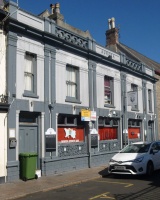 Why not start at a pub? The Aurora in Cattle Street. It's been there since 1858, and the Caesarea, next door, even longer. The frontage was altered to allow the street to be widened in the 1870s. Remarkably, save for the colour scheme, the Aurora has changed very little since then, from pavement to roof level. It may be unusual to have two public houses next door to each other, but it seems that hardly a street in the commercial heart of the town now lacks a row of several eateries of one sort or another
 -
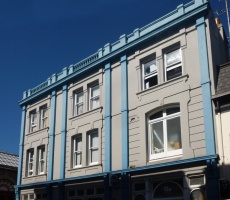 At the end of Cattle Street, on the corner with Beresford Street, is something of an architectural mystery. Is the single window arch on the right of the first floor original? It seems more likely that it originally matched the other two bays, with two identical smaller windows. The change has been accomplished reasonably tastefully, but the beautiful symmetry of the original facade has been lost for ever
 -
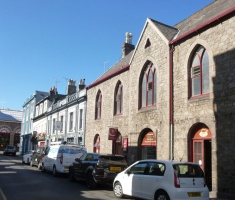 Looking down the street towards the Beresford Street junction we have Church Hall, one of the few buildings in the town centre still faced with the original granite, rather than the cement render with which Victorian property owners delighted in covering their buildings ...
 -
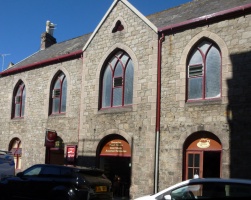 ... A closer view of a building which is situated at the rear of what was the Evangelical Church in Halkett Place, a much more impressive building which has now been given a new lease of life having been adopted by the Portuguese Community ...
 -
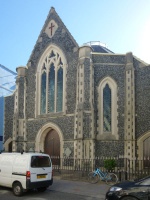 ... and here it is; a masterpiece, totally out of keeping with all the other properties in its neighbourhood, but of more architectural merit than all the others combined. We will return to Halkett Place further down the page
 -
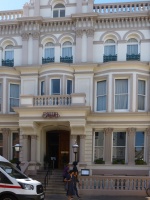 The striking facade of Banjo, an up-market restaurant in Beresford Street, formerly the Victoria Club. Lovingly and admirably restored to its former glory over three storeys and several balustrades. The building was designed by one of Jersey's most famous architects, Adolphus Curry and erected in 1894. Brett was less than impressed, referring to a 'very heavy and unclassical porch' and rendering which he found 'disconcerting both to the sight and to the touch'.
 -
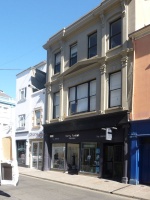 Across the road from Banjo, a modern shopfront, but look up and there are much older cornices and pillars to be admired; not by Brett, however, who failed to mention anything on this side of the street, save for the Fish Market
 -
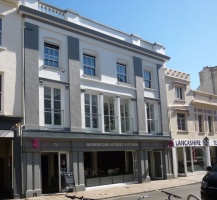 ... and further along the street, while there may be little to admire at street level, No 17 has two striking floors above, with what look like original sash windows, or very tasteful replacements, in the upper story, and those ubiquitous balustrades on top
 -
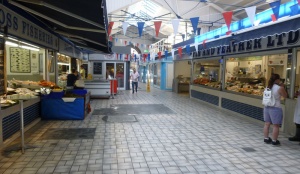 Originally a much larger, multi-purpose market, all that remains of the Beresford Market is today's Fish Market, a narrow arcade between Beresford Street and Minden Place ...
 -
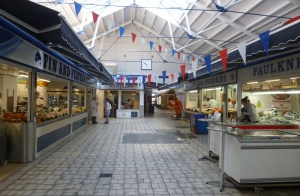 ... Brett found the interior 'disappointing' and was not particularly impressed with the granite entrance
 -
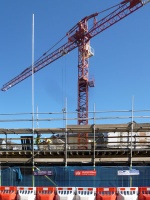 Having passed through the Fish Market into Minden Place, which has never had much to commend it, and was dismissed by Brett as 'a dreary street' I noticed that what was originally the three-storey Corbins Auction Rooms on the corner with James Street, and was replaced in the '60s, if my memory serves me correctly, as the two-storey Corbins furniture store, has again been demolished and is rising from the ground under a giant tower crane, as I know not what.
 -
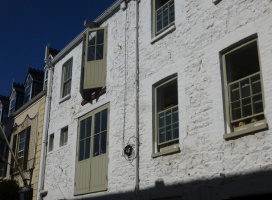 I left the retail centre of town along what I knew as James Street, and has become Rue de Funchal, in recognition of St Helier's close links with Madeira, through the Portuguese island's many immigrants to Jersey. I know that this was where the Portuguese would traditionally gather - perhaps they still do - but could the contribution they have made to the Jersey community over the decades not have been recognised by naming a more attractive location after their island's capital town? And why put 'Rue de' in front of Funchal?
 -
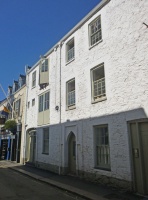 This is a street of car parks, nondescript commercial buildings, and back doors. The only building of any merit is this property, half residential and half commercial. I think it is what in Brett's time was occupied by St Helier Galleries. He noted that, despite reservations about what had been done to the downstairs arch, 'if sympathetically tidied up and freshly painted, this could be outstandingly attractive'. I think he was right. It's one of the hidden gems of central St Helier ...
 -
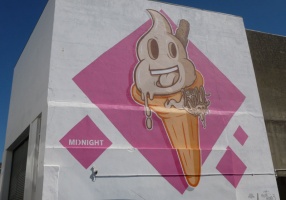 ... unlike this, the mural on the bare wall of the store overlooking car parks to the left and right, and exposed to the world's gaze from all around. Apparently the latest work of Skipton Open Studios' Mural Project - too recent to have even made it onto their website, as I write, and apparently ignored by the island's media - it is apparently called 'SAINT hell-YEAH', and if islanders like it, they are welcome to it. The Mural Project has already made its mark on other St Helier buildings beyond the route of my central tour, and is threatening to move into the countryside in 2018. Somebody better stand guard over Mont Orgueil.
 -
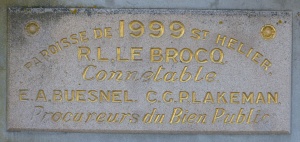 Along the road, behind another car park, lies the original Town Arsenal in Nelson Street. These two plaques would appear to have little to do with the building on the wall of which they have been placed ...
 -
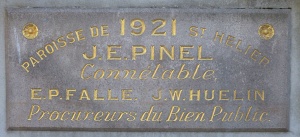 ... the building is now used for what are known as Parish Hall Inquiries and the plaques have presumably been transferred from other parish buildings. Although a noteworthy building, the Arsenal is hemmed in by parked cars and impossible to photograph satisfactorily
 -
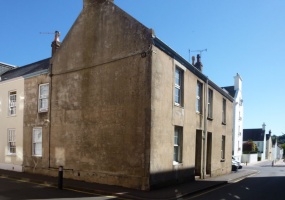 Back to reality, and a strangely attractive, if somewhat neglected, pair of cottages on the street's corner ...
 -
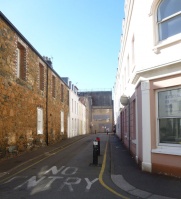 ... and some rare granite walls at the other end. That's the back of the former Odeon Cinema at the bottom, no more or less ugly than the Bath Street aspect, which is now subject to a preservation order
 -
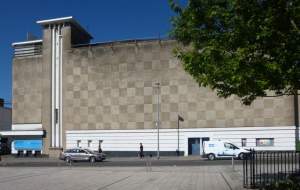 ... is this the ugliest preserved building in St Helier? It's all very well the planning people feeling guilty about their predecessors allowing the far more attractive Forum Cinema to be demolished in the 1970s, but insisting that this is kept hardly counts as any form of compensation
 -
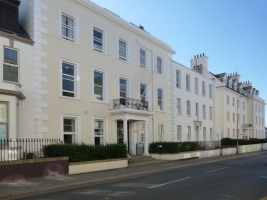 Let's cross the road quickly: Spot the old and the new in David Place! As far as I am aware the impressive three-storey town house in the foreground is original, and that to its right, and the next one out of frame, although of a fittingly similar style, are modern copies
 -
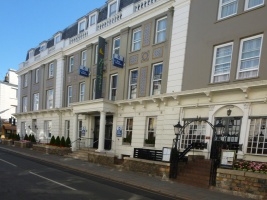 This is certainly original (or very old), at least for the first three three lower floors, although the less said about the dormers, probably the better. The Royal Hotel on the corner of David Place and Stopford Road probably traded as Bree's Boarding House in 1842, and may have been there earlier under a different name. There are conflicting views on whether it is the island's oldest hotel operating on the same side - the Pomme d'Or Hotel having been established in 1837, but not traded continuously, having become semi-derelict at one time in the 20th century
 -
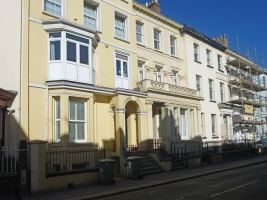 From its corner with Victoria Street to Val Plaisant, the upper section of David Place has some fine old terrace buildings, although, as this photograph shows, some owners have done their best to spoil them with modern embellishments. How and when did the planning authority permit the PVC additions to the first floor?
 -
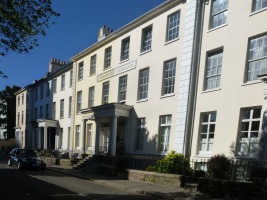 Pembroke Terrace looks much better, its architecture and current appearance being much more in keeping with other grand houses in this street. It's just a shame that the owners of the two halves could not agree on what colour to paint them
 -
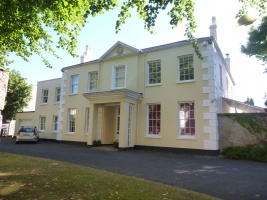 Across the street is the Deanery, home to the Church of England's senior clergyman in Jersey for nearly 200 years. Brett ovbiously failed to look over the wall at this imposing town mansion, set back from the road and, despite synergies of style, entirely different from the nearby terrace houses. Stevens notes that it was built in 1842 for Dean Francois Jeune, and is 'a handsome house of simple design, with a large garden at the rear'. Dean Jeune also initiated the building of the neighbouring St Mark's Church
 -
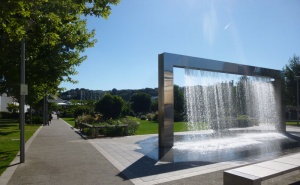 It didn't quite make it for Millennium and my departure ...
 -
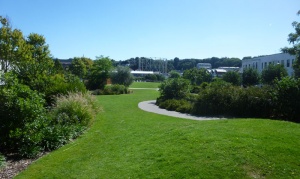 ... but I think the new park running from Bath Street ...
 -
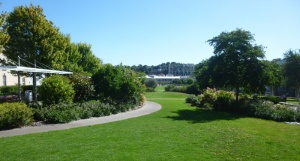 ... almost to St Saviour's Road ...
 -
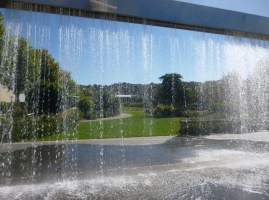 ... is without a shadow of doubt, the most welcome addition to the town this century ...
 -
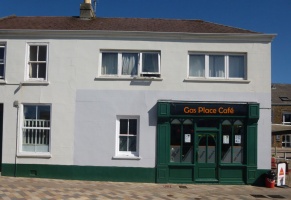 ... and it has opened up areas such as Gas Place, which now boasts a strategically placed cafe with a degree of old-fashioned charm
 -
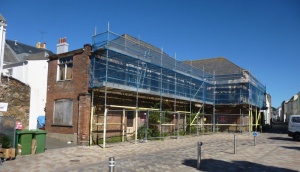 Around the corner the former Le Seelleur workshops are now being given a long overdue renovation
 -
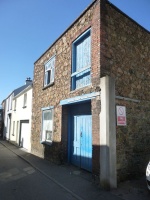 There are few small commercial properties in the otherwise residential area of the town, but here's a little gem in Common Lane. I'll forever remember it, not for its fading paintwork, but for almost being mown down by an impatient motorist as I tried to compose the photograph
 -
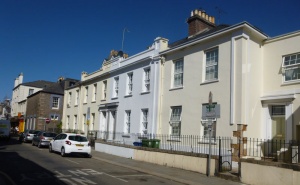 We emerge into Stopford Road to find Apsley Place, another fine Victorian terrace which has been brought into the 21st century much more sympathetically than most. Brett described these as 'fine Regency Villas'
 -
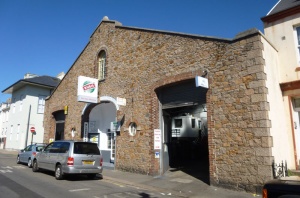 I must admit that I failed to notice the overhanging roof of the adjoining property on the corner with Byron Road. Brett gave it 'a special mention, even though much altered, because of the Byronic and romantic manner in which its hipped roof widely oversails the pavement of Byron Road'. That's stretching the pun somewhat ... ... who would have thought of calling a roof Byronic unless it happened to overlap Byron Road?
 -
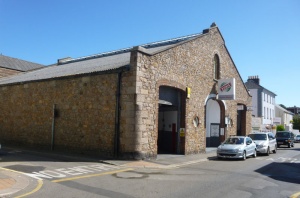 I was more impressed with the garage on the opposite corner, which is a complete anacronism in this street, but a welcome punctuation in the row of Regency houses ...
 -
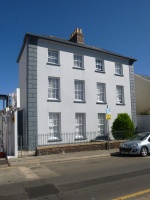 ... the most elegant of which is this three story 'semi' opposite the Masonic Temple ...
 -
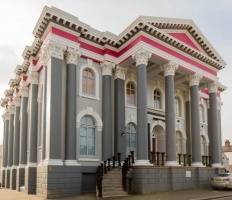 ... which completely escaped my camera's attention on the day, but cannot be ignored, so I will borrow an image from the Freemasons' website Their site is full of gushing praise for their Jersey headquarters: "One of the most attractive buildings of its type and compares very favourably with other similar buildings throughout the United Kingdom. It is constructed of brick and cement with granite facings in pure Corinthian style, classical in appearance and beautiful as regards detail. The principal facade on the North side of the building facing Stopford Road has a most imposing porch of four columns rising 26 feet high", but rightly so, because it is undoubtedly one of St Helier's finest buildings
 -
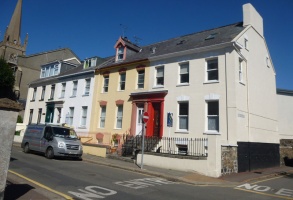 In this property at the junction of St Mark's Road and Byron Road the sash windows are certainly not original, but much remains of the inimitable style of a typical Victorian terrace. What a shame that the stylish dormer window in the centre could not have been repeated across all four properties ...
 -
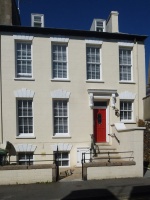 ... a short distance away in Byron Road we find two matching dormers which could not be more out of proportion with the remainder of the building, but what a frontage
 -
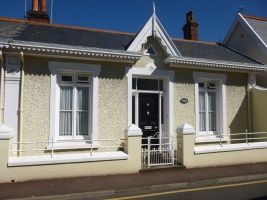 I'd forgotten just how far Oxford Road stretches, crossing Stopford Road, Byron Lane and St Mark's Road, before turning left to run parallel with them to Byron Road ...
 -
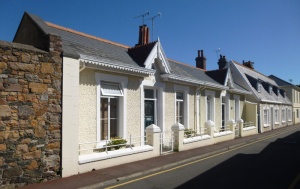 ... it's along this final stretch that there is a row of lovely, single-storey cottages ...
 -
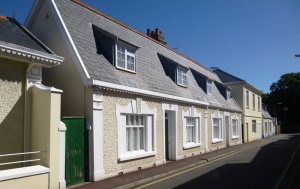 ... beautifully maintained, and thankfully the colour scheme of the these two semis again matches its partner, having been a most inappropriate black and white when the Google Streetview car passed in 2010
 -
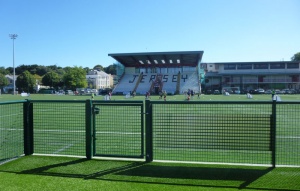 We pass along the side of Springfield, now a fine, modern stadium ...
 -
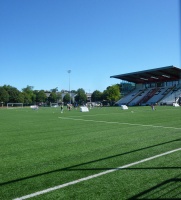 ... but not quite the centre of island life I remember when, as well as being the venue for Muratti football matches, it also hosted cattle shows, and Beatles and Rolling Stones concerts
 -
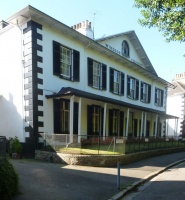 We are now going to head back into the centre of town along Val Plaisant, passing the thankfully unspoilt row of Windsor Villas on the right ...
 -
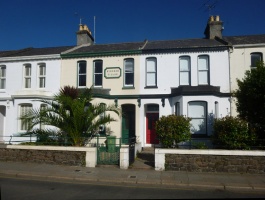 ... and the imposing Windsor Terrace opposite ...
 -
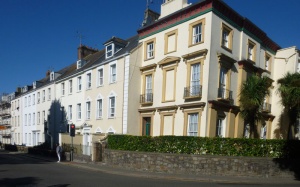 ... to the junction with David Place and Midvale Road, where a rather fine town house on the corner adjoins a long and much blander terrace
 -
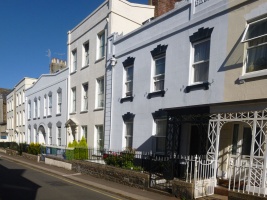 Turning left into Vauxhall Street (or should it be simply Vauxhall? I'm never sure which is right) we find more terraces, but on a much smaller scale ...
 -
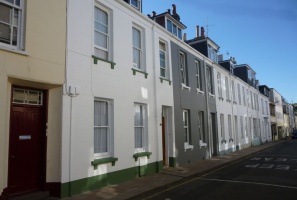 ... an interesting juxtaposition of two- and three-storey one one side, contrasting with an unbroken, homogenous row opposite ...
 -
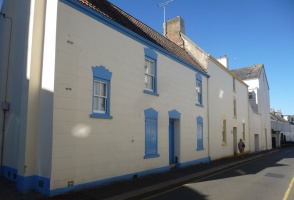 ... and then a pair of delightful town cottages, the positioning of whose windows by their designers seemingly something of an afterthought
 -
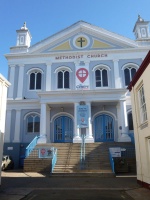 It was not previously possible to pass down the side of Wesley Grove Methodist Church (now 'The Centre') into Halkett Place, but now it is, and we can turn to look back on an imposing building from the top of whose steps one can enjoy an uniterrupted view for some 500 metres to the other end of Halkett Place. This grand vista was made possible in the late 19th century by road widening in several places, and what were previously Grove Place at this end, and Morier Lane at the other, were both renamed as part of a renumbered Halkett Place
 -
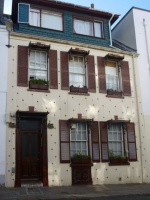 No 110 - the town house with measles. A perfect example of how to spoil a well-proportioned facade of a narrow, two-storey town property. First stick an ugly dormer across the full width of the roof, and then, after adding some character with louvre shutters and window boxes, inexplicably, because it looked so much better when the Google car passed in 2010, litter the wall with diamond spots
 -
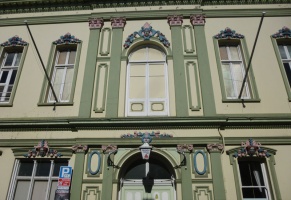 The Mechanics Institute, a working men's snooker club of long standing, started life in 1873 as Albert Hall, according to Brett. I'm not sure, because according the 1874 Jersey Express Almanac shows tAlbert Hall, whatever it was, at 1 Grove Place, which was further down on the corner with Burrard Street. What we do know is that the building housed the General Post Office from 1881 to 1909, and almanacs from the 1880s and '90s are agreed that this was at 2 or 3 Grove Place, which became part Halkett Place by the turn of the century. We also know that this building was constructed by Fallaize and Tostevin. Brett noted that it is 'remarkably ornate' and thought the overall effect 'splendid', but regretted the 'unhappy siting of a parking sign outside the building'. Nobody took any notice, and, as my picture shows, it's still there.
 -
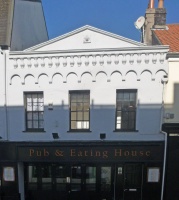 Brett found little else worth a mention at this end of the street, other than what was then the Red Lion Hotel - a 'pleasant two-storey three-bay stucco building'. Now part of the Halkett Pub and Eating House, it's still pleasant and also one of the few buildings in this area to catch my eye, other than the church a few doors up on the other side of the street, which I have already mentioned
 -
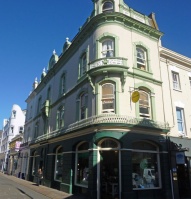 The two buildings which make the corner of Halkett Place and Waterloo Street, although of distinctly different vintages and architectural styles, are a strange match for each other ...
 -
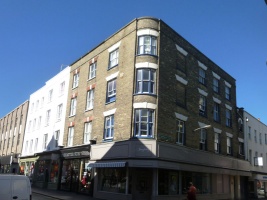 ... if one ignores the angular shopfront of Jersey Pottery; at least they have toned down the colour scheme from the horrible Royal Blue and Orange which the Google car encountered in 2010
 -
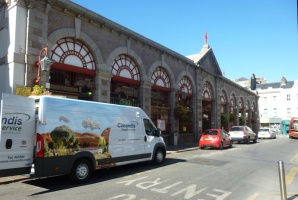 We cross the street to the Market, which is much as Brett found it, and much as it was envisaged by T W Helliwell, of Helliwell and Bellamy, who won the competition to design it in 1881. This is the Beresford Street facade - sorry about the van, but as it moved away, another moved in, and I could have waited all day for an uninterrupted view
 -
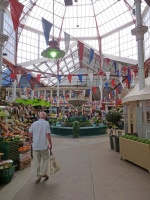 Inside was remarkably less busy, and it was possible to admire the stalls (not many fruit and veg, these days) ...
 -
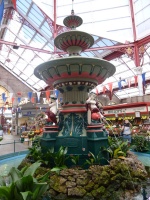 ... the fountain ...
 -
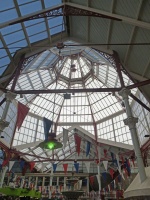 ... and the roof
 -
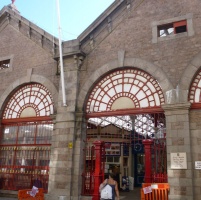 The gateway on the Halkett Place side and the adjoining bay are as they always were, but I deliberately excluded the next bay from this photograph, so that we can pretend that the ugly box that contains some sort of machinery was never misplaced there, and return quickly to exit into ...
 -
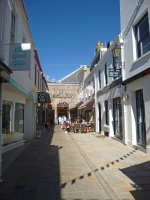 ... Market Street, on the other side
 -
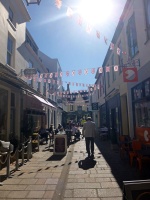 A delightful area for al fresco dining, leading to ...
 -
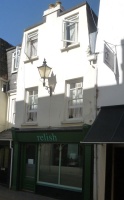 ... Halkett Street, much of which has been rebuilt, but even in Brett's day he found 'no individual building of much interest'. I did - this two-bay, three storey building which is part of the Relish restaurant. I suspect that it was once a two-storey town cottage. How much better the extra floor would have looked with windows to match those on the first floor. I don't know why it is that sash windows look so much better than side opening metal frames - they just do
 -
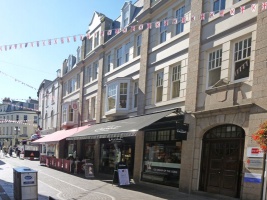 Into Queen Street, and this interesting row before the Snow Hill corner recalls the days when virtually every town shop had extending blinds to protect the window displays from the sun. I wonder if those two angular bay windows are original
 -
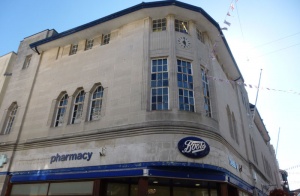 Across the street it is sad to see that a company the size of Boots, founded by Jesse Boot, whose wife Florence lived next to where this store was built in 1896, cannot take more pride in its appearance. What would Baron and Baroness Trent, as they became, have thought of the stained walls, peeling paintwork, rusty window frames and a clock frozen at 5 o'clock? (I took the picture at 11 am)
 -
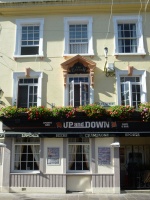 And why can so many public houses no longer trade under their traditional names? We have already noted the Aurora, which does, the Red Lion, which doesn't, and now we discover that the Exeter, opposite Boots, is 'Up and Down'.
 -
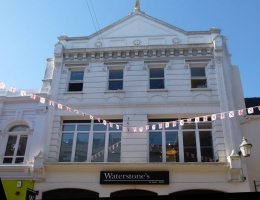 Waterstone's, Jersey's only surviving bookshop in the age of the Kindle, is a perfect example of the importance of looking up when wandering the streets of St Helier. Brett clearly did not, because he ignored what was behind him when in 1976 he noticed the datestone from the earlier building set in the facade of the recently completed modern retail block opposite. Perhaps nobody told him that the building in my picture was once the Grand Hotel du Calvados, which moved there after a devastating fire at its previous location in the Royal Square. And did Brett know that the two-storey building on the left was the General Post Office, from 1852 to 1881, before it moved to Grove Place?
 -
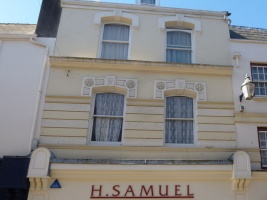 Another worthwhile upward glance above H Samuel ...
 -
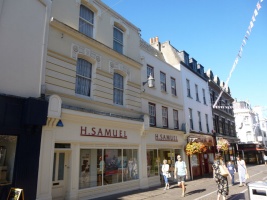 ... and a good mixture of ancient styles above relatively understated modern shopfronts looking down the street to ...
 -
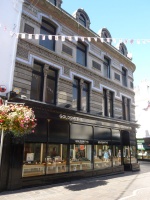 ... what is now Goldsmiths, continuing the tradition in St Helier's jewellery quarter, this property occupied for so long by Assinder's. It was not always a jewellers; before the 1870s it had been home to tobacconists, grocers and drapers and tailors
 -
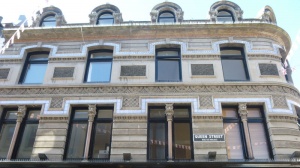 I don't know if it had such an elaborate facade in those days - I suspect not - but whatever their age, I just cannot help but be impressed by what are surely the most magnificent arched dormer windows in St Helier
 -
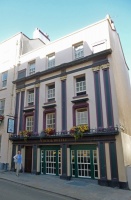 Before heading down King Street we cast a glance to the left at the Halkett Place frontage of the Cock and Bottle. I grew up knowing this as the Cosy Corner, but at least the change of name is a reversion to an older one, not some 21st century invention
 -
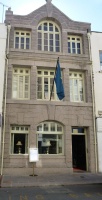 Now we look to the right, back to the original part of Halkett Place, and No 28, a three-bay granite faced property, built for Jersey Mutual Insurance by Messervy and Queree in 1912. The insurance company outgrew their home in the late 20th century and moved along the street to the corner with Burrard Street. No 28 now houses a restaurant.
 -
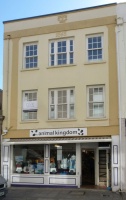 Next door is another attractive three-bay property, which for so long was an animal food and pet shop in the Touzel family. They have gone but the business and the property which houses it are little changed
 -
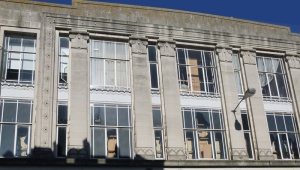 The same is about all that can be said for the Burton's building across the road. It may be redolent of a certain age, but the only word which springs to my mind is 'ugly'. I have a sentimental link to the business, if not the building, because I can remember being measured on the first floor for my first, tailor-made, school suit, and buying what may well be my last, off-the-peg suit, from the racks which now occupy more-or-less the same spot. At least, I presume that they do, because I have had no need for a suit, nor the desire to shop at Burton's, for some 20 years
 -
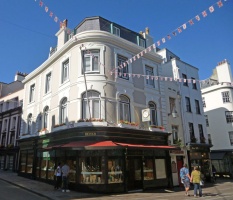 Now we can set off down King Street, and immediately notice the distinction between small properties on this, the south side, and the much larger stores which dominate the north. This is Hettich, a family-run jewellery business since 1900, before that Joseph Collenette's 'fancy repository', and previously a wine merchant, a grocery and a tobacconist's
 -
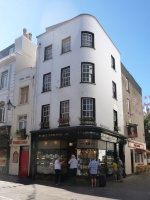 With the side door to The Peirson sandwiched in between, we next find another family jeweller of long standing, on the corner with Peirson Place. This is Pearce's, and although the design of their building may be somewhat less elaborate, it is, nonetheless as imposing as Hettich's, in its own way
 -
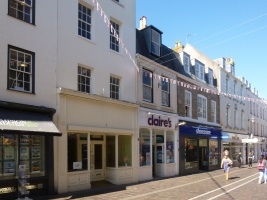 There is a marked distinction between the large department stores on the north side of King Street, and smaller properties on the south. Here we have a row of the latter, of indeterminate age, one a sorry example of many of St Helier's precinct shops without a tenant
 -
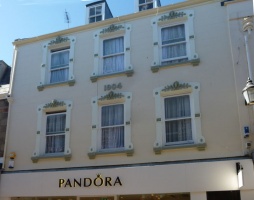 There is no doubting the age of No 13, and even if he had not decided to put the date on the front when he commissioned the building, I could confirm that my grandfather Jimmy Rimington's building is, indeed, 114 years old. It was home to his family and fruit and veg business for some 60 years, and I remember the interior of the building well, although from a little while later than the time I lived there when my parents brought me back to Jersey as a baby in the late 1940s.
 -
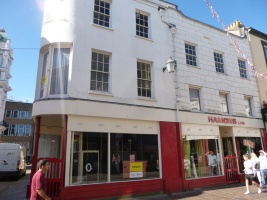 Now that Hamons has closed, it can no longer be referred to as 'one of St Helier's longest established family businesses'. Quite why it has so long been so described I'm not sure. Perhaps it's that the business inside resisted all pressures to modernise, but , having opened as Hamon and Vonberg in 1845, is was something of a young upstart compared with Voisins across the road ...
 -
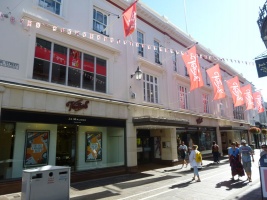 ... because Voisin and Company was founded by Francis Voisin on 5 April 1837 as a haberdashery shop at 26 King Street, and is still in the family. The other thing the two businesses had in common apart from their longevity was a dislike of the apostrophe, so we remember Hamons and celebrate Voisins
 -
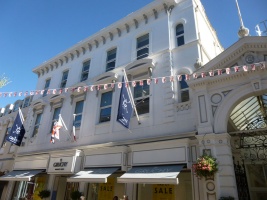 Although no longer a family business, de Gruchy (no 's here, either) puts the other two King Street oldies in the shade. It was in 1824 that Abraham de Gruchy, having moved his business to town from St Peter four years earlier, decided to foresake rented accommodation in Broad Street and acquire 52 King Street ...
 -
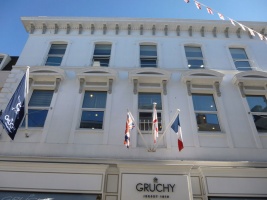 ... as has Voisins along the street, the interior of de Gruchy and the nature of its business has changed much over the years, but there is much of its exterior that its founder would recognise
 -
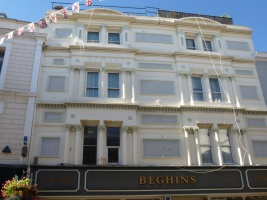 Always ahead of his time, Abraham clearly foresaw the future in moving from Broad Street, then undeniable to town's most fashionable shopping street, to Rue de Derriere, and although the eye-catching King Street facade of Beghins opposite (no apostrophe, either, for this long-time family business), this would originally have been the back door, with the business trading from Broad Street
 -
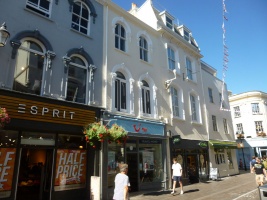 A row of smaller properties, all of which would have been back entrances originally, with the shops trading on Broad Street, which was not part of my route this time
 -
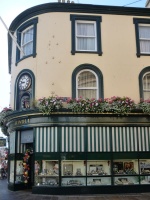 Brett found little worthy of mention in King Street, but I think he missed some gems. I cannot recall what the junction with New Cut looked like in the 70s, but both corners are real gems today. Jewellers Rivoli, like Hettich, obviously find a working street clock an essential promotional tool, whereas Beghins' is long since gone ...
 -
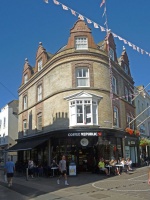 ... and the building on the opposite corner is a gem, from pavement level to the original ornate dormer windows, via the traditional rounded corner and octagonal section bay window on the first floor
 -
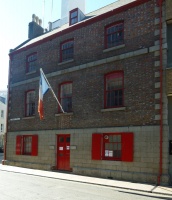 We head briefly into Library Place to visit Jersey's original public library ...
 -
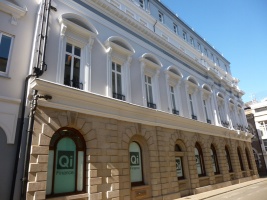 ... before turning into Vine Street, very much a backwater between this striking building, originally built for London City and Midland Bank...
 -
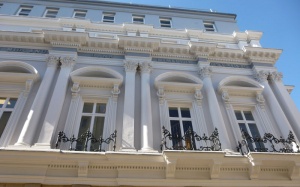 ... and now home to a finance company ...
 -
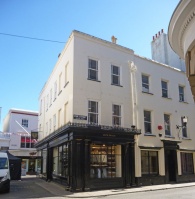 ... and the back of what was, for so long, Maine's London Jewellers, and is now a clothing shop ...
 -
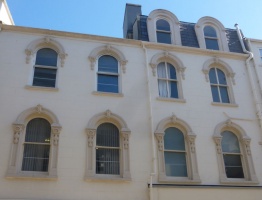 ... past some interesting upper storeys ...
 -
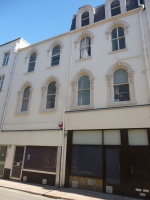 ... above nondescript shop premises below.
 -
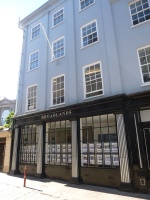 We enter the Royal Square, past the well-proportioned building with period ground-floor windows, which is home to an estate agency, and turn the corner to see ...
 -
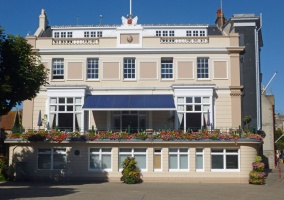 ... the full majesty of St Helier's Registry Office, with the United Club, a gentlemens' club above
 -
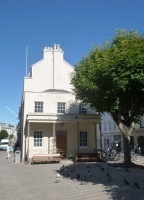 Another historic building, the Piquet House, which has been empty for some years and whose future use has been an ongoing controversy
 -
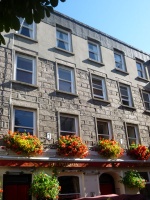 Tucked away in the corner of the square, next to the Cock and Bottle, is The Peirson public house, described by Brett as 'a pleasant, ordinary, five-bay, four-storey building'. Named after the hero of the Battle of Jersey and previously sporting musket shot holes from the brief conflict which was the last battle fought on British soil, this charming building is surely better than 'pleasant and ordinary'.
 -
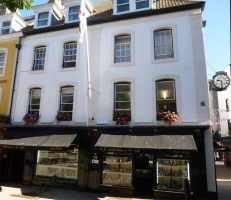 We end our journey at the property opposite, on the corner of the Royal Square ...
 -
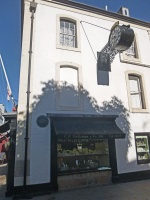 ... and Peirson Place, the home of Jersey's oldest jewellers, E J Gallichan, which opened there in 1845, the same year as Hamons, and will doubtless outlast them by many years. Note the fine clock on the Peirson Place facade